
$7.95
 <–
2 in stock
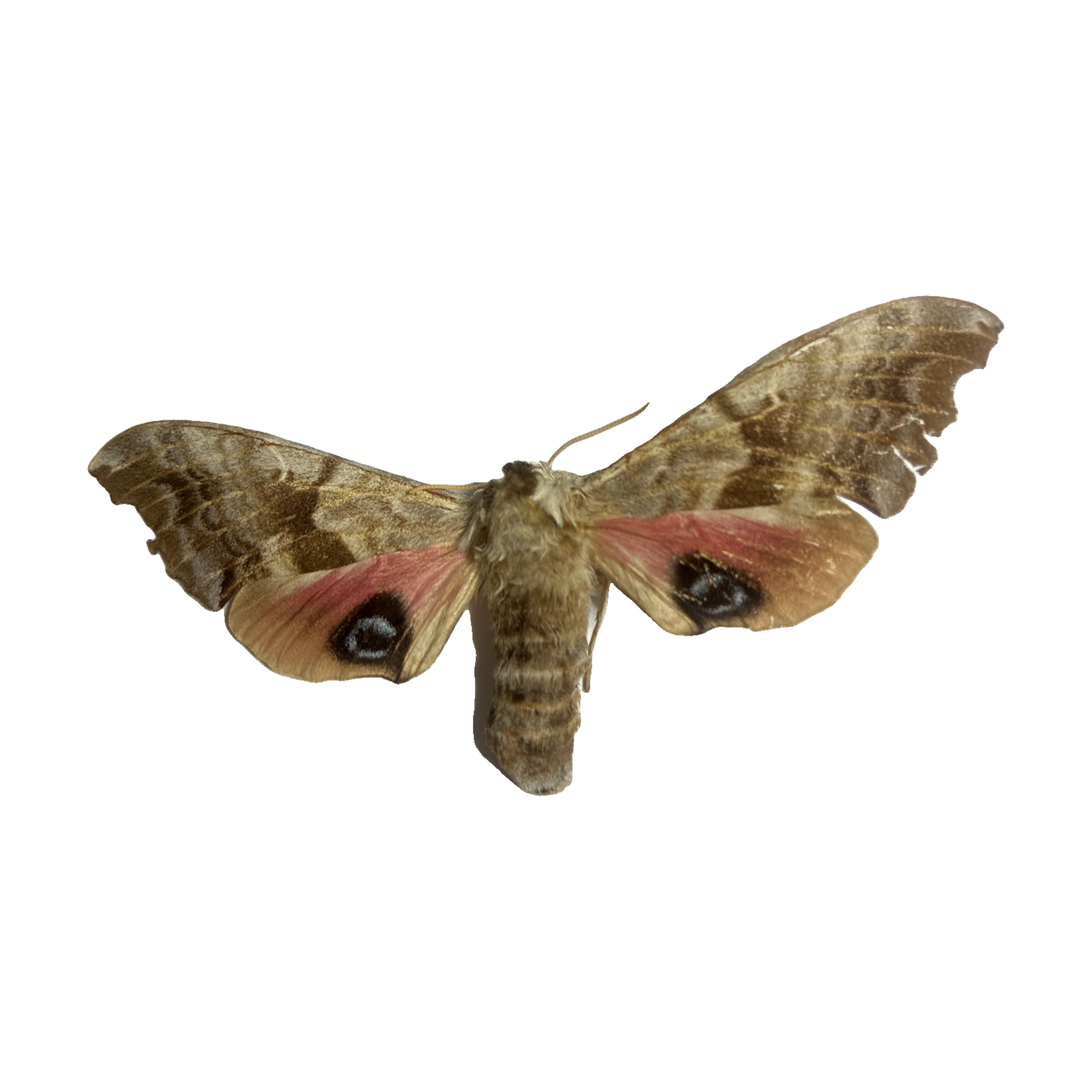
The Twin-spotted Sphinx has a wingspan of 45-83 mm (4.5 to 8.3 cm). The forewing of the male is gray with black and white markings, while the female’s forewing is a warmer yellowish brown with dark brown and white markings. A thick dark bar runs across the middle of the forewing, and there is usually a dark, incomplete spot near the center of the wing. The outer edge of the forewing is unevenly scalloped. The hindwings are mostly rosy red with a pale yellow border, and near the inner corner there is a large blue eyespot ringed in black. The blue spot is divided by a black bar, so it looks like two blue spots, which gives this moth its common name. The very similar One-eyed Sphinx (Smerinthus cerisyi) has a single blue ring around a solid, round black pupil, with no black bar through it, and it lacks the obvious dark spot on the forewing.
This species is found across most of North America, from Newfoundland and Nova Scotia west to British Columbia and north into the Yukon, and south to Florida, Texas, and Arizona. It is absent only from the southern half of western California. It lives in deciduous woodlands, stream sides, wetlands, orchards, and suburbs where willows, poplars, and fruit trees grow. Our specimen was collected in Douglas County, Wisconsin.
Adults fly at night and come readily to lights. Like other members of its subfamily, the adult does not feed. When disturbed, the moth lifts its forewings to flash the red hindwings and blue eyespots, which may startle a bird or other predator.
Adults fly from April to September. There is one generation per year in the North and two or more in the South. The caterpillars feed on willow, poplar, cottonwood, birch, ash, elm, apple, cherry, and plum. They are pale yellowish or bluish green and finely granular, with pale diagonal side stripes and a nearly straight horn at the rear that is often bluish or black on top. The species overwinters as a pupa in the soil.
The caterpillars eat the leaves of willow, poplar, and fruit trees, but they are rarely numerous enough to cause serious damage. The species is common and considered globally secure.
Hodges number 7821. Smerinthus jamaicensis (Drury, 1773), originally described as Sphinx jamaicensis, belongs to the sphinx moth family Sphingidae, subfamily Smerinthinae, tribe Smerinthini. Despite its scientific name, it does not occur in Jamaica. It is one of several eyed sphinxes in the genus Smerinthus found in North America.
Check it out on BugGuide! https://bugguide.net/node/view/3707/bgimage