
$3.00
 <–
1 in stock
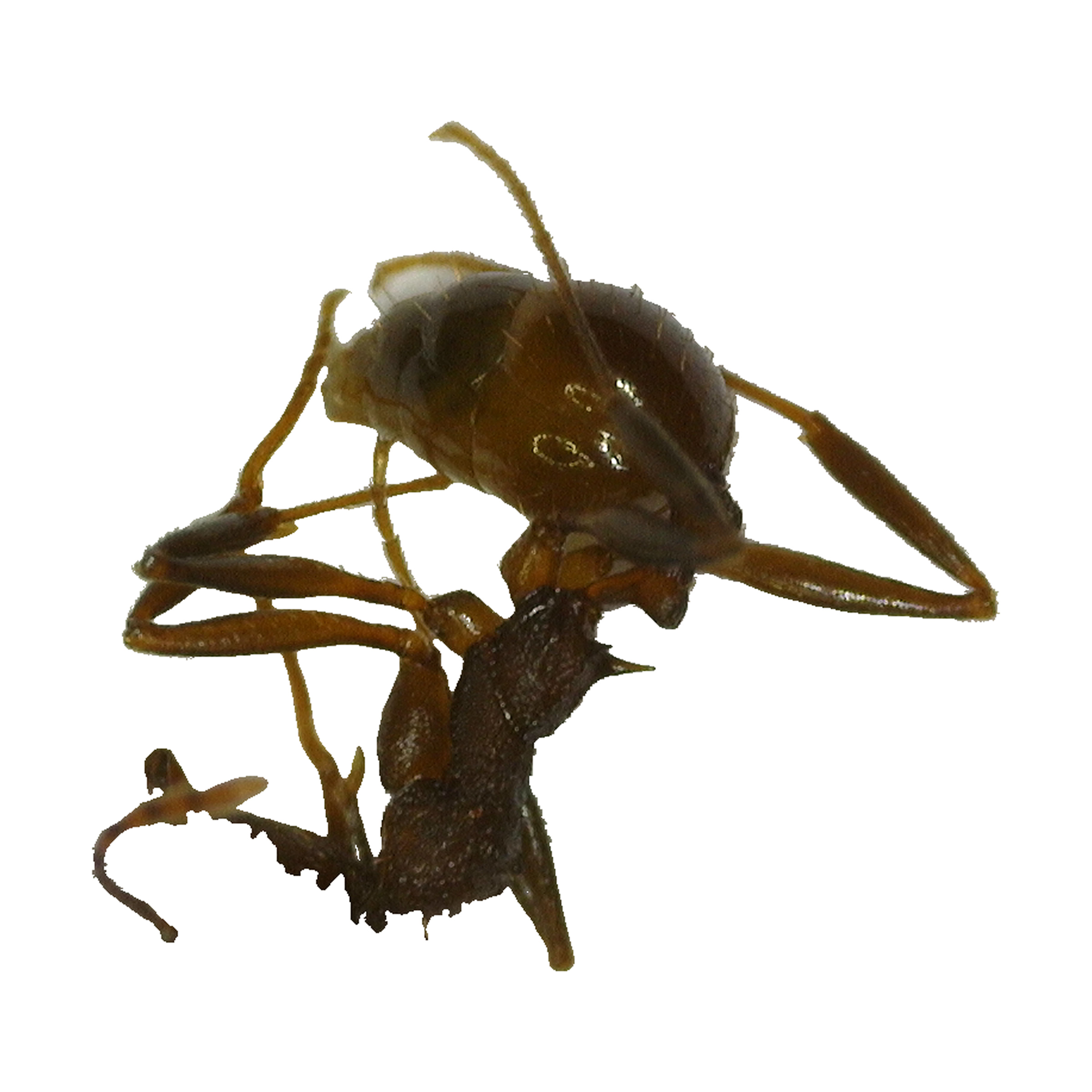
Spine-waisted Ants are slender, long-legged ants in the genus Aphaenogaster. Workers of common eastern species are usually about 3.5 to 7 mm long. The head and thorax are typically darker and more heavily sculptured than the smoother, shinier gaster. A pair of spines on the rear of the thorax gives the group its common name. The waist has two segments, the antennae have 12 segments ending in a weak club, and the legs and antennae are long and slender. Color ranges from reddish brown to dark brown. This specimen is a worker.
Aphaenogaster is widespread in North America and is common in eastern forests, including Missouri. These ants nest in rotting wood, under bark, under stones, in soil, and in leaf litter. Our specimen was collected from leaf litter with a Berlese funnel in Phelps County, Missouri, in November 2026.
Workers forage on the forest floor and in rotting wood, where they hunt small insects and scavenge. Some eastern species are important seed dispersers for woodland plants, carrying seeds back toward the nest. They are not household pest ants. Workers can sting small prey, but they are not a problem for people.
Like other ants, spine-waisted ants have complete metamorphosis, with egg, larva, pupa, and adult stages. Colonies are usually started by a single queen and live in wood, soil, or litter. Workers, queens, and males are produced in season, and winged reproductives leave the nest to mate. This preserved specimen is a worker.
Spine-waisted ants are a normal part of the forest community and are not agricultural or household pests. As predators of small arthropods and as seed dispersers, they are generally considered beneficial in woodlands. They do not damage structures or stored products.
Aphaenogaster Mayr, 1853 belongs to the ant family Formicidae, subfamily Myrmicinae. Several species occur in Missouri forests, and workers in this group can be hard to identify to species from a single habitus photograph, so this specimen is listed as Aphaenogaster sp.
This preserved specimen educates on ants and the leaf litter community, suitable for displays or studies.
Check it out on BugGuide! https://bugguide.net/node/view/8376/bgimage