
$3.00
 <–
29 in stock
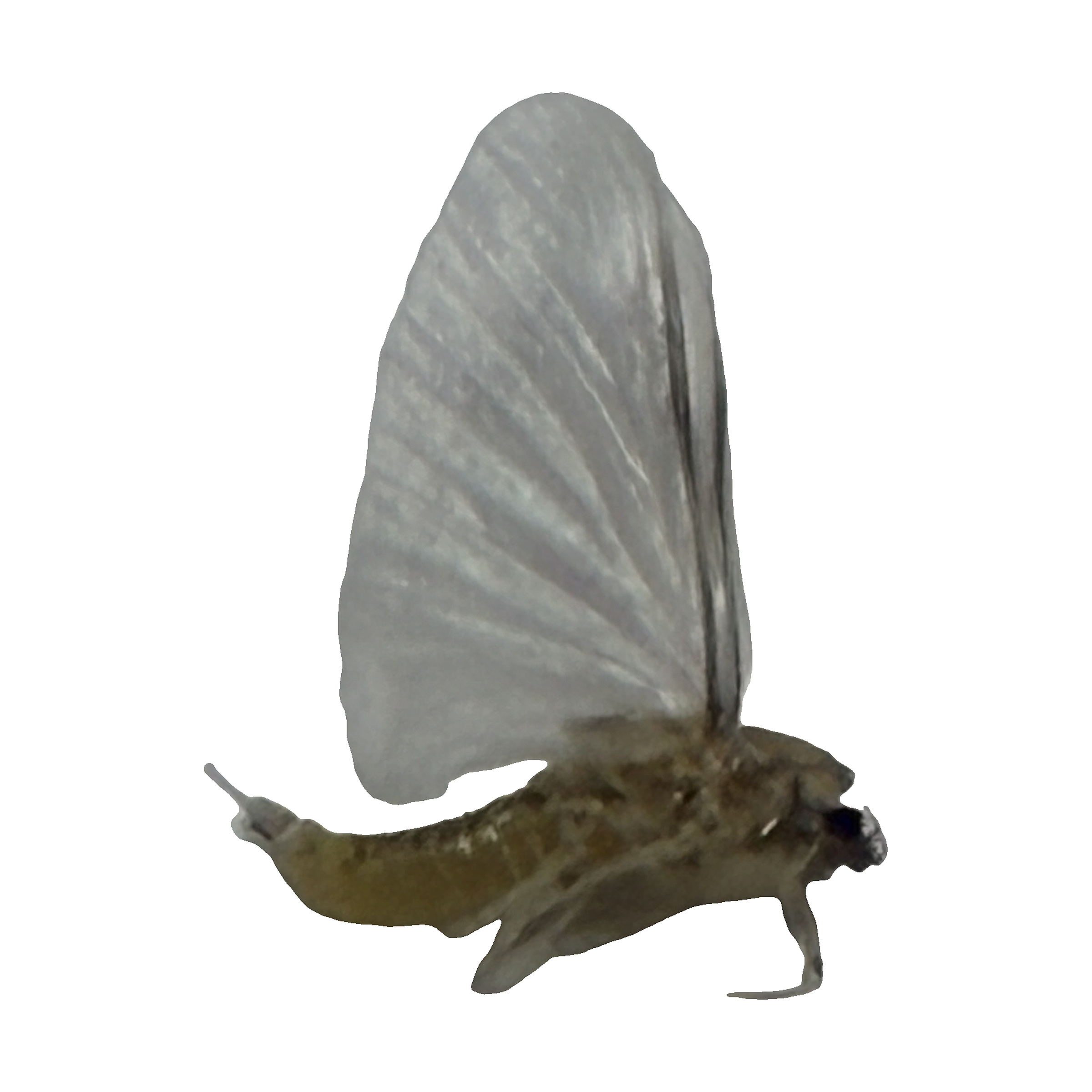
The Small Squaregilled Mayfly belongs to the genus Caenis in the family Caenidae, the small squaregilled mayflies. Adults are among the smallest mayflies and are typically about 3 to 5 mm long, not counting the tails. The body is delicate and often pale. The forewings are relatively broad, and the hindwings are absent or nearly so. Three thread-like tails extend from the tip of the abdomen; in males the tails are often longer than in females. At rest, Caenis adults often hold the wings out to the sides rather than pressed together over the back. The common name refers to the squarish gill covers of the nymphs, not to a feature of the adult. This specimen has a pale yellowish body with brown mottling on the thorax, a translucent whitish wing held out to the side, and a dark eye.
Caenis is found worldwide. There are about 13 species in North America and about 150 species worldwide. The nymphs live in lakes, ponds, and the slower parts of streams and rivers, often on silt, sand, weeds, or debris. Adults are found near those waters and may come to lights. This specimen was collected in Indiana.
Adults live only a short time and do not feed. They fly mainly to mate and lay eggs, and some species emerge in the evening, sometimes in large numbers. The nymphs live on or in the sediment. They have squarish, lid-like gills that help them live on silty bottoms. They are not strong swimmers.
Mayflies have a life cycle unlike that of other insects: egg, nymph, subimago, and adult. The female lays eggs in the water. The nymph grows underwater, then comes to the surface and molts into a winged subimago, the dull-winged stage fly fishers call a dun. The subimago later molts into the shiny-winged adult, or spinner. Mayflies are the only insects that molt after they already have functional wings. In much of the range, adults may be collected from late spring through summer.
Caenis species are not pests. They do not damage crops, stored products, or structures, and they are harmless to people. The nymphs and adults are a food source for fish and a normal part of lake and stream communities. Because the adults are so small, fly fishers sometimes find them hard to imitate and have called them the angler’s curse. The preserved specimens are used in teaching and collections.
Caenis Stephens, 1835 belongs to the family Caenidae, the order Ephemeroptera (mayflies), and the superfamily Caenoidea. Caenidae includes about 37 species in 7 genera in North America and about 230 species in 26 genera worldwide. Caenis is one of the largest mayfly genera. A sure species identification often requires a closer look than a photo can provide, so this specimen is listed at the genus level as Caenis sp.
This preserved specimen educates on mayflies and the genus Caenis, suitable for displays or studies.
Check it out on BugGuide! https://bugguide.net/node/view/45093/bgimage