
$7.95
 <–
5 in stock
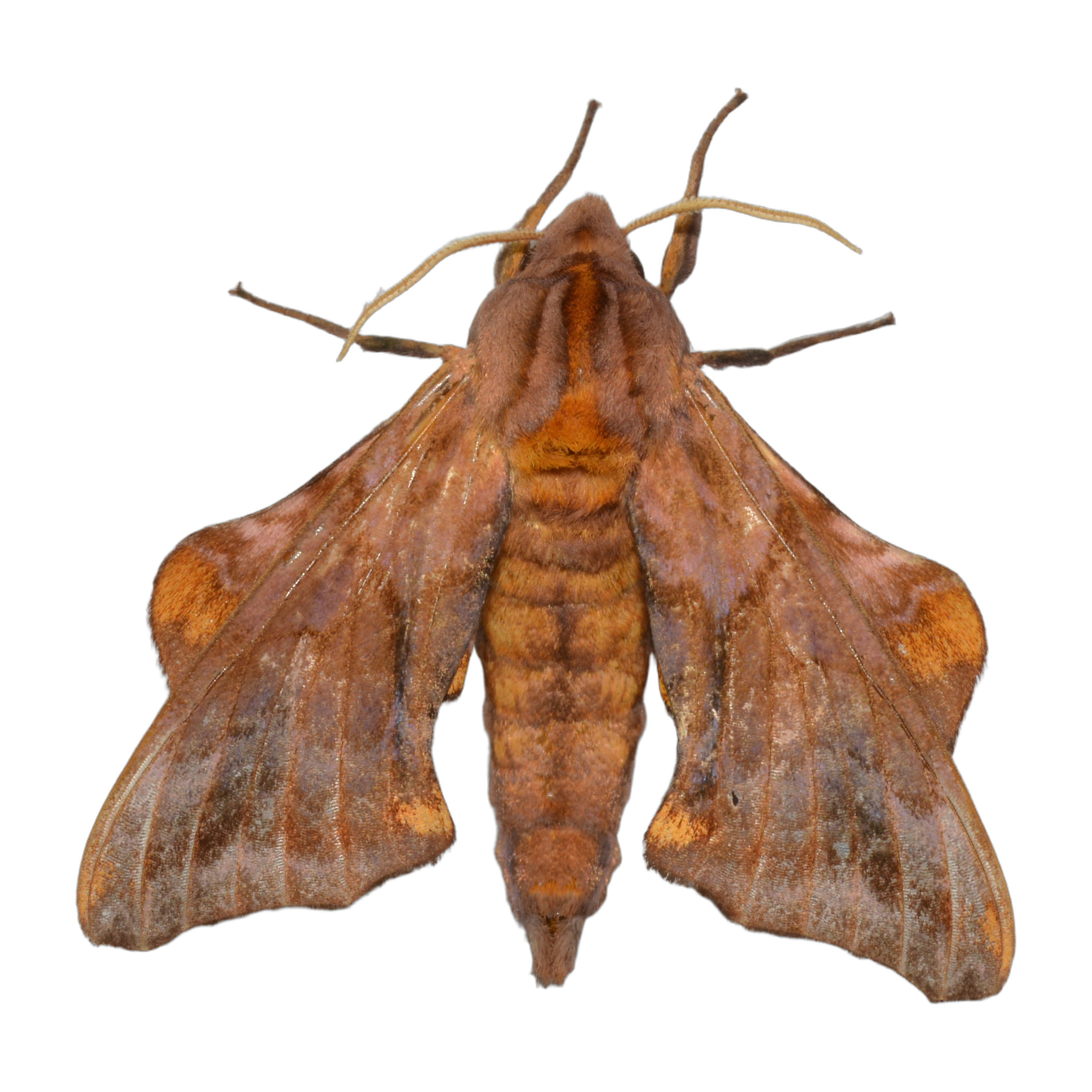
The Small-eyed Sphinx has a wingspan of 45-75 mm (4.5 to 7.5 cm), and females are usually a little larger than males. The forewings are rusty to dark brown with wavy lines, often with ochre or golden patches near the tip and the inner corner. The outer margin of the forewing is doubly indented, with one or two lobes, rather than scalloped all along. The hindwings have a yellow patch enclosing a small blue eyespot ringed in black, with a black pupil in the center. It can be told from the Blinded Sphinx (Paonias excaecata), which has a deeply scalloped forewing margin and a blue hindwing spot with no black pupil, and from the One-eyed Sphinx (Smerinthus cerisyi) and Twin-spotted Sphinx (Smerinthus jamaicensis), which have pink, not yellow, around the hindwing eyespot.
This species is found throughout much of North America, from Nova Scotia and Maine south to Florida and west to British Columbia, California, and Arizona, and south into Mexico. It lives in deciduous woodlands, woodland edges, fields, roadsides, fencerows, and suburbs. Our specimen was collected in Douglas County, Wisconsin.
Adults fly at night and come to lights. Adults do not feed. At rest, the hindwings are held forward so they show above the forewings, a habit typical of this subfamily.
Adults are most common from April to October. There are several generations per year in the South and fewer in the North. The caterpillars feed on cherry and other Prunus species, birch, hawthorn, poplar, willow, serviceberry, and basswood. They are green, sometimes with red blotches, with diagonal white side streaks (the last one bold) and a green, granular horn at the rear. The species overwinters as a pupa in the soil.
The caterpillars feed on the leaves of cherry and other trees, but they are seldom numerous enough to cause noticeable damage. The species is considered globally secure.
Hodges number 7825. Paonias myops (J.E. Smith, 1797), originally described as Sphinx myops, belongs to the sphinx moth family Sphingidae, subfamily Smerinthinae, tribe Smerinthini. It is one of three Paonias species found in North America north of Mexico.
Photo: Andy Reago & Chrissy McClarren, via Wikimedia Commons, licensed CC BY 2.0.
Check it out on BugGuide! https://bugguide.net/node/view/3713/bgimage
