
$3.00
 <---
8 in stock
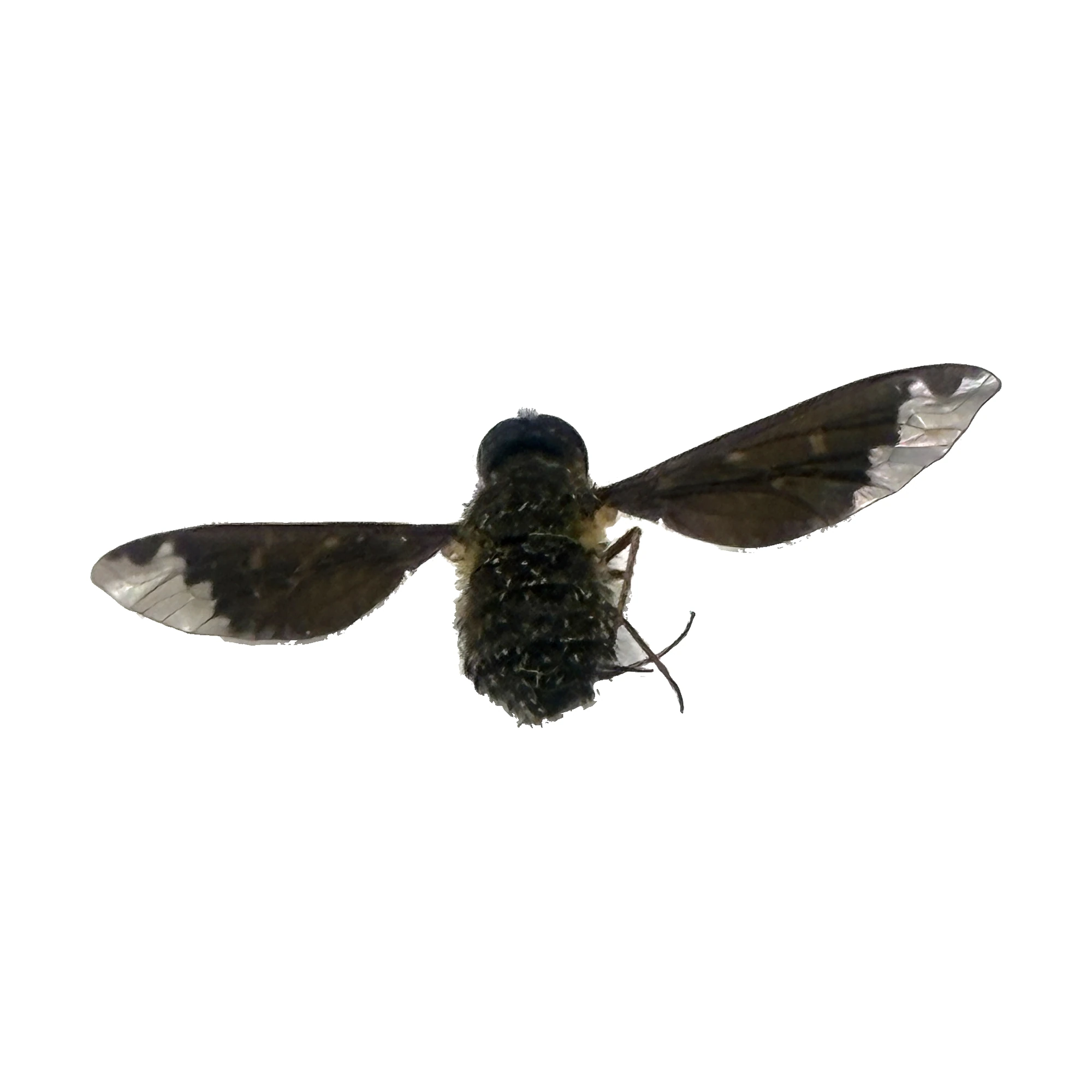
The Sinuous Bee Fly in this listing is Hemipenthes sinuosa, a bee fly in the family Bombyliidae. Adults are about 5 to 15 mm long. The head, thorax, and abdomen are black or very dark, with no bands or other obvious markings. The wings are the best way to recognize this species. The front part of each wing is dark brown to black, and the rear part is clear. The border between the dark and clear areas is irregular and wavy, or sinuous, which is how the species got its name. There is also a small rounded dark blob near the wing tip. A similar species, Hemipenthes jaennickeana, has almost the same wing pattern but has a crossvein between veins R2+3 and R4, which H. sinuosa lacks.
This species is found across much of North America, from southern Canada through the United States into Mexico, including Wisconsin. Adults are usually found in open areas with sandy or well-drained soil and sparse or low vegetation, and also in pine woods and boreal forest. Some of our specimens were collected in Douglas County, Wisconsin.
Adults visit flowers for nectar, often on low plants in the open. They do not sting. The structure at the front of the head is a short proboscis used for feeding, not a stinger. They are most often seen from late May through September in the north.
Like other true flies, this bee fly has complete metamorphosis: egg, larva, pupa, and adult. The larvae are parasitoids. This species has been recorded from pine sawflies (Neodiprion), including the European pine sawfly. Other members of the genus Hemipenthes are also known as hyperparasitoids of tachinid flies and ichneumon wasps that themselves attack caterpillars and sawflies.
This species is beneficial. The larvae parasitize pine sawflies, which can damage pine trees, and the adults visit flowers. They are not pests, and they do not sting or bite people. The preserved specimens are used in teaching and collections, and they are a good example of a dark-winged bee fly in the family Bombyliidae.
This preserved specimen educates on dark-winged bee flies and the family Bombyliidae, suitable for displays or studies.
Check it out on BugGuide! https://bugguide.net/node/view/14123
Only logged in customers who have purchased this product may leave a review.
Reviews
There are no reviews yet.