
$3.00
 <—
1 in stock
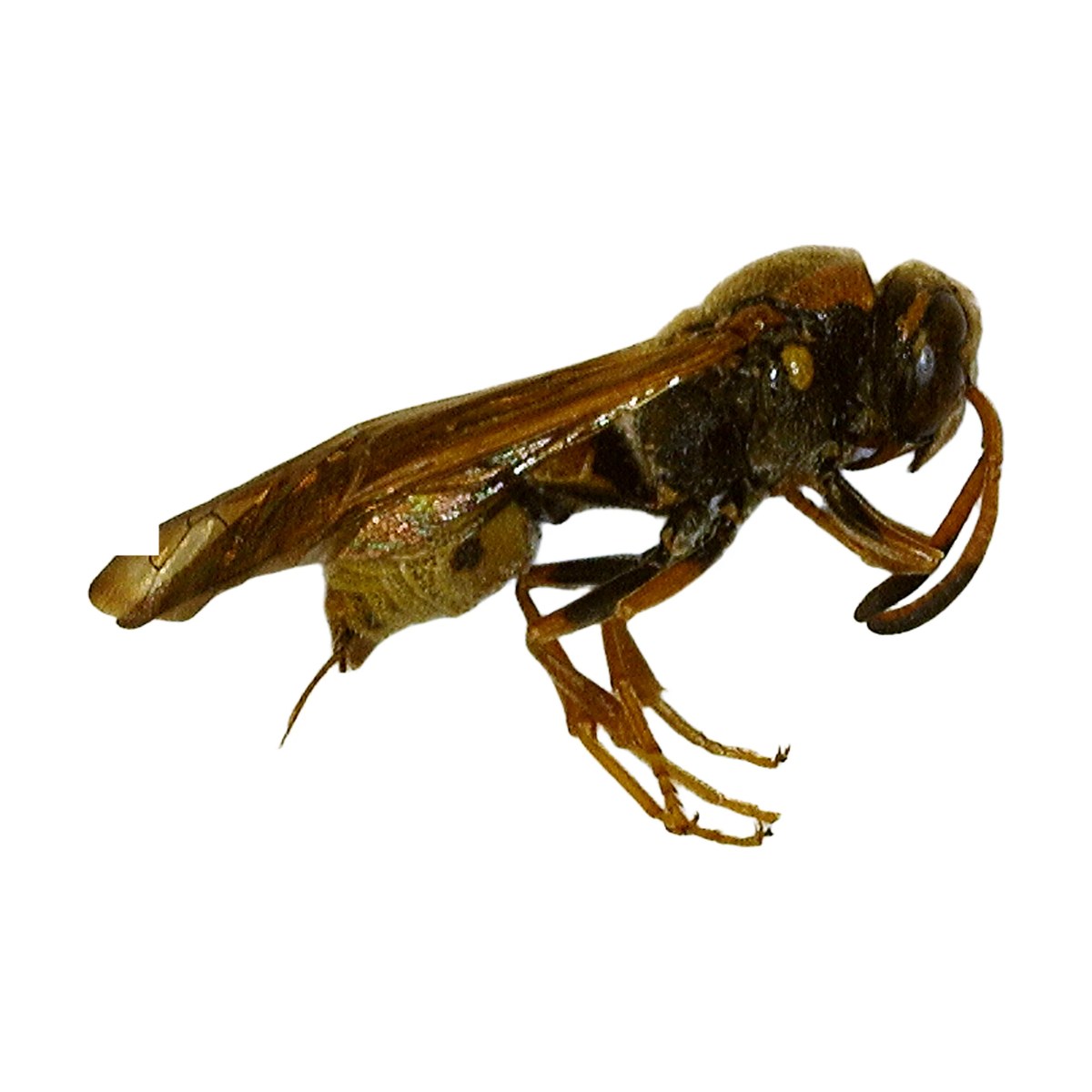
The Ringed Mason Wasp, Euodynerus annulatus, is a medium-sized solitary wasp in the subfamily Eumeninae, the potter and mason wasps. The forewing is about 8 to 10.5 mm long, a little longer in females than in males. The body is black and often strongly tinged with rusty orange, with yellow bands on the first four abdominal segments (also on the fifth and sixth in many males) that give the species its common name. The yellow on the head and thorax is often suffused with rusty red, the legs are mostly orange-brown, and the wings are folded lengthwise at rest and tinted amber. It looks much like the very common Hidalgo Mason Wasp, Euodynerus hidalgo, but it has a less angular rear of the thorax (the propodeum), lacks the raised, lamellate rims on the rear edges of the second and third abdominal segments, and has two yellow spots on the scutellum, which E. hidalgo lacks. Five subspecies are recognized, and their colors and markings vary a good deal.
This wasp occurs from coast to coast in the United States, in southern Canada from British Columbia to Saskatchewan, and south to northern Mexico. Unlike most mason wasps, it does not use old beetle borings or hollow stems. It nests in the ground, in hard or soft soil, and usually close to water. Some of our specimens were collected near Hot Springs, South Dakota.
Females dig their own burrows. They carry water in their mouths to soften the soil, and they build a curved mud chimney about an inch long over the nest entrance, which is unusual among ground-nesting Eumeninae. Several cells branch off the main tunnel. The female hunts caterpillars of moths such as the Crambidae, Pyralidae, and Noctuidae, only weakly paralyzes them with her sting, and packs several into each cell as food for one larva. Adults feed on nectar, and both sexes are often found on flowers. These wasps rarely sting people and do not defend their nests.
Euodynerus annulatus undergoes complete metamorphosis (egg, larva, pupa, adult). The female lays a single egg in each cell, hung from the wall on a short thread, before she fills the cell with caterpillars. When all the cells are stocked she seals the nest, takes the mud chimney apart, and uses it to close the entrance flush with the ground, so the nest is nearly invisible. The larva eats the stored caterpillars and pupates inside its cell.
The Ringed Mason Wasp is beneficial. It removes many caterpillars, including webworms and other moth pests of crops and gardens, and the adults visit flowers for nectar. It is harmless to people and buildings and is not a pest.
This preserved specimen educates on solitary ground-nesting wasps and their mud chimneys, suitable for displays or studies. Check it out on BugGuide! https://www.bugguide.net/node/view/143494