
$3.00
 <---
35 in stock
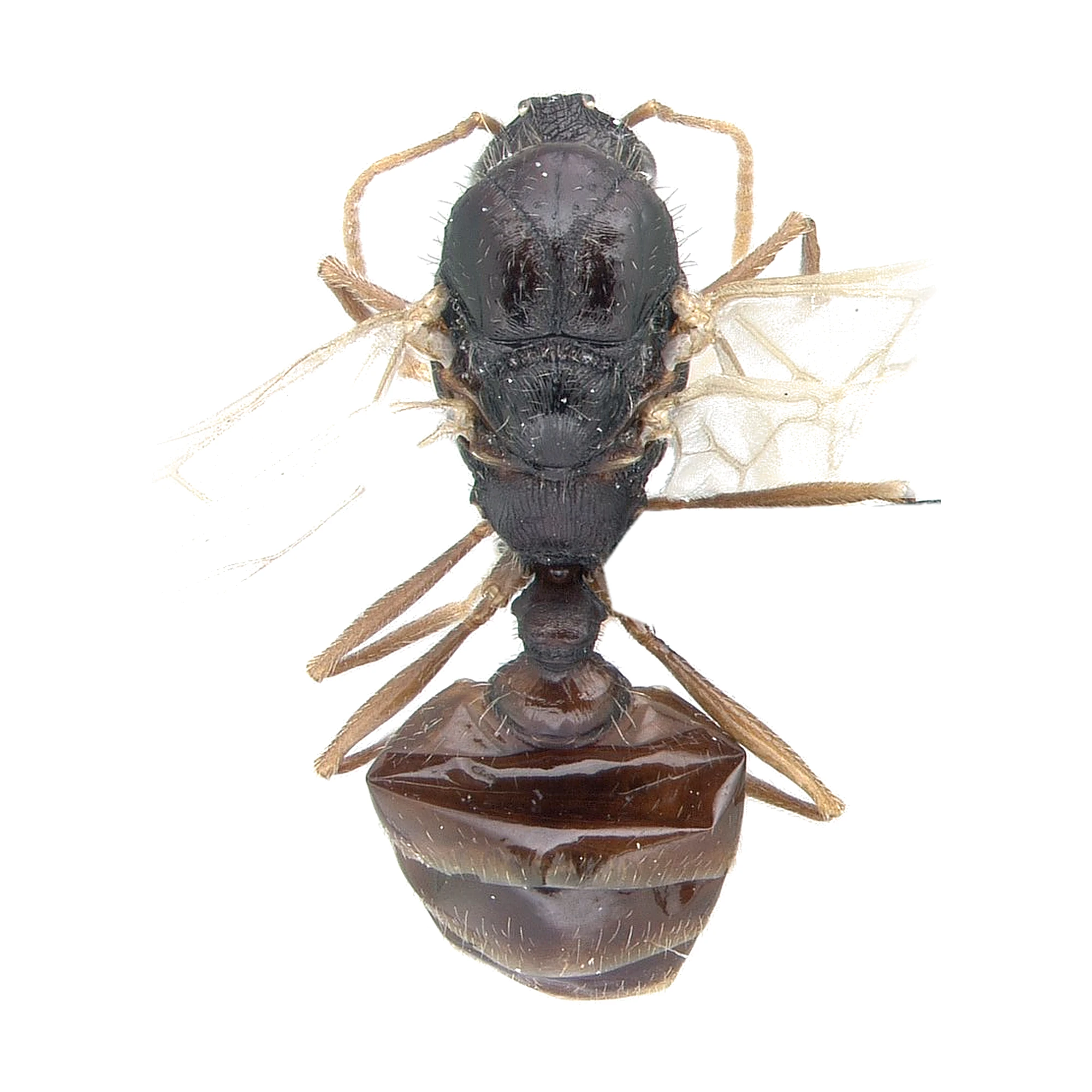
The Pavement Ant, Tetramorium immigrans, is a small, sturdy ant in the subfamily Myrmicinae of the family Formicidae. The specimens offered here are winged queens and males, the colony’s reproductive ants. They are about 5.5 to 8 mm long, roughly twice the size of the 2.5 to 4 mm workers. They are dark brown to blackish, with clear wings and fine parallel grooves on the head and thorax, the same grooved sculpture seen on the workers. Like all pavement ants, they have a two-segmented waist (two small nodes between the thorax and abdomen). Queens carry a pair of short spines at the rear of the thorax, while males lack these spines and have a smaller head with large eyes.
The Pavement Ant is native to Europe and was introduced to North America from Europe, probably in the early 1800s. It is now found in cities and towns across the United States and southern Canada, though it is mostly absent from the southernmost states. These specimens were collected in Hot Springs, South Dakota. It lives in urban parks, yards, vacant lots, and under sidewalks, building slabs and rubble, and also along rural roadsides, on farms and in rock quarries. Colonies nest in the soil, often in cracks along pavement, patios, driveways and foundations.
Pavement Ants are omnivores. They take sweets such as nectar, fruit and syrup, and they also collect grease, dead insects and small seeds. Workers leave small piles of sand or soil at pavement cracks and nest entrances. In spring, large groups are often seen on sidewalks where neighboring colonies battle over territory. Workers have a small stinger, but it is too weak to be more than a mild annoyance to people.
Like all ants, the Pavement Ant goes through complete metamorphosis (egg, larva, pupa, adult). Winged queens and males typically leave the nest in mating swarms in spring and early summer, although they can emerge at almost any time of year inside heated buildings. After mating, a queen sheds her wings, digs a small chamber in the soil and raises her first workers on her own. Development from egg to worker takes about 6 to 9 weeks at room temperature. Colonies usually have a single queen and can grow to more than 10,000 workers.
The Pavement Ant is one of the most commonly encountered ants in the United States and a familiar household nuisance, especially in towns and cities of the northern states. Workers come indoors through cracks in foundations and slabs to forage for crumbs, grease and sweets, and winged ants sometimes emerge inside homes, which often alarms homeowners. Colonies also leave sand piles along sidewalks and floors, and they occasionally injure garden plants. Their sting is weak, so to people they are mainly a nuisance.
This preserved specimen educates on a familiar introduced ant and on the winged queens and males that start new colonies, suitable for displays or studies. Check it out on BugGuide! https://bugguide.net/node/view/45144
| Weight | 0.01 lbs |
|---|
Only logged in customers who have purchased this product may leave a review.
Reviews
There are no reviews yet.