
$5.95
 <–
16 in stock
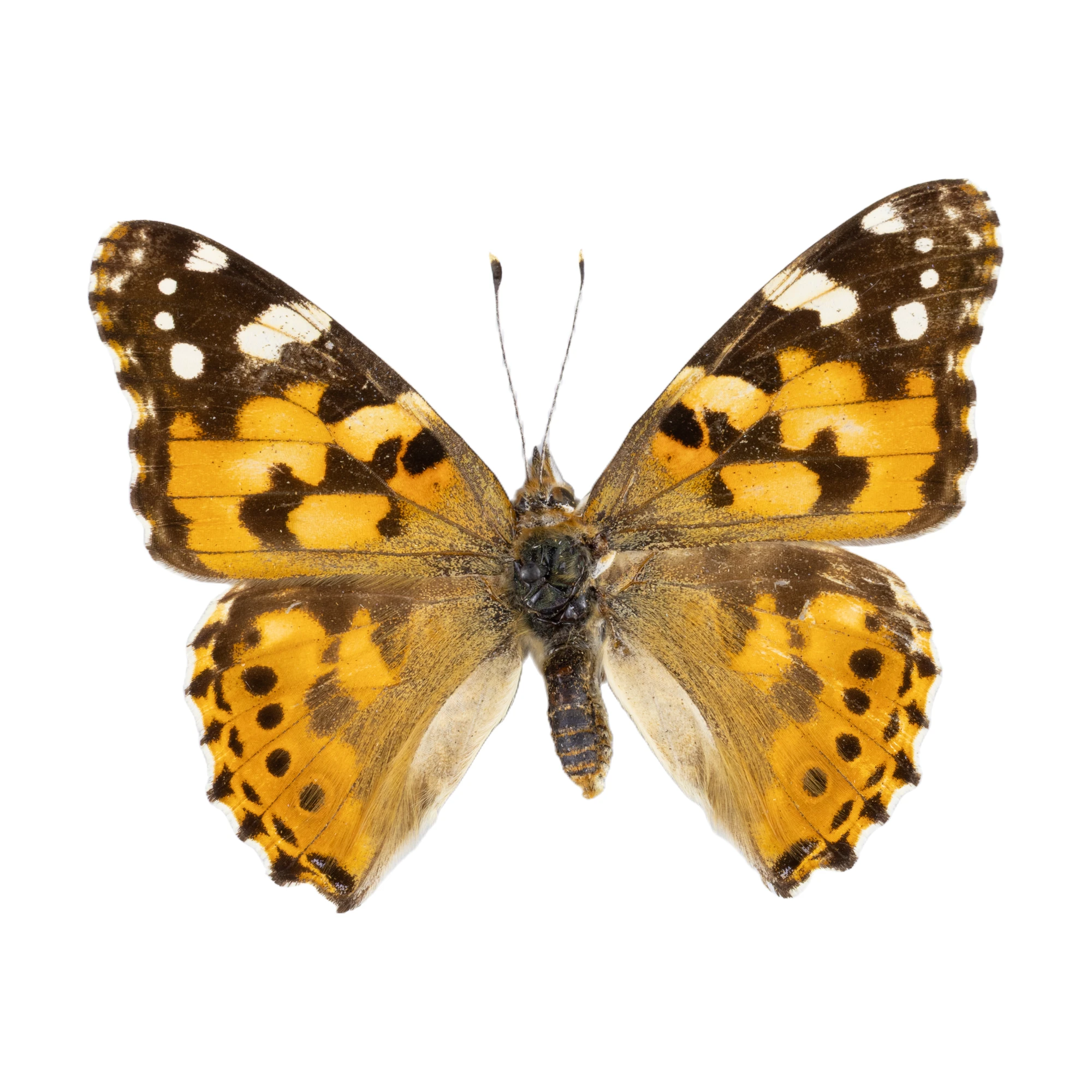
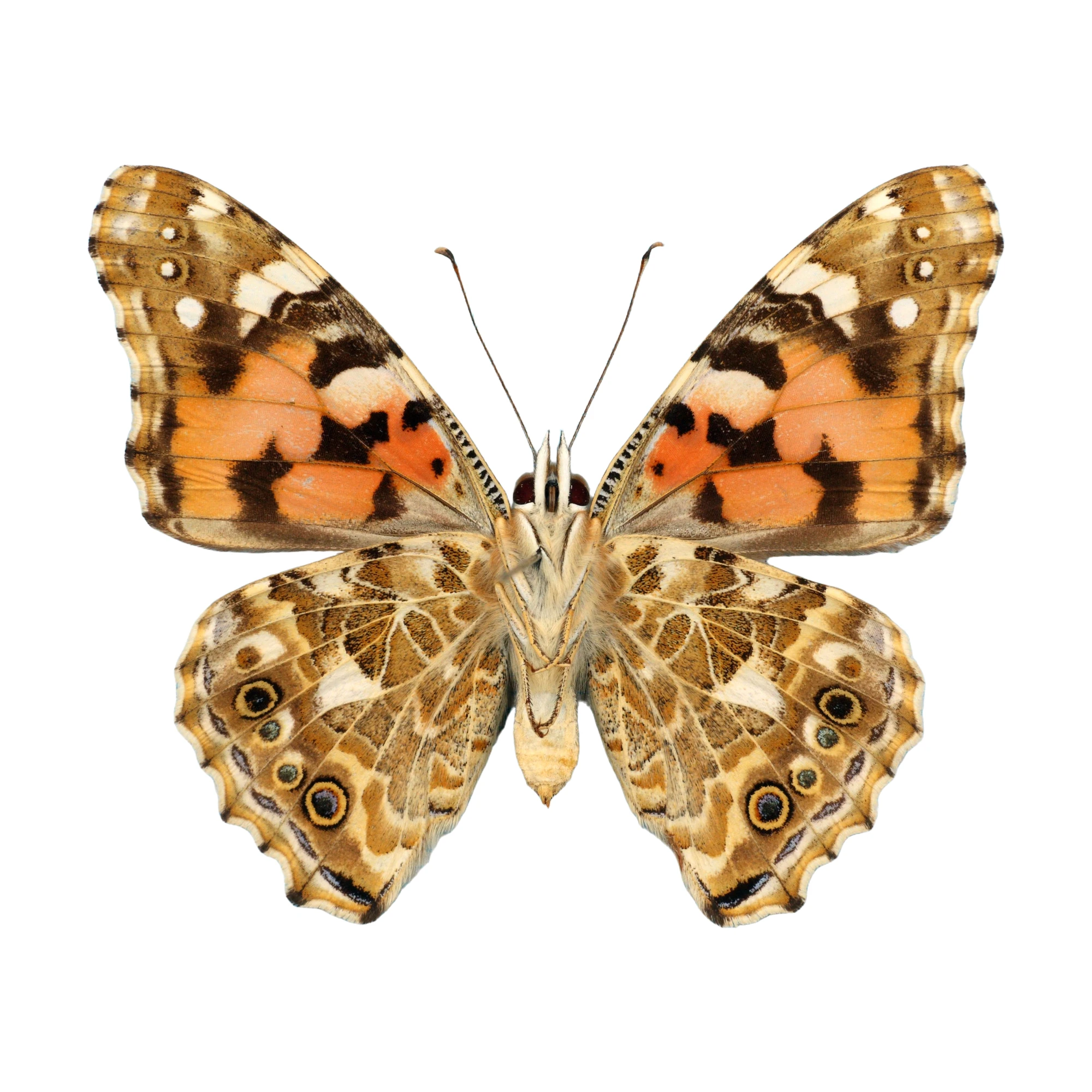
The Painted Lady, Vanessa cardui, is a medium-sized butterfly with a wingspan of 51 to 73 mm (about 2 to 2.9 inches). The dorsal wings are orange-brown with darker wing bases. The dorsal forewing has a black patch at the tip with white spots, including a large white spot near the front edge, and a row of small black spots crosses the dorsal hindwing, sometimes with a few blue scales. The ventral hindwing is a mottled pattern of black, brown, gray, and cream with a row of small eyespots. The Painted Lady is generally a little larger than the American Lady, Vanessa virginiensis, and its forewing spot is always white. The American Lady has two large eyespots on the ventral hindwing, while the Painted Lady has a row of small ones. Our photo shows the dorsal view of a spread specimen. Caterpillars are dark with branching spines and narrow pale yellow or cream stripes.
The Painted Lady lives in open and disturbed places such as gardens, fields, old fields, and dunes. It is one of the most widely distributed butterflies in the world, which is why it is also called the Cosmopolitan, and it is found on most continents. In North America it cannot survive the freezing winters of the north, so each spring it migrates north from the deserts of northern Mexico and recolonizes the northern states and Canada. Numbers swing widely from year to year, and in some years huge migrations occur.
Males perch and patrol in the afternoon looking for receptive females. In the East they usually perch on bare ground in open areas, and in the West they often perch on shrubs on hilltops. Adults prefer nectar from tall composite flowers 3 to 6 feet high, especially thistles, and also visit aster, cosmos, blazing star, ironweed, joe-pye weed, red clover, buttonbush, privet, and milkweeds. Autumn movements south are more scattered and less obvious than the spring migration north.
Complete metamorphosis (egg, larva, pupa, adult). The female lays single eggs on host plant leaves. The caterpillars live in silk nests made by weaving leaves together and eat the leaves. More than 100 host plants are known, and favorites include thistles, burdock, hollyhock, mallow, and legumes. Development can take as little as three weeks from egg to adult. In the East there are one to three flights a year from May to October. The adults hibernate only in the South and in mild winters. Painted Lady caterpillars are easy to raise on an artificial diet, so they are widely raised in school classrooms.
Generally not a serious pest. The caterpillars mostly feed on thistles and mallows, and BugGuide lists crop plants such as alfalfa, soybean, and beet among their many hosts, but we found no record of serious crop damage.
Some of our specimens were collected by Don Barnhart in Douglas County, Wisconsin.
These are damaged specimens, sold at a reduced price. They are a low-cost way to study the orange-brown dorsal wings and mottled ventral wings of one of the world’s most widespread butterflies, suitable for displays, practice mounting, or art projects. Check it out on BugGuide! https://bugguide.net/node/view/2649/bgimage
Photos: dorsal view by Lfavretto (Museo Tazzetti), CC BY 4.0, via Wikimedia Commons; ventral view by Magnefl, CC BY-SA 3.0, via Wikimedia Commons. Both cropped, background removed. Photo is a representative example, not the exact insect you will receive.