
$7.95
 <–
19 in stock
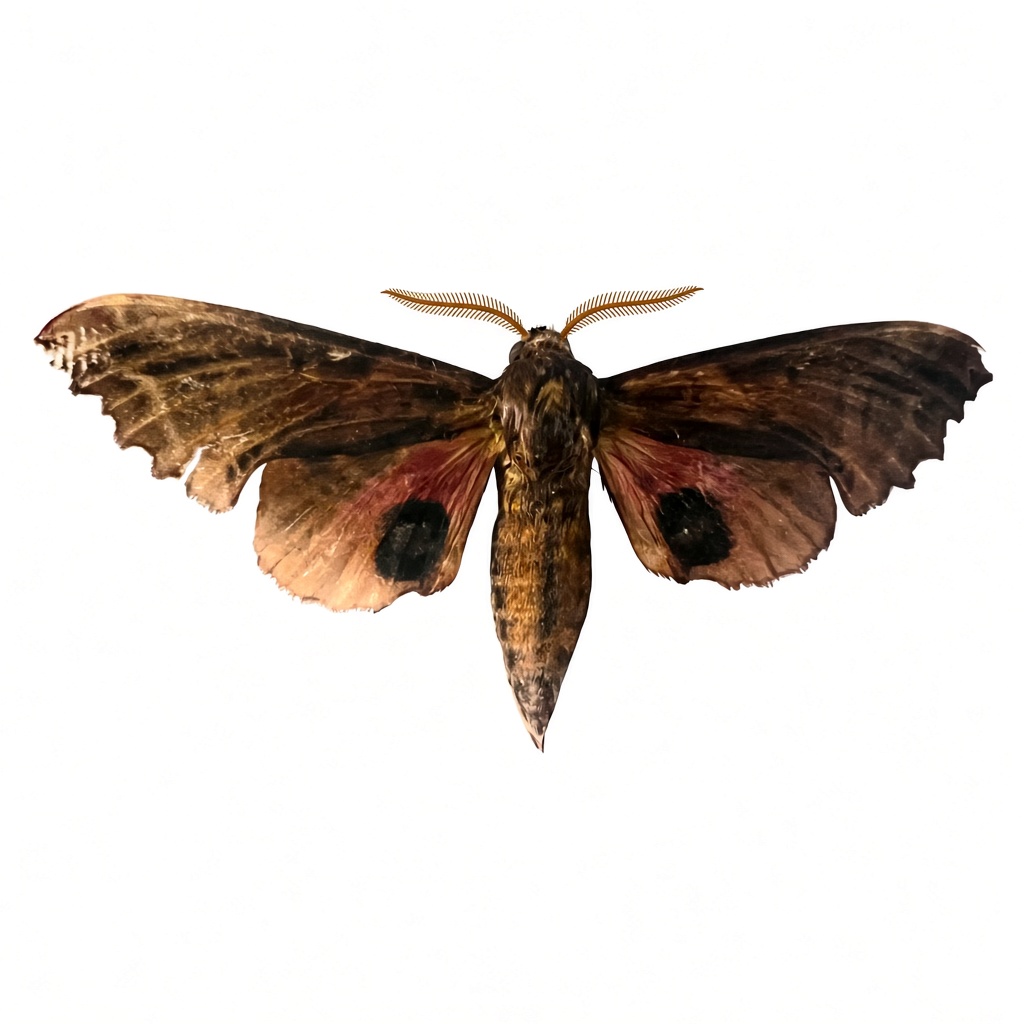
The One-eyed Sphinx has a wingspan of 62-90 mm (6.2 to 9 cm). The forewings are a cryptic mix of pale gray and dark brown, with a cross vein at the end of the discal cell, and the veins toward the outer margin are usually outlined in paler brown. The hindwing carries the feature that gives this moth its name: a blue eyespot, usually with a black bull’s-eye center and a thick black outer ring, surrounded by a small to large amount of pink shading. It can be told from the Blinded Sphinx (Paonias excaecata), whose blue hindwing spot has no black center, and from the Twin-spotted Sphinx (Smerinthus jamaicensis), whose blue spot is split into two.
This species occurs across Canada and the northern United States, south in the east to about Indiana, Ohio, and Pennsylvania, with records as far south as Missouri. Populations in the Pacific states and most of British Columbia are now treated as a separate species, Smerinthus ophthalmica. It lives along river margins and in low ground where willow and poplar grow. Our specimen was collected in Douglas County, Wisconsin.
Adults fly at night and are attracted to lights. Adults do not feed. To attract a mate, the female extends a scent gland from the tip of her abdomen to lure night-flying males, and a mated pair may stay joined until the following evening.
There is one generation per year, with adults flying from May to July or August. Smooth, shiny oval eggs are laid singly or in pairs from June to August. The caterpillars feed on the leaves of willow, poplar, pear, and plum. They are pale bluish-green or yellowish-green with granular skin, pale diagonal side lines, and a horn at the rear that is red in the first instar and blue in later instars. The species overwinters as a pupa.
The caterpillars feed on willow, poplar, and fruit trees, but they are seldom numerous enough to cause noticeable damage.
Hodges number 7822. Smerinthus cerisyi Kirby, 1837 belongs to the sphinx moth family Sphingidae, subfamily Smerinthinae, tribe Smerinthini. It was named in honor of the French entomologist Alexandre Louis Lefebvre de Cerisy. Western populations once included here are now treated as Smerinthus ophthalmica, and the Rocky Mountain population as Smerinthus astarte.
Check it out on BugGuide! https://bugguide.net/node/view/24880/bgimage
| Weight | 0.01 lbs |
|---|
Only logged in customers who have purchased this product may leave a review.
Reviews
There are no reviews yet.