
$7.95
 <—
1 in stock
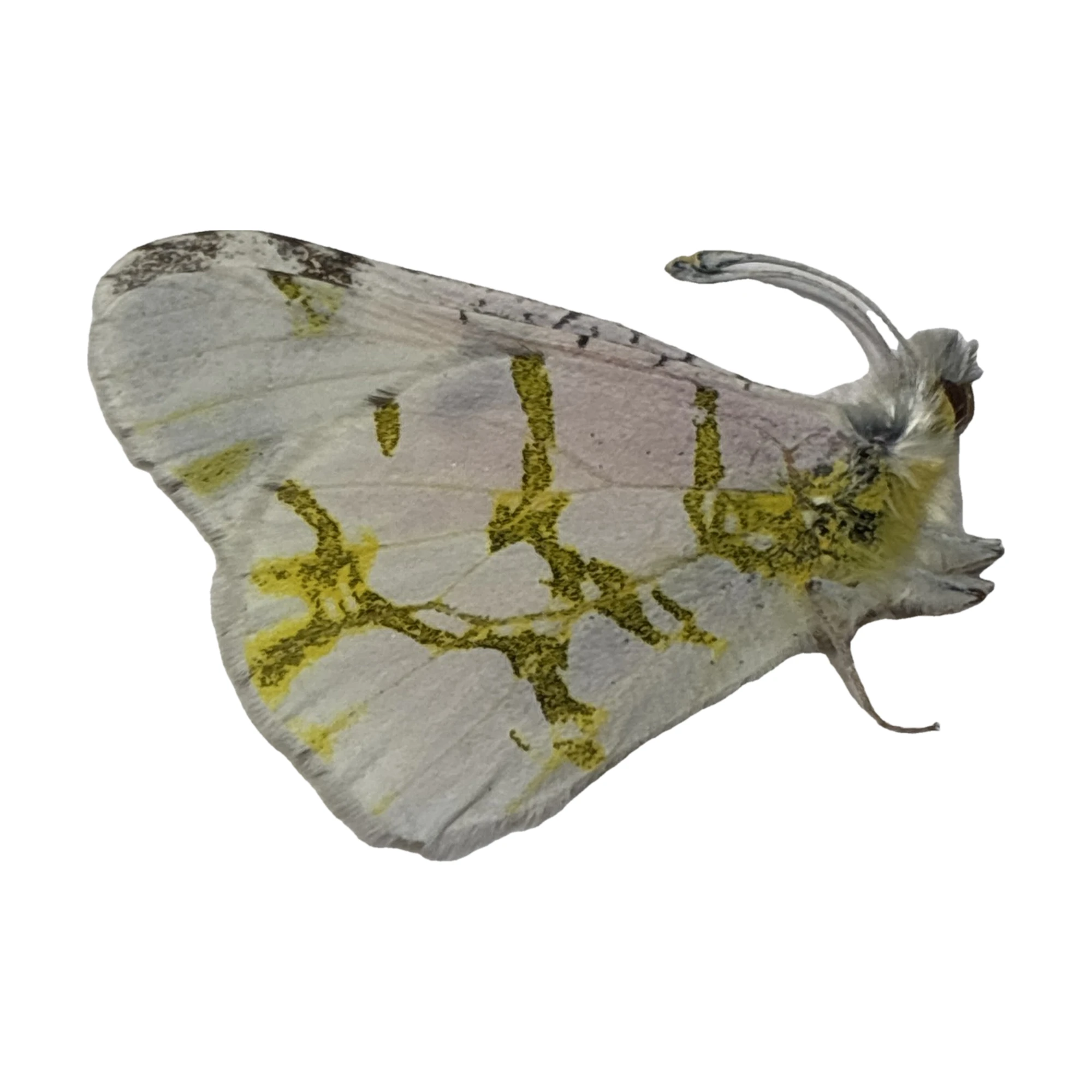
The Olympia Marble, Euchloe olympia, is a medium-sized white butterfly with a wingspan of about 35 to 51 mm (1 3/8 to 2 inches). The upperside is white with only a little black, a narrow bar in the forewing cell and a diffuse grayish patch at the forewing tip. The underside, which is the view in our photo, is the easy way to identify it. The hindwing is white with a loose network of yellow-green marbling along the veins, leaving a lot of white space, and the forewing has no marbling. In fresh butterflies the underside of the wing bases has a pink or rose flush, which fades quickly after death. The antennae are white. The similar Large Marble, Euchloe ausonides, found in the Black Hills, has dense green marbling on the hindwing underside, plus scattered white scales in the black forewing bar.
The Olympia Marble lives in dry, open places such as prairie hills, foothills, badlands, rocky ridges, shale and limestone barrens, sand prairies, dunes, and open woodlands. It is found from southern Canada, from Alberta to southwestern Quebec, south through the Great Plains and the Midwest to central Texas, with an isolated group of colonies in the Appalachians from Pennsylvania to Tennessee. In South Dakota it is listed statewide with one generation a year, and it has been recorded in Fall River County. Some of our specimens were collected near Hot Springs, South Dakota.
This is one of the first butterflies to fly in spring. In South Dakota the flight runs from about late April to mid June, and at any one place the adults are on the wing for only about 3 to 4 weeks. Males patrol hilltops and ridge slopes through the day looking for females. Adults visit the flowers of rock cress and other mustards, as well as chickweed, phlox, and bluets for nectar. The species does not migrate. Populations are often small, and a collector will often see only a single butterfly at a time.
Complete metamorphosis (egg, larva, pupa, adult), with one generation a year. The female lays white, bullet-shaped eggs one at a time on the flower buds and leaves of a host plant, which turn red and then gray before they hatch in about a week. Host plants are mustards (Brassicaceae), mostly rock cresses (Arabis), and also tansy mustard (Descurainia), peppergrass (Lepidium), and hedge mustard (Sisymbrium). Young caterpillars eat flower buds, flowers, and seedpods, and older ones also eat leaves. A full-grown caterpillar is about 25 mm long and bluish green with yellow stripes along its back. It finishes growing in only a few weeks, and the slender, thorn-shaped chrysalis forms in June. The chrysalis spends the summer, fall, and winter in that stage, and the adult emerges the next spring.
Not an economic pest. Its caterpillars feed on wild mustards, and we found no record of crop damage from this species. It is rated globally secure, but it has declined in several areas. Spraying for gypsy moths, habitat loss, herbicide use along roadsides and power lines, and hot prairie burns have all hurt local populations, because the chrysalis lies in the litter at the base of the host plant through the winter. A 2025 study of butterfly surveys across the United States found the Olympia Marble down about 75 percent between 2000 and 2020 in the areas surveyed.
This preserved specimen educates on butterfly identification, the underside marbling of the Marbles, and the early-spring butterfly season, suitable for displays or studies. Check it out on BugGuide! https://bugguide.net/node/view/48741/bgimage