
$3.00
 <–
6 in stock
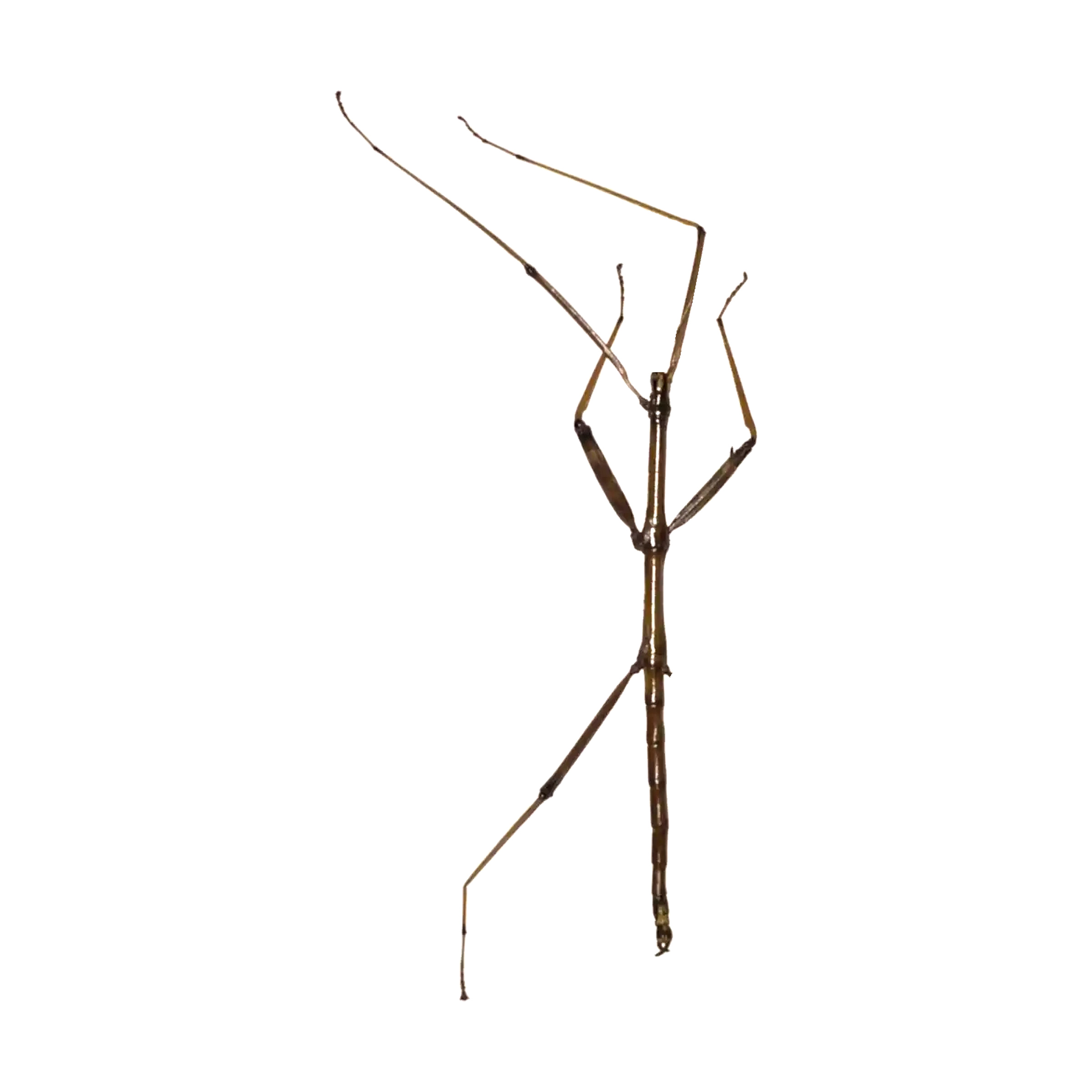
The Northern Walkingstick, Diapheromera femorata, is a wingless stick insect in the family Diapheromeridae. Its body is very long and slender, about 75 mm (3 inches) in males and 95 mm (3 3/4 inches) in females, not counting the legs or antennae. Males are brown, while females are larger and greenish brown. The antennae are about two-thirds the length of the body, and the head is small and square. Males have thickened, banded middle femora and use the cerci at the tip of the abdomen as claspers. At rest, the front legs are held straight forward beside the antennae, making the insect look even more like a twig. These are slightly damaged specimens: they are missing the right hind leg and both antennae, but the body and the other five legs are intact.
This is the most common and widespread walkingstick in North America. It lives in deciduous woods and forest edges from the Atlantic coast south to northern Florida, west to New Mexico, and north into southern Canada as far as Alberta. Adults and older nymphs live up in the tree canopy, where they are hard to spot.
Northern Walkingsticks rely on camouflage for defense. They hold still or sway slowly like a twig in the wind, and they can drop a leg to escape a predator. Adults and older nymphs feed on the leaves of deciduous trees, especially oaks and hazelnut, while young nymphs feed on low plants such as blueberry, strawberry, and sweet fern before climbing higher. They are harmless to people and cannot bite or sting.
Walkingsticks go through incomplete metamorphosis, with egg, nymph, and adult stages. In late summer and fall, females drop their seed-like eggs one at a time from the treetops to the leaf litter below. The eggs overwinter on the forest floor and hatch in spring; in the north many eggs wait through a second winter before hatching. The green nymphs grow through several molts and become adults by mid to late summer. Adults die with the first hard frosts.
The Northern Walkingstick is usually harmless, but in outbreak years large numbers can strip the leaves from oaks and other hardwoods over wide areas of forest, especially in the Great Lakes region and the Midwest. Healthy trees usually leaf out again. It does not damage crops, gardens, homes, or stored food.
These preserved specimens, though slightly damaged, are a low-cost way to study stick insect camouflage, suitable for displays, practice mounting, or studies.
Check it out on BugGuide! https://bugguide.net/node/view/34736/bgimage
Only logged in customers who have purchased this product may leave a review.
Reviews
There are no reviews yet.