
$3.00
 <–
22 in stock
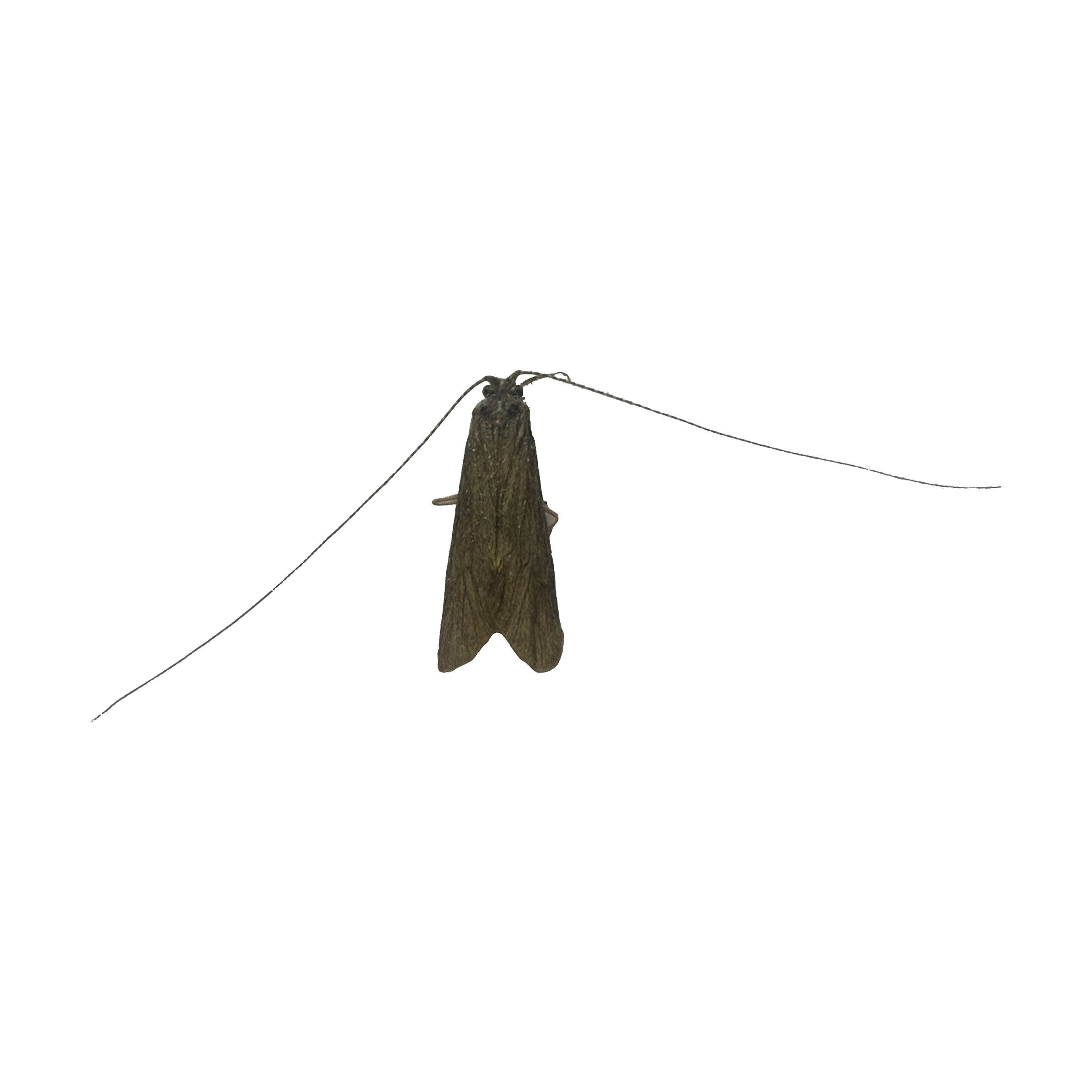
The Long-horned Caddisfly belongs to the family Leptoceridae. Adults are slender caddisflies with unusually long, thread-like antennae, often longer than the body and wings combined. The wings are typically pale tan to golden brown and are held roof-like over the body at rest. The body is narrow, and the legs are slender. This specimen is about 11 mm long, not counting the antennae. Adults in the family are commonly about 5 to 17 mm from head to wing tip.
Leptoceridae is found throughout North America. The larvae live in streams, rivers, ponds, and lakes. Some prefer slow or still water with vegetation or a sandy bottom. Adults rest on vegetation near the water during the day and fly at night, when they often come to lights. These specimens were collected in Douglas County, Wisconsin, in June 2014.
Adults rest near the water by day and are most active after dark. Fly fishers know some of the species as long-horn sedges. The larvae of most species carry a portable case as they feed. Cases may be built from sand, silk, or bits of plant material, and the shape often tapers toward the rear. In a few genera the larva can swim, using its long hind legs and a buoyant case.
Like other caddisflies, long-horned caddisflies have complete metamorphosis: egg, larva, pupa, and adult. The female lays eggs in or near the water. The larva builds its case and carries it while it feeds. When fully grown it seals the case and pupates inside. The adult later crawls out of the water, sheds the pupal skin, and expands its wings. In much of the range, adults are most often collected from spring through fall.
Long-horned caddisflies are not pests. They do not damage crops, stored products, or structures, and they are harmless to people. The larvae are a normal part of stream, pond, and lake communities and are useful indicators of freshwater habitat. Adults are of interest to fly fishers, and the preserved specimens are used in teaching and collections.
Leptoceridae Leach, 1815 belongs to the order Trichoptera (caddisflies). The family name comes from the Greek words for slender and horn, a reference to the long antennae. In North America the family includes the genera Ceraclea, Leptocerus, Mystacides, Nectopsyche, Oecetis, Setodes, and Triaenodes. Genera can be hard to separate from a side photograph alone, because a sure identification often requires a closer look at the wings or, in males, the genitalia. This specimen is therefore listed at the family level as Leptoceridae.
This preserved specimen educates on caddisflies and the long-horned caddisfly family, suitable for displays or studies.
Check it out on BugGuide! https://bugguide.net/node/view/11600/bgimage