Honey Bees vote on their home’s location by doing a “waggle dance” to sway the hive!

Honey Bees vote on their home’s location by doing a “waggle dance” to sway the hive!
$3.00
 <—
<—28 in stock
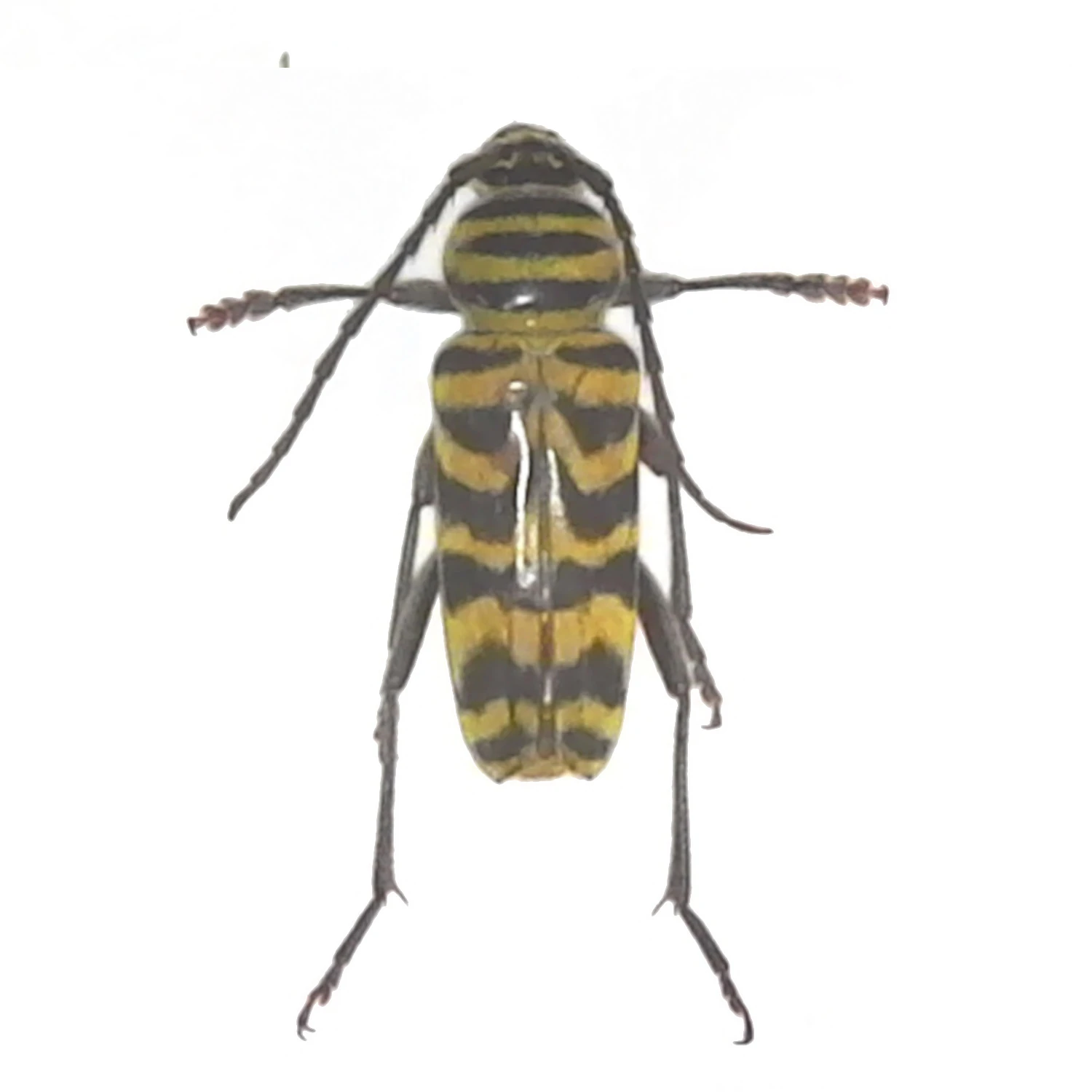
The Locust Borer, Megacyllene robiniae, is a striking longhorned beetle in the Cerambycidae family. Adults range from 11 to 28 mm in length, with a slender, cylindrical body covered in black pubescence. The elytra feature bold yellow markings that form three transverse bands, creating a distinctive pattern reminiscent of warning coloration. The metepisternum, the area between the second and third pairs of legs, is nearly fully covered in yellow hairs, a reliable field mark. Antennae are long and segmented, typical of cerambycids, while legs and head show subtle yellow accents. This mimicry of wasps or other aposematic insects may deter predators. Males and females differ slightly in size, with females often larger for egg-laying.
This species occurs wherever black locust (Robinia pseudoacacia) grows, its primary host. Originally limited to the northeastern United States, it has spread with ornamental plantings across much of the US and into parts of Canada. Adults favor open areas with flowering plants, particularly goldenrod (Solidago spp.), where they congregate from August to October. Larvae develop in stressed or felled trees, making it common in urban parks, orchards, and forests with introduced locusts.
Locust Borers are active diurnals, with adults aggregating on goldenrod flowers to feed on pollen and nectar, aiding pollination while seeking mates. They exhibit swarming behavior in late summer, buzzing loudly during flight. Larvae bore into black locust wood, creating galleries that weaken trees, especially young or damaged ones. This makes them a significant pest, often killing hosts outright. Unlike honey locust (Gleditsia triacanthos), which resists infestation, black locust suffers heavy damage from larval tunneling.
The one-year cycle begins in fall when females lay eggs in bark crevices of black locust. Newly hatched larvae overwinter under the bark in diapause. In spring, they resume feeding, tunneling inward to form 10 cm long, 6 mm wide galleries rich in frass. By late July or early August, mature larvae pupate within the wood. Adults emerge in late August to September, completing the cycle. This timing synchronizes with host availability and flowering resources.
This preserved specimen exemplifies cerambycid pest dynamics, ideal for forestry education or collections. Check it out on BugGuide! https://bugguide.net/node/view/436