
$5.95
 <—
1 in stock
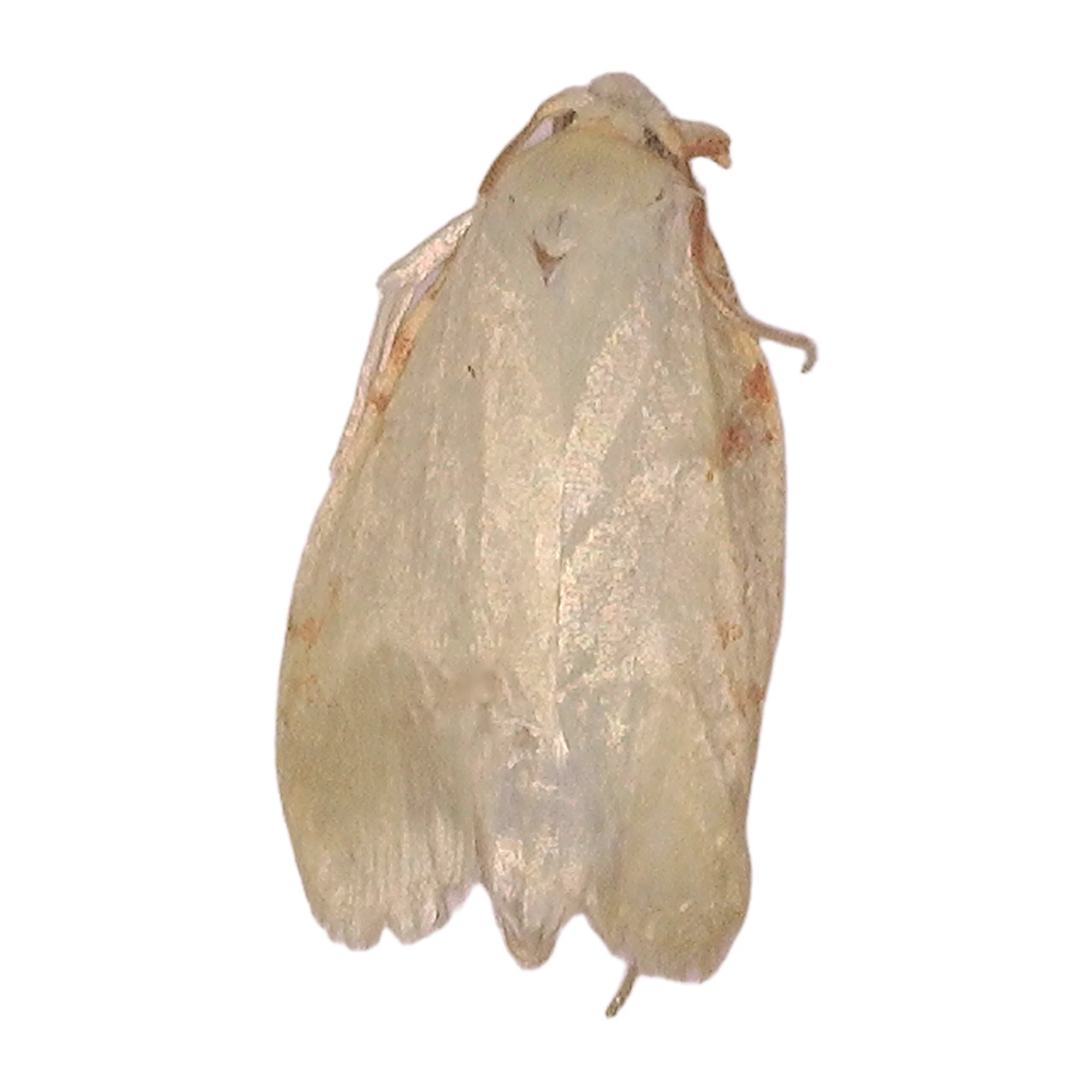
The Lesser Maple Spanworm Moth, Speranza pustularia, is a small, glossy white geometer moth with a wingspan of about 18 to 27 mm (3/4 to 1 1/16 inches). The forewing is white with sharp orange-yellow to brown markings. They are heaviest at the front edge of the wing, where each of the lines starts as a bold mark, and a line near the outer edge usually runs on across the hindwing. In some moths only the marks along the front edge show. The forewing tip is slightly hooked and the hindwing is somewhat pointed, which separates it from other white geometers. Our photo shows the top of a specimen with its wings folded, as the moth rests, so the markings show mainly along the front edge and the wing tips. Its scientific name is now Macaria pustularia, and it was also known as Itame pustularia.
This moth lives in deciduous and mixed woods, especially in wet or moist places, wherever its maple host trees grow. It ranges from Nova Scotia to Florida, and west to Mississippi, with records north to North Dakota and Saskatchewan. It is recorded in Missouri from May to July. It can be locally abundant, and numbers vary a great deal from year to year.
Adults fly at night and come readily to lights. They fly from May to July in the south and from June to August in the north.
Complete metamorphosis (egg, larva, pupa, adult). The female lays gray or pink eggs one at a time on the branches and trunk of the host tree, and the eggs spend the winter. The caterpillars hatch in May or early June. They are green, or sometimes wine red, with narrow white, cream, or yellowish stripes. They feed mainly on maple leaves, especially red maple, and also on sugar maple, silver maple, and mountain maple. Other trees such as birch and cherry have been reported but need to be confirmed. Pupation begins in late June or early July and lasts about 10 days. There is one generation a year.
Not known as a pest. The caterpillars eat maple leaves, and although the moth can be locally abundant, we found no record of significant damage.
Some of our specimens were collected at a light near Saint James, Missouri.
This preserved specimen educates on moth identification and the small white geometers of maple woodlands, suitable for displays or studies. Check it out on BugGuide! https://bugguide.net/node/view/551/bgimage