
$7.95
 <—
2 in stock
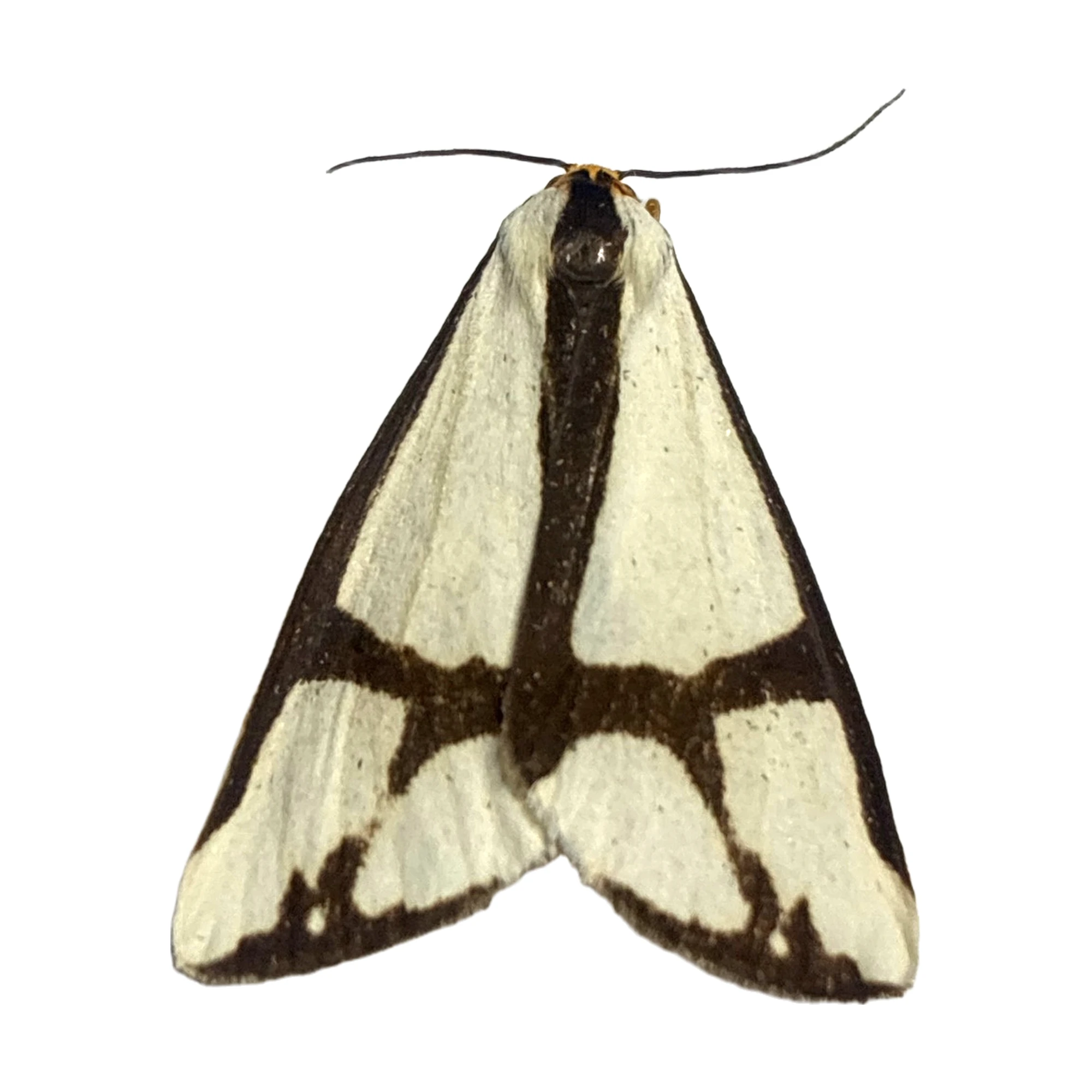
Leconte’s Haploa, Haploa lecontei, is a medium-sized tiger moth with a wingspan of about 36 to 50 mm (1 3/8 to 2 inches). The forewings are white to cream, outlined in black along the edges, and the moth holds them folded over its back like a roof, as in our photo. A bold black line usually runs from the outer edge just below the wing tip inward to the inner edge, where it swells into a dark blotch. Black lines or spurs often also cross the wing from the front edge. The hindwings are plain white, but they are hidden in our photo. Haploa patterns are very variable, from heavily marked moths to almost all white ones, so the species is hard to separate from its relatives. The Clymene Moth, Haploa clymene, has a bold cross pattern with a strong spur rising from the inner edge near the wing corner and usually no lines running down from the front edge. Its hindwings are bright orange-yellow with one or two dark spots, and it is a bit larger, with a wingspan up to 55 mm. The Confused Haploa, Haploa confusa, is smaller and browner, with a white spot in the dark blotch on the inner edge. Fully white Leconte’s Haploas cannot be told from the all-white forms of other Haploas.
Leconte’s Haploa lives in mixed woodlands, wooded river banks, forest edges, and grasslands, and it is often found around fruit trees. It ranges from Nova Scotia to Georgia and west to Manitoba and Arkansas, with records from Alberta as well, and it has been recorded in Wisconsin. Some of our specimens were collected in Douglas County, Wisconsin.
This moth flies in the daytime and also comes to lights at night. It is easily flushed from vegetation and makes short, weak flights, and it can be mistaken for a butterfly. The adults fly in a single flight from about late May to August, mostly from late June to mid July in the north. Like other tiger moths, it is distasteful to predators because of chemicals the caterpillars take in from their food plants, and the bold black and white pattern is a warning.
Complete metamorphosis (egg, larva, pupa, adult), with one generation a year. The caterpillars are yellow and black striped, with sparse hairs and small warts, and the stripes along the back and sides are made of bright yellow and white spots. They eat a wide range of woody and non-woody plants, including apple, blackberry, peach, willow, aspen, elm, maple, spearmint, and boneset (Eupatorium). The caterpillars spend the winter and finish growing in spring or early summer, and the adults fly in midsummer.
Not a significant pest today. More than a century ago it was listed as a pest of apple orchards, and it was nicknamed the Blue-spangled Peach Moth, but it is not noted as a problem now. The species is common and secure.
This preserved specimen educates on moth identification, the variable patterns of the Haploas, and tiger moth warning colors, suitable for displays or studies. Check it out on BugGuide! https://bugguide.net/node/view/23290/bgimage