
$9.95
 <–
9 in stock
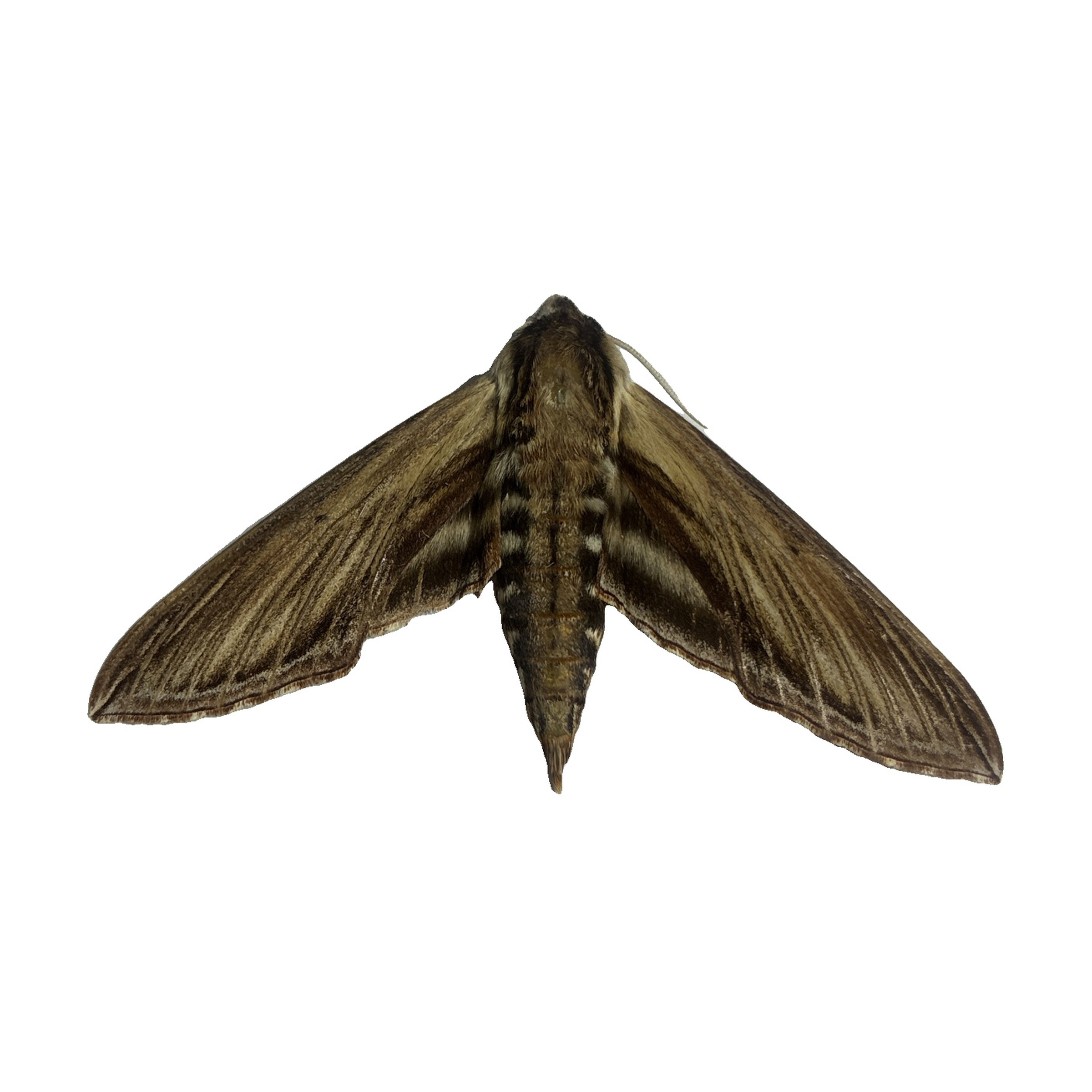
The Laurel Sphinx has a wingspan of 75-103 mm (7.5 to 10.3 cm). The forewings are warm yellow-brown to tan-brown and streaked, with a dark outer margin, a bold whitish line along the outer edge, and black shading along the inner margin. Some specimens show small pale spots on the forewings. The hindwings are tan with a black border, a black median band, and a black patch at the base. The abdomen has white spots along the sides. It can be told from the Wild Cherry Sphinx (Sphinx drupiferarum) and Clemens’ Sphinx (Sphinx luscitiosa), which have a black, velvety thorax. The Laurel Sphinx has no dark hood on the thorax and is warmer brown overall. This moth is also known as the Fawn Sphinx.
This species is found in eastern North America, from Newfoundland and Maine west to Manitoba and North Dakota, and south to northern Florida, Alabama, and Louisiana, becoming uncommon in the South. It lives in woodlands, forests, yards, and nurseries, and is often found near ornamental lilac. Our specimen was collected in Douglas County, Wisconsin.
Adults fly at night and come to lights. They take nectar from flowers such as bouncing bet and Japanese honeysuckle. In the North they fly from May through August.
There is one generation per year in the North and two in the South. The caterpillars feed on lilac, ash, privet, fringe tree, mountain laurel, poplar, and other plants. The caterpillar is blue-green or yellow-green with seven diagonal white lines edged in black, orange spiracles, and a blue horn at the rear. Fully grown caterpillars pupate in cells dug in loose soil, and the species overwinters as a pupa.
The caterpillars feed on the leaves of lilac, ash, privet, and other ornamental plants, but they rarely occur in numbers large enough to cause serious damage. Butterflies and Moths of North America reports that conservation is not usually required.
Hodges number 7809. Sphinx kalmiae J.E. Smith, 1797 belongs to the sphinx moth family Sphingidae, subfamily Sphinginae, tribe Sphingini. The species was long called the Laurel Sphinx because the name was thought to refer to the host plant genus Kalmia (laurel), but it actually honors the botanist Pehr Kalm, a student of Carl Linnaeus.
Check it out on BugGuide! https://bugguide.net/node/view/3733/bgimage