
$3.00

10 in stock
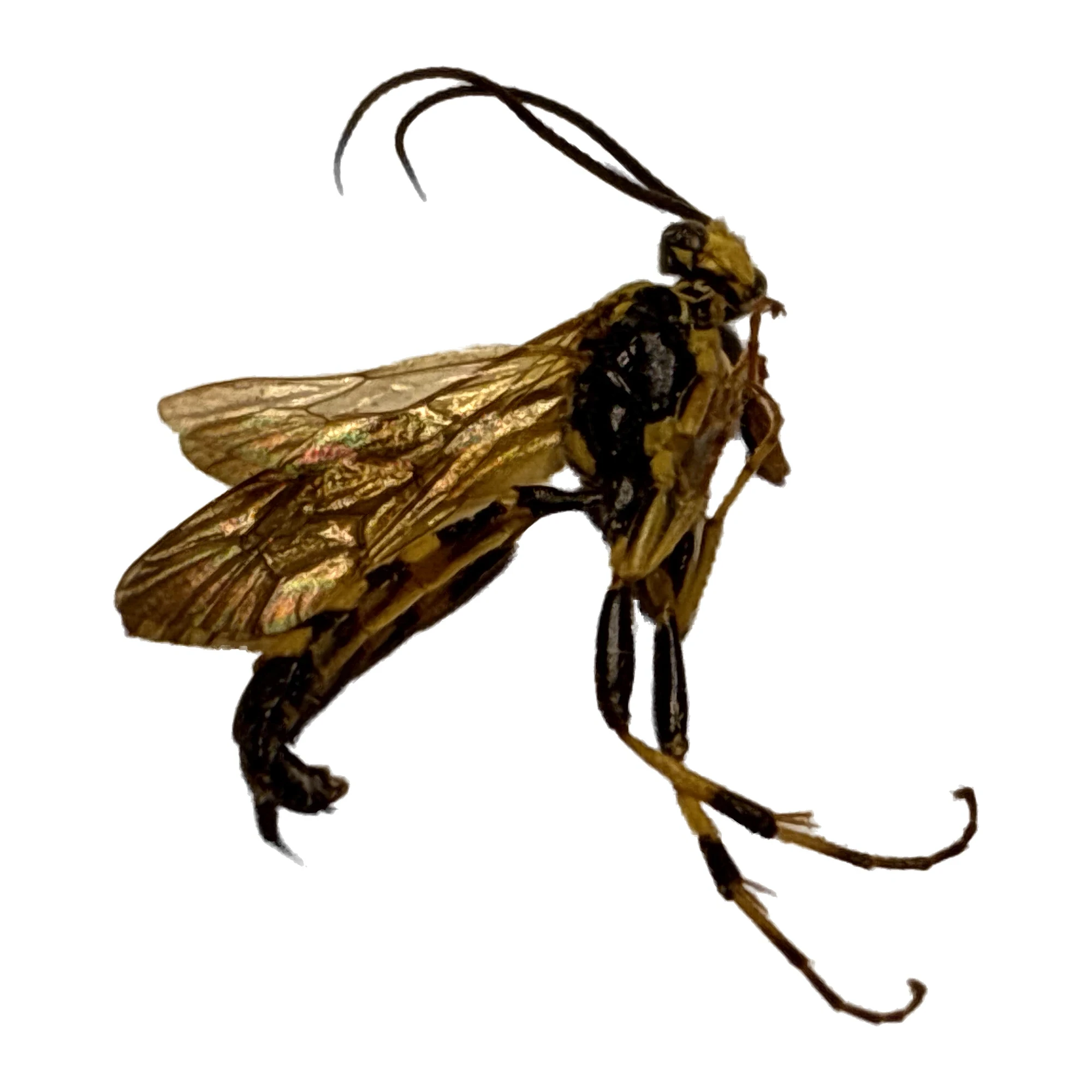
Wasps in the genus Ichneumon are medium-sized parasitoid wasps with long, thread-like antennae, a narrow waist and a stout, slightly flattened abdomen. Many North American species are boldly patterned in black and yellow or black and white. This male has a yellow face, a black thorax with yellow marks and a yellow scutellum (the small shield behind the wings), a black abdomen with yellow bands, yellow and black ringed legs, amber-tinted wings and long dark antennae. Males in this genus often have pale faces, while females of many species have a pale band partway along the antennae. Females carry only a short ovipositor that barely shows at the tip of the abdomen. This is a real, US-collected specimen from Douglas County, Wisconsin.
Ichneumon is a large genus found across the Northern Hemisphere. It is the type genus of the family Ichneumonidae and was named by Linnaeus in 1758. More than 100 species have been named from North America, and many look very much alike, so most specimens are identified only to genus. These wasps are found in woodlands, forest edges, meadows and gardens wherever their caterpillar hosts live.
Adults are active during the day and are often seen walking on leaves and tapping surfaces with their antennae as they search for hosts. Adults visit flowers for nectar. Males often gather on flowers and in sunny openings where they look for females. They are not aggressive toward people.
Females lay their eggs in caterpillars or pupae of moths and butterflies. The wasp larva develops inside the host, and the adult wasp later chews its way out of the host’s pupa. Mated females survive the winter as adults, sheltering under bark, in rotting logs or in leaf litter, and become active again in spring. Males do not overwinter. This male was collected on August 18, 2014.
Ichneumon wasps are beneficial natural enemies of moths and butterflies, including some caterpillars that damage crops, gardens and forests. They help keep those populations in check and do not damage plants, homes or stored food.
This preserved specimen educates on parasitoid wasps and their role in controlling caterpillars, suitable for displays or studies. Check it out on BugGuide! https://bugguide.net/node/view/337936
| Weight | 0.01 lbs |
|---|