
$3.00
 <---
46 in stock
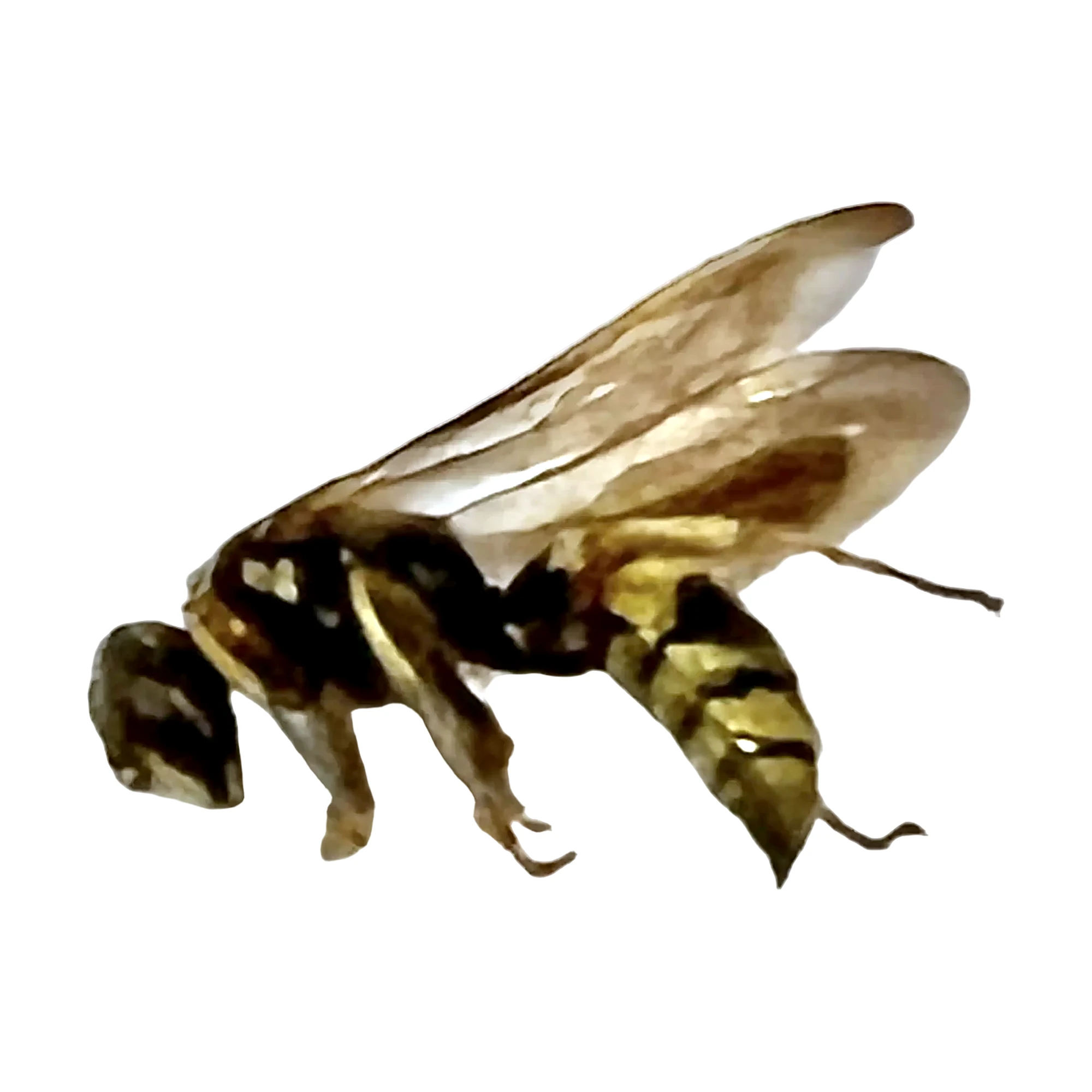
The Humped Bee Wolf, Philanthus gibbosus, is a small, sturdy bee hunting wasp in the family Crabronidae (some recent classifications place beewolves in their own family, Philanthidae). BugGuide gives its length as about 8 to 10 mm. It has a broad head and a shiny black body with yellow markings on the face and yellow bands across the abdomen. The abdomen is covered in large, deep pits (punctures), a useful feature for telling it apart from other beewolves. Females usually have more yellow on the face than males. The species name gibbosus means “humped.”
Philanthus gibbosus is the most common and widespread beewolf in North America and is found coast to coast. It lives along forest edges, in meadows and in yards, and females nest in the ground in many soil types, on flat ground or steep earthen banks. Adults are active all season in the south, while in Canada they fly from late June to mid September.
Females hunt small bees to feed their young, usually sweat bees (family Halictidae) such as Augochlora pura and Lasioglossum, along with bees like Sphecodes and Colletes and small Crossocerus wasps. Each bee is stung and paralyzed, then carried back to the nest. Adults of both sexes feed on flower nectar, and males spend much of the day on flowers such as goldenrod. At night females sleep inside their closed nests, while males shelter in small burrows, often in groups; one marked male returned to the same burrow every night for 49 days. This wasp is solitary, but it has an unusual habit: early in the season, newly emerged females often share their parental burrow for a few days before moving out to start their own nests nearby, and several wasps may use one entrance even though each female raises her own brood.
Like all wasps, the Humped Bee Wolf goes through complete metamorphosis (egg, larva, pupa, adult). A female digs a sloping tunnel with about 7 cells branching off the main burrow and stocks each cell with 8 to 16 paralyzed bees before laying an egg. The larva eats the bees, then spins a cocoon. Depending on location there are one or two generations each summer. Larvae of the last generation spend the winter in their cocoons, pupate in spring and emerge as adults in early summer.
Humped Bee Wolves are not pests. They mostly hunt small native bees rather than honey bees and are harmless to people: females rarely sting unless handled, and males cannot sting at all. Adults visiting flowers for nectar may help pollinate some plants. Their nests are attacked by the parasitic fly Senotainia trilineata, and Streptomyces bacteria associated with beewolves are studied by scientists as a source of new antibiotic compounds.
This preserved specimen educates on bee hunting wasps and their unusual shared nesting behavior, suitable for displays or studies. Check it out on BugGuide! https://bugguide.net/node/view/38345
| Weight | 0.01 lbs |
|---|
Only logged in customers who have purchased this product may leave a review.
Reviews
There are no reviews yet.