
$9.95
 <—
40 in stock
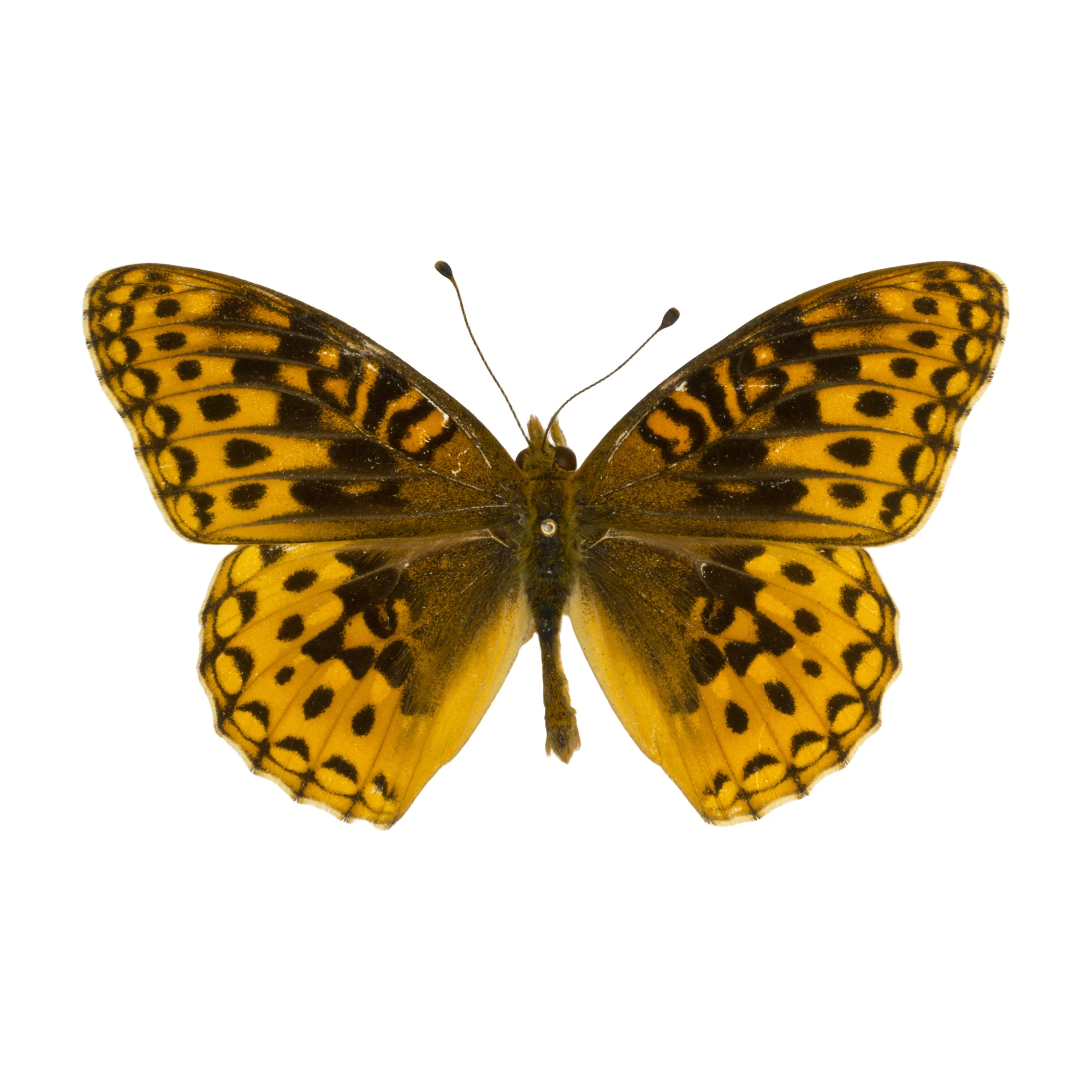
The Greater Fritillaries of the genus Speyeria are medium to large, broad-winged orange butterflies. Their wingspan runs from about 35 to 105 mm (1 3/8 to 4 1/8 inches), depending on the species, and most are over 2 inches. The upperside is orange with a pattern of black dashes and spots. The underside of the hindwing is the part you see when the butterfly rests with its wings closed, and it has round or oval spots that are usually silver. Our photo shows a spread museum specimen of the Northwestern Fritillary (Speyeria hesperis) from Arizona, upperside up. Only a few smaller butterflies, such as the lesser fritillaries of the genus Boloria, look similar, and they are much smaller.
We list this butterfly only to the genus. Many Speyeria species look alike, the silvering and the ground color vary within a species, and several species fly in Colorado in July. Our specimen is dried and unspread, so its upperside cannot be seen, and the species is not safe to name from a closed-wing view alone.
Speyeria butterflies live in the cool temperate and boreal regions of North America, wherever their host violets grow. BugGuide counts about 14 to 16 North American species. Deckers lies along the South Platte River in Douglas County, Colorado, at about 6,400 feet. The Butterflies and Moths of North America checklist for Douglas County lists nine Speyeria species with verified sightings: the Great Spangled Fritillary (Speyeria cybele), Aphrodite Fritillary (S. aphrodite), Regal Fritillary (S. idalia), Edwards’ Fritillary (S. edwardsii), Coronis Fritillary (S. coronis), Callippe Fritillary (S. callippe), Atlantis Fritillary (S. atlantis), Northwestern Fritillary (S. hesperis), and Mormon Fritillary (S. mormonia).
Adults feed mostly on nectar and visit flowers often, and they gather in numbers on composites, the daisy family. Occasionally they also visit moist, mineral-rich ground.
Complete metamorphosis (egg, larva, pupa, adult). There is one brood a year, with adults flying mostly from mid-June to mid-September. The caterpillars eat violets (Viola) and begin feeding in late winter or spring, when the plants start to grow, and they mature quickly.
Not known as a pest. The caterpillars eat only violets, and we found no record of damage to crops or gardens. The adults visit many wildflowers for nectar.
Our specimen was collected by JR Flyte near Deckers, Douglas County, Colorado.
This preserved specimen educates on greater fritillaries and how hard look-alike species are to separate, suitable for displays or studies. Check it out on BugGuide! https://bugguide.net/node/view/4220/bgimage
Photo: Robbie Hannawacker, CC0, via iNaturalist.