
$3.00
 <—
37 in stock
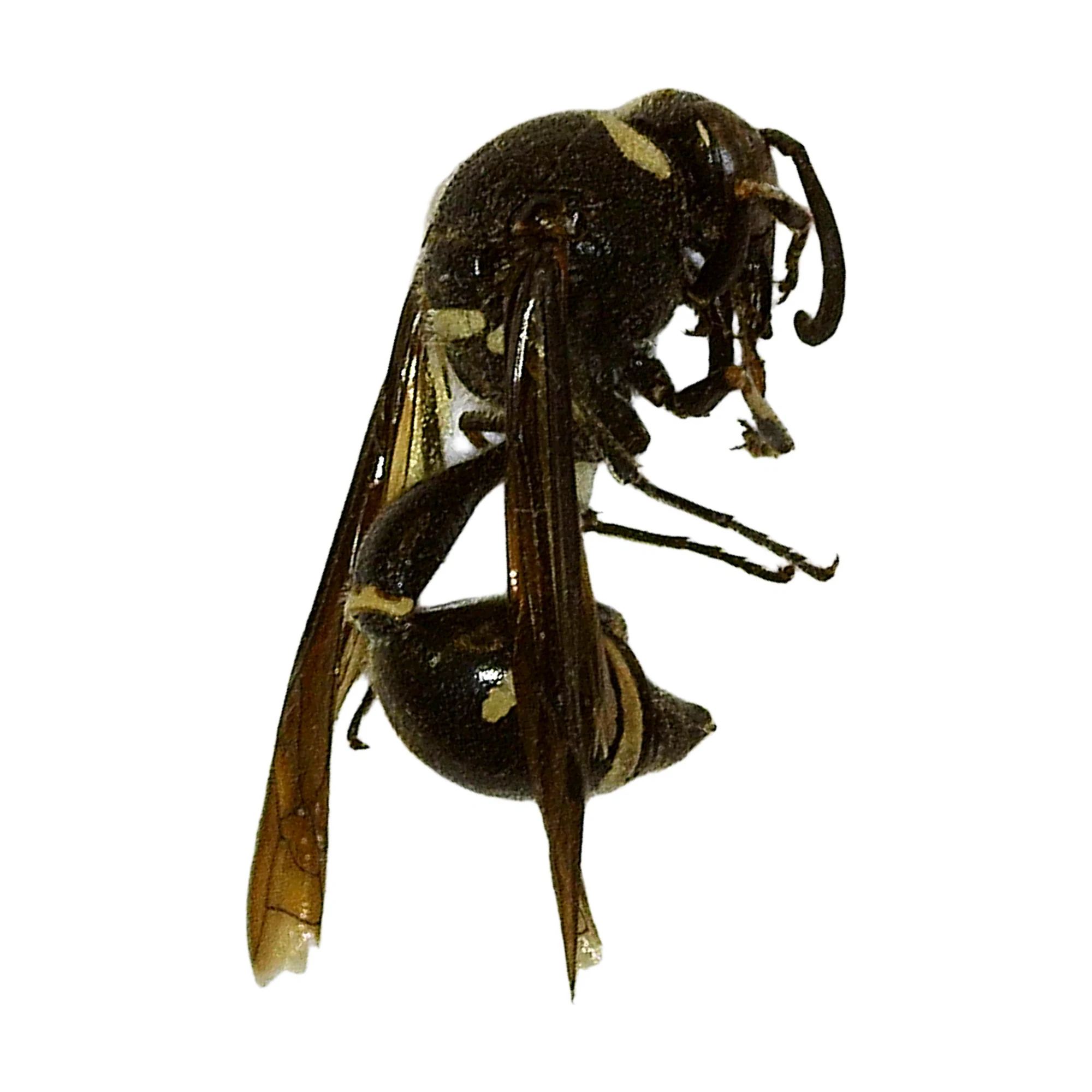
The Fraternal Potter Wasp, Eumenes fraternus, is a black solitary wasp with a few ivory or pale yellowish-white markings, in the subfamily Eumeninae of the family Vespidae. It is about 13 to 20 mm long, with a forewing about 8 to 10.5 mm in males and 10 to 12.5 mm in females. The first abdominal segments are drawn out into a slender stalk (petiole) that widens gradually, and the rest of the abdomen is a rounded black bulb with a pair of pale spots on the second segment and thin pale bands on the rear edges of several segments. Pale spots also mark the head and the front edge of the thorax. The wings are dark and evenly colored, which separates it from other black and pale potter wasps of the genus Eumenes, and its pale markings are ivory, not the reddish orange of the Southern Potter Wasp, Eumenes smithii. The wings are folded lengthwise at rest.
The Fraternal Potter Wasp is a wasp of eastern and central North America. It ranges from Ontario and New England south to Florida and west to Minnesota, Nebraska, Kansas, Oklahoma, and Texas, and BugGuide also shows records from the western Dakotas, Colorado, and New Mexico. It lives in woodland edges and shrubby fields, and its nests are also found on houses, sheds, window screens, and shrubs. Some of our specimens were collected near Hot Springs, South Dakota.
This is a solitary wasp, so each female builds and provisions her own nests and there is no colony. She makes a small jug-shaped pot of mud, usually fastened to a twig, and fills it with small caterpillars, which she stings to paralyze, as food for one larva. Moth caterpillars are the usual prey, and some beetle larvae and sawfly larvae have been reported. The adults visit flowers for nectar and are seen from late spring into fall. The wasp is not aggressive, and it only stings people if it is handled.
The Fraternal Potter Wasp undergoes complete metamorphosis (egg, larva, pupa, adult). The female hangs a single egg from a slender thread inside the pot, then fills the pot with caterpillars and seals it. The larva eats the stored prey and pupates inside the pot, and the adult chews its way out through the side of the nest. There are at least two generations a year, and the last generation spends the winter as a resting larva (prepupa) in its cell.
The Fraternal Potter Wasp is beneficial. It kills many caterpillars, including pests of crops, gardens, and ornamental plants, and that benefit far outweighs the untidy look of a few mud pots on a house or shed. The pots hold only young wasps, so there is no danger of stings from them, and a nest that has to be removed can simply be scraped off.
This preserved specimen educates on solitary wasps and their jug-shaped mud nests, suitable for displays or studies. Check it out on BugGuide! https://www.bugguide.net/node/view/32193