
$3.00
 <—
19 in stock
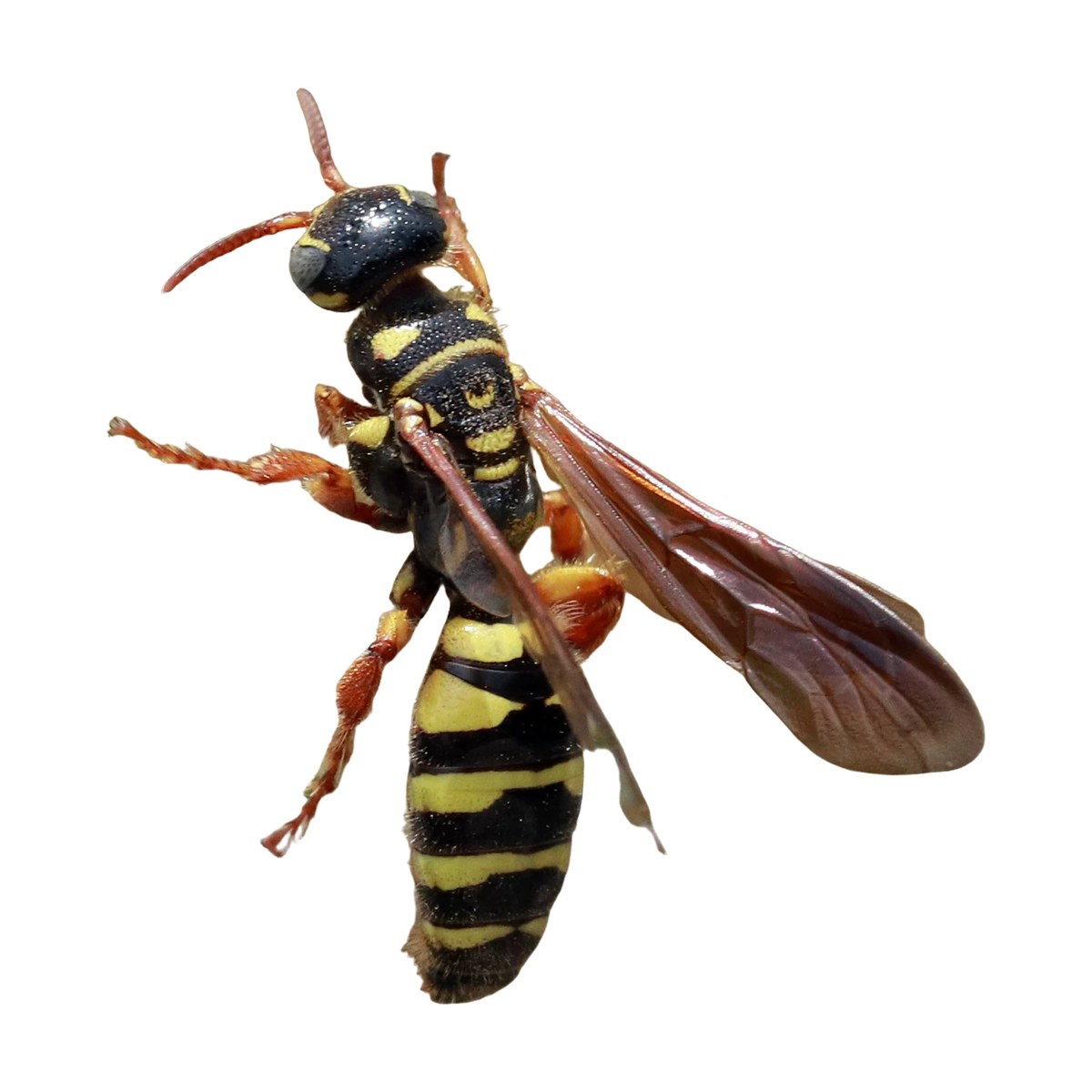
The Five-banded Thynnid Wasp, Myzinum quinquecinctum, is a black and yellow wasp about 16 to 22 mm long. The sexes look very different, and this listing is for females. Females are large, robust, and heavy-looking, with thick hind thighs used for digging, short antennae, and five yellow bands across the abdomen. Their wings are an even orange-brown, their legs are orange, and the antennae have a uniformly orange to red flagellum with yellow often showing on the base segment. Together with a yellow-marked rear of the thorax (propodeum), these traits separate it from related Myzinum species, whose females may have black antennae, black legs, or two-toned wings. Males, by contrast, are slender, with long straight black antennae, brownish wings, and an upcurved false stinger at the tip of the abdomen.
This species is the most widespread member of its genus, ranging across the eastern half of North America, from southern Quebec to Florida and west to the Dakotas, Wyoming, and Arizona, and south through Mexico to Costa Rica. It lives in open, sunny places such as meadows, prairies, old fields, roadsides, lawns, and gardens, where the soil is suitable for digging and flowers are nearby. Some of our specimens were collected near Hot Springs, South Dakota.
Adults are seen from early summer into fall, with July through September the prime months in the central states. Both sexes drink nectar, mostly from flowers in the daisy family (Asteraceae) and the carrot family (Apiaceae). The robust females are usually seen alone, walking over the ground and digging into the soil in search of their prey, while the slender males often gather in groups on a single plant, where they rest in the heat of the afternoon and sleep at night. Males cannot sting, and the females sting only the grubs they hunt, so these wasps are not a threat to people.
The Five-banded Thynnid Wasp undergoes complete metamorphosis (egg, larva, pupa, adult). The female finds a scarab beetle grub (a white grub) in the soil, such as a May beetle (June bug) or Japanese beetle grub, and lays one egg on it. After hatching, the wasp larva first feeds on the grub’s nonessential tissues and keeps it alive, then eats its vital organs and kills it as it nears pupation. The wasp pupates in the soil, spends the winter there, and emerges as an adult in early summer. There is one generation per year.
The Five-banded Thynnid Wasp is beneficial. Its larvae are parasitoids of scarab grubs, including Japanese beetle and May beetle grubs that damage lawns and crop roots, and wasps of this genus are used in turfgrass pest management. Adults also visit flowers for nectar. It is not a pest.
This preserved specimen educates on parasitoid wasps and the striking differences between male and female thynnid wasps, suitable for displays or studies. Check it out on BugGuide! https://bugguide.net/node/view/109316
| Weight | 0.01 lbs |
|---|
Only logged in customers who have purchased this product may leave a review.
Reviews
There are no reviews yet.