
$7.95
 <–
1 in stock
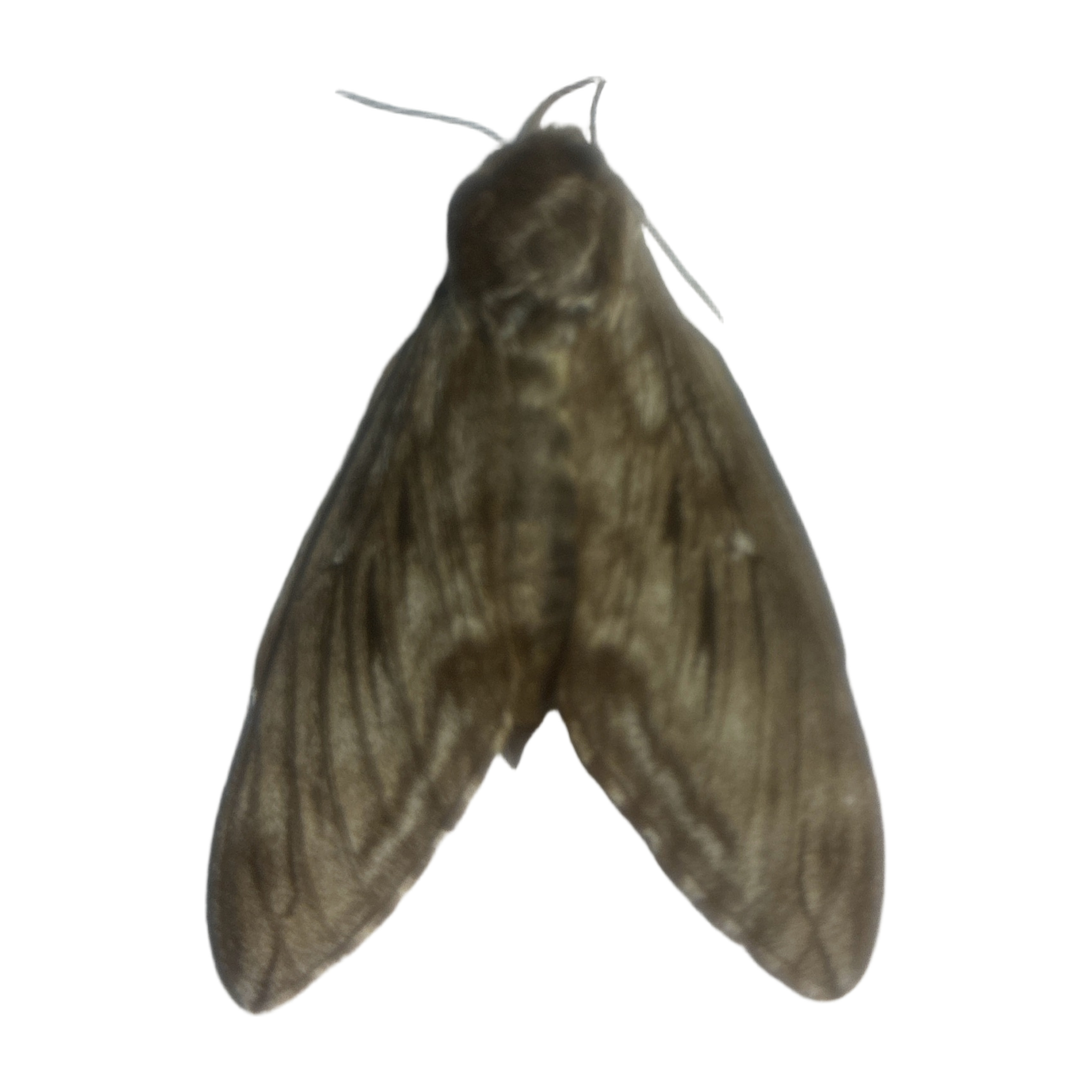
The Elm Sphinx has a wingspan of 82-115 mm (8.2 to 11.5 cm). It is a large, mottled brown to olive-brown sphinx moth. The forewings carry irregular dark streaks running lengthwise between the veins in the outer part of the wing, a whitish postmedian line, and a whitish tint along the costa (leading edge), especially near the base. The hindwings are brown with a darker brown border and incomplete lines. The thorax is very fuzzy, paler in the center with dark brown to blackish edges. It resembles the Waved Sphinx (Ceratomia undulosa), but lacks that species’ strong wavy cross bands. The caterpillar’s four spiny thoracic horns give this moth its other name, the Four-horned Sphinx.
This species ranges across eastern and central North America, from Nova Scotia west to Saskatchewan, North Dakota, and Colorado, and south to central Florida, the Gulf Coast, Texas, and New Mexico. It lives in deciduous woodlands, woodland edges, stream sides, and other forested and open habitats where elm, birch, and basswood grow. Our specimen was collected in Douglas County, Wisconsin.
Adults fly at night and are readily attracted to lights, with peak activity around midnight. Adults probably do not feed. When disturbed, the large caterpillars thrash and click their mandibles, and they can bite.
There is one generation per year in the North, with adults flying mainly in June and July, and two generations in the South, from March to October. Females lay pale green eggs on host plant leaves. The caterpillars feed on elm, birch, basswood, cherry, and black locust. They are green or brown, with four spiny horns on the thorax, a horn at the rear, white-tipped granules over the body, and a ridge of scalelike plates down the back. Mature larvae pupate and overwinter in burrows underground.
The caterpillars feed on the leaves of elm and other shade trees, but they are seldom numerous enough to cause noticeable damage. The species is considered globally secure.
Hodges number 7786. Ceratomia amyntor (Geyer, 1835) belongs to the sphinx moth family Sphingidae, subfamily Sphinginae, tribe Sphingini. Older names include Ceratomia quadricornis Harris, 1839 and Ceratomia ulmi Boisduval.
Check it out on BugGuide! https://bugguide.net/node/view/3741/bgimage