
$12.95

1 in stock
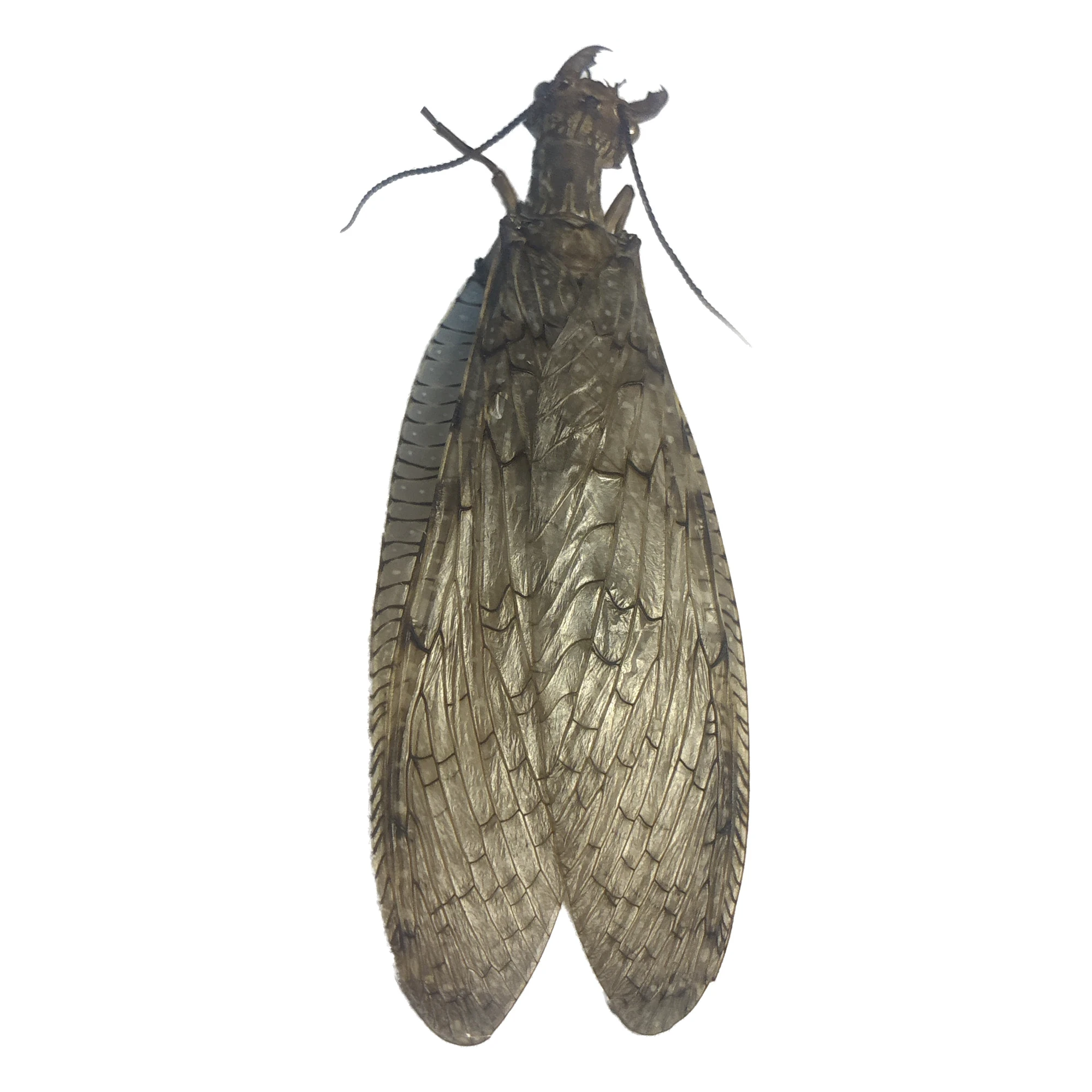
The Eastern Dobsonfly (Corydalus cornutus) is one of the largest aquatic insects in North America, with a body about 48 to 60 mm (about 2 inches) long and a length of 100 to 140 mm (4 to 5.5 inches) to the wing tips. Adults are soft-bodied and drab gray-brown, with pale markings on the head and long, thread-like antennae. The large wings have dark, conspicuous veins and many small pale spots, and they are folded flat along the body at rest. The sexes are easy to tell apart by the jaws. The female has short, powerful mandibles that can give a painful, even skin-breaking pinch. The male has very long, sickle-shaped mandibles, up to about 40 mm (1.6 inches) long, which he uses in contests with rival males and to hold the female during mating. Despite their fierce look, the male’s long jaws cannot give a painful bite. This listing is for a female, with the short, strong jaws. This is a real, US-collected specimen from Douglas County, Wisconsin.
The Eastern Dobsonfly lives in eastern North America, from southern Canada south to Florida and west to Texas, and it is the only Corydalus species found in the eastern part of the continent. The larvae live in clean, fast-flowing, rocky streams and rivers, where they hide under stones. Adults stay near the water, resting in thick vegetation along streams, and are most often seen from late spring through summer.
Adult dobsonflies are active at night and are strongly attracted to lights, which is where most people see them. They are slow, fluttering fliers. Adults live only a few days, about three days for males and eight to ten days for females, and they generally do not feed. When disturbed, both sexes raise the head and spread the jaws in a defensive display. Dobsonflies are not venomous.
Dobsonflies go through complete metamorphosis. Females lay white, coin-sized masses of 100 to 1,000 eggs on rocks or vegetation hanging over the water. The newly hatched larvae drop or crawl into the stream. The larvae, called hellgrammites, are fierce predators of other aquatic insects and small animals, and they grow up to about 70 mm (2.75 inches) long. They molt 10 to 12 times over one to three years. When fully grown, a hellgrammite crawls out of the water and builds a pupal cell under a rock or log on the bank, and the adult emerges in spring or summer.
Dobsonflies are beneficial insects. Hellgrammites are prized as fishing bait, especially for smallmouth bass, and their collection for sale is regulated in some states. Because hellgrammites need clean, well-oxygenated water, their presence is used as a sign of good stream health in water quality studies. Adults do not damage crops, gardens, homes or stored food.
This preserved female specimen educates on aquatic insects and stream ecology, suitable for displays or studies. Check it out on BugGuide! https://bugguide.net/node/view/4873
| Weight | 0.01 lbs |
|---|