
$9.95
 <–
1 in stock
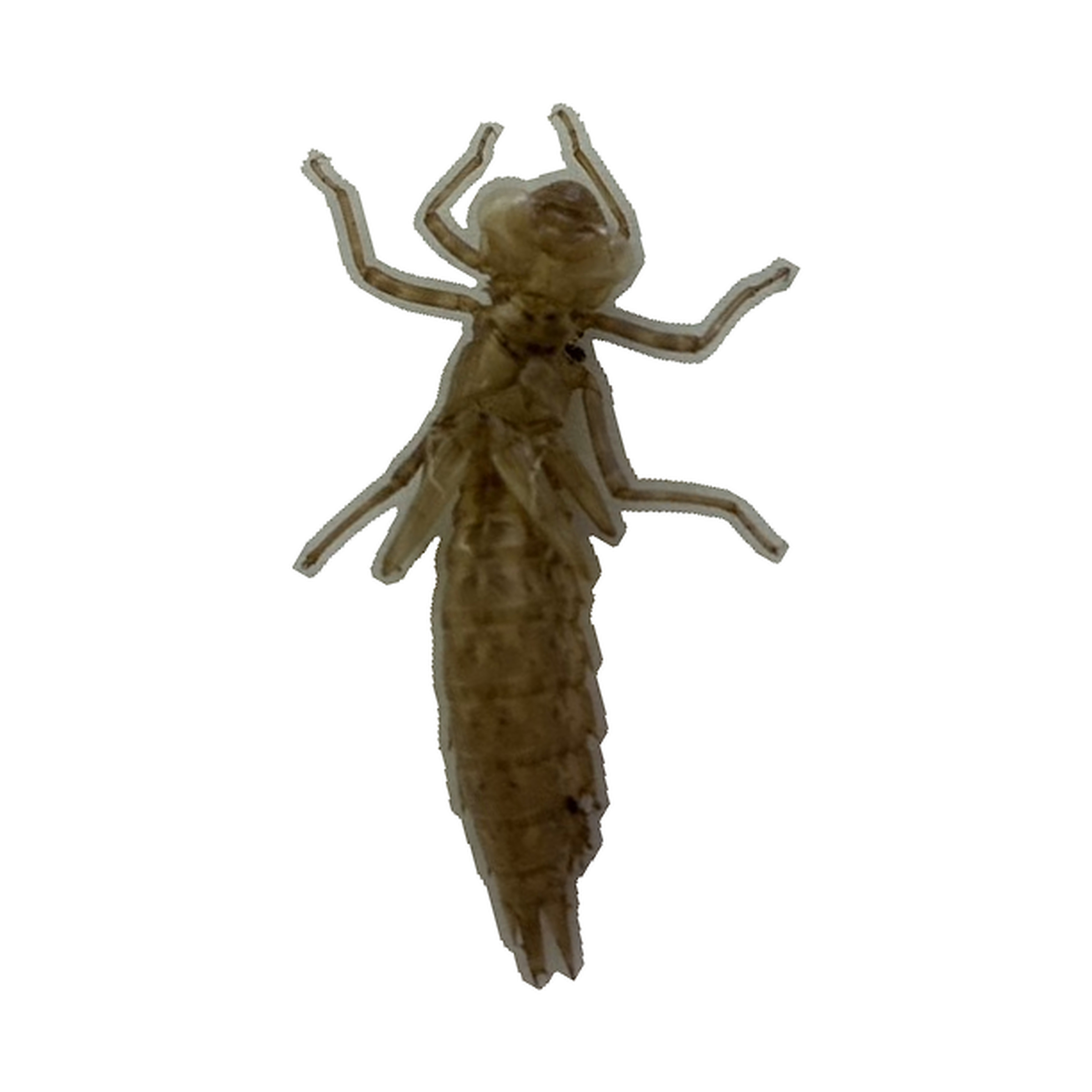
This listing is a dragonfly nymph exuvia, the empty skin left behind when the adult emerged. It is pale tan, with a stout body, visible wing pads, an opening down the back of the thorax where the adult crawled out, and spines at the tip of the abdomen. The family is not determined. The stout shape and the spines at the abdomen tip are consistent with a skimmer (Libellulidae) or an emerald (Corduliidae). Final-instar exuviae in those families are typically about 13 to 32 mm long; this specimen was not measured. It is a dragonfly (Anisoptera) exuvia, not a damselfly.
Dragonfly nymphs, also called naiads, live in ponds, lakes, marshes, and slow streams, clinging to plants, debris, or the bottom until they are ready to emerge. Adults of many species then fly in nearby fields and wetlands. Dragonflies occur worldwide, with many species in the eastern and central United States, including Wisconsin. Some of our specimens were collected in Douglas County, Wisconsin.
Naiads are aquatic ambush predators. They catch mosquito larvae and other small invertebrates with a hinged lower lip (the labium) that shoots forward from under the head. They also draw water in and out of the end of the abdomen to breathe and, when needed, to dart forward. When a nymph is ready for its last molt, it climbs out of the water onto a stem, a bank, or another support. The skin splits down the back, and the adult crawls out, leaving this hollow shell behind.
Dragonflies have incomplete metamorphosis, with egg, aquatic naiad, and adult stages, and no pupa. The naiad molts many times as it grows. This exuvia is the last naiad skin, shed at emergence. The newly emerged adult is soft and pale at first, then hardens and takes on adult color over the following days.
Dragonfly naiads and adults are beneficial predators of mosquitoes and other small insects. They are not pests and have no significant economic impact.
This specimen belongs to the order Odonata, suborder Anisoptera (dragonflies). The family has not been determined.
This preserved specimen educates on dragonfly life cycles and aquatic insects, suitable for displays or studies.
Check it out on BugGuide! https://bugguide.net/node/view/95208/bgimage