
$6.95

 <–
1 in stock
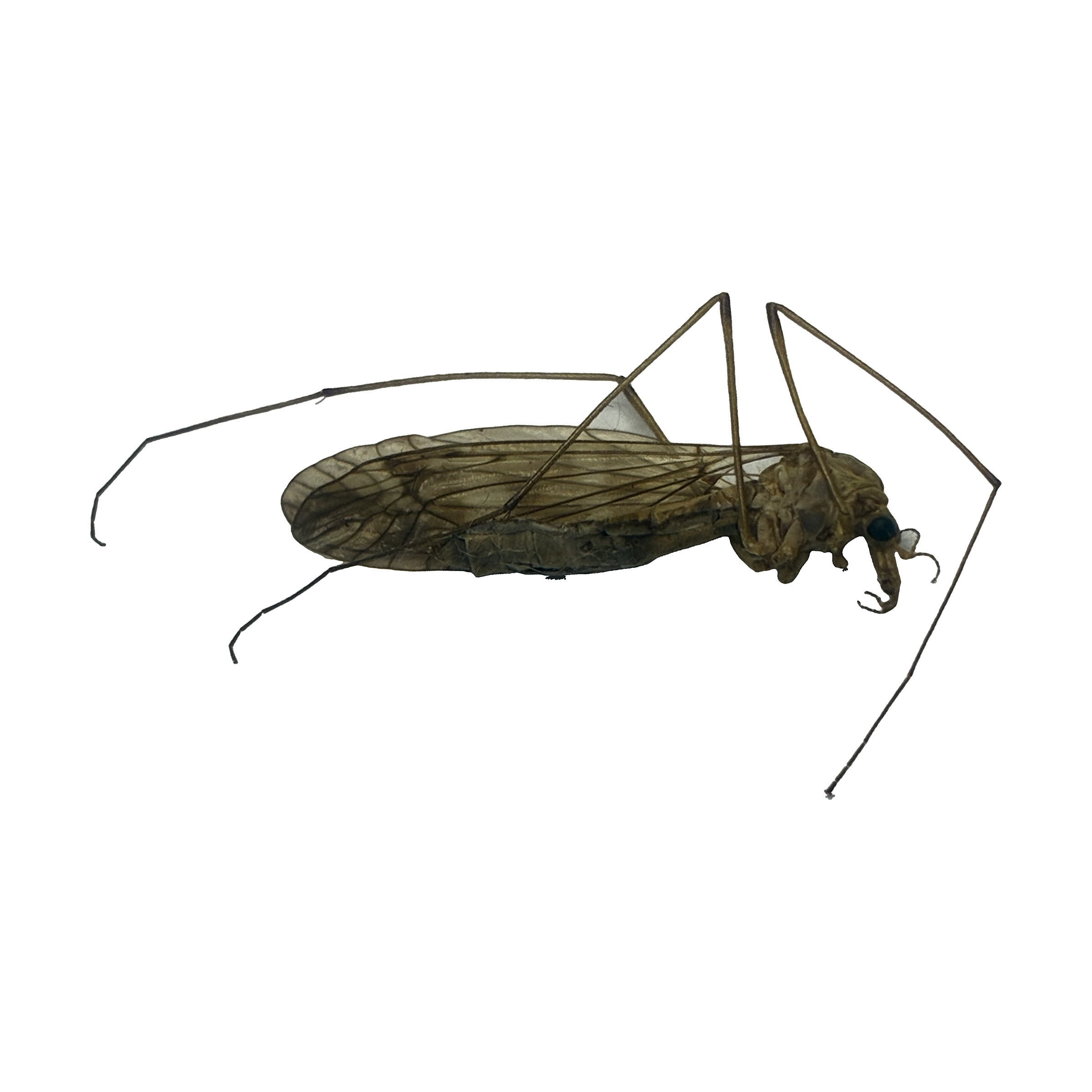
The Crane Fly belongs to the family Tipulidae, the large crane flies. Adults have a slender body and exceptionally long, fragile legs, which is why they are sometimes mistaken for giant mosquitoes or even spiders in flight. The wings are long, clear to tan, and strongly veined, and they are held along or slightly out from the body at rest. The antennae are usually 13-segmented. A useful family character is the maxillary palpus: the fourth, terminal segment is longer than the first three segments combined, which helps separate Tipulidae from the related Limoniidae, or limoniid crane flies. Color ranges from pale tan or yellowish brown to gray or darker brown. This listing’s specimens are about 13 to 18 mm long, not counting the legs. Adults in the family are commonly about 15 to 25 mm long, and a few are larger.
Tipulidae is found worldwide and throughout North America. The larvae live in moist soil, leaf litter, decaying wood, or shallow fresh water. Adults are often found in forests, meadows, gardens, and other damp places near the larval habitat. This specimen was collected in Douglas County, Wisconsin.
Adults are weak, slow fliers, and the long legs often dangle in flight. Many species are most active at dusk or after dark and come to lights. Some adults sip nectar or other sugary liquids, and a few visit flowers. Many species probably do not feed as adults and live only long enough to mate and lay eggs. Adults do not bite people and are not mosquitoes. The larvae, sometimes called leatherjackets, feed mainly on decaying plant matter, roots, algae, or other material in damp soil or water.
Like other true flies, crane flies have complete metamorphosis: egg, larva, pupa, and adult. The female lays eggs in moist soil or water. The larva usually passes through four instars and may take months to a year or more to mature, depending on the species and the climate. In temperate areas there is often one generation a year, and the insect commonly overwinters as a larva. Pupation takes place in soil or debris. The adult is short-lived, often only days to a few weeks.
Most crane flies are not pests. The larvae help break down decaying plant material, and the insects are food for birds, fish, and other animals. A few species, including some that have become established in parts of North America, have larvae that feed on grass roots and can damage lawns, golf courses, or pastures. Adults are harmless to people and do not bite or transmit disease. The preserved specimens are used in teaching and collections, and they are a good example of the long-legged crane fly form.
Tipulidae Latreille, 1802 belongs to the order Diptera (true flies). The family is commonly called the large crane flies, for the long legs. In North America the family includes more than 560 species in 12 genera, about 80 percent of them in the genus Tipula; worldwide there are about 4,400 species in about 30 genera. Related families such as Limoniidae are also called crane flies, but they are listed separately. A sure species identification often requires a closer look at the wings, palps, or, in males, the genitalia. This specimen is therefore listed at the family level as Tipulidae.
This preserved specimen educates on crane flies and the family Tipulidae, suitable for displays or studies.
Check it out on BugGuide! https://bugguide.net/node/view/183/bgimage
| Weight | 0.01 lbs |
|---|
Only logged in customers who have purchased this product may leave a review.
Reviews
There are no reviews yet.