
$3.00
 <---
10 in stock
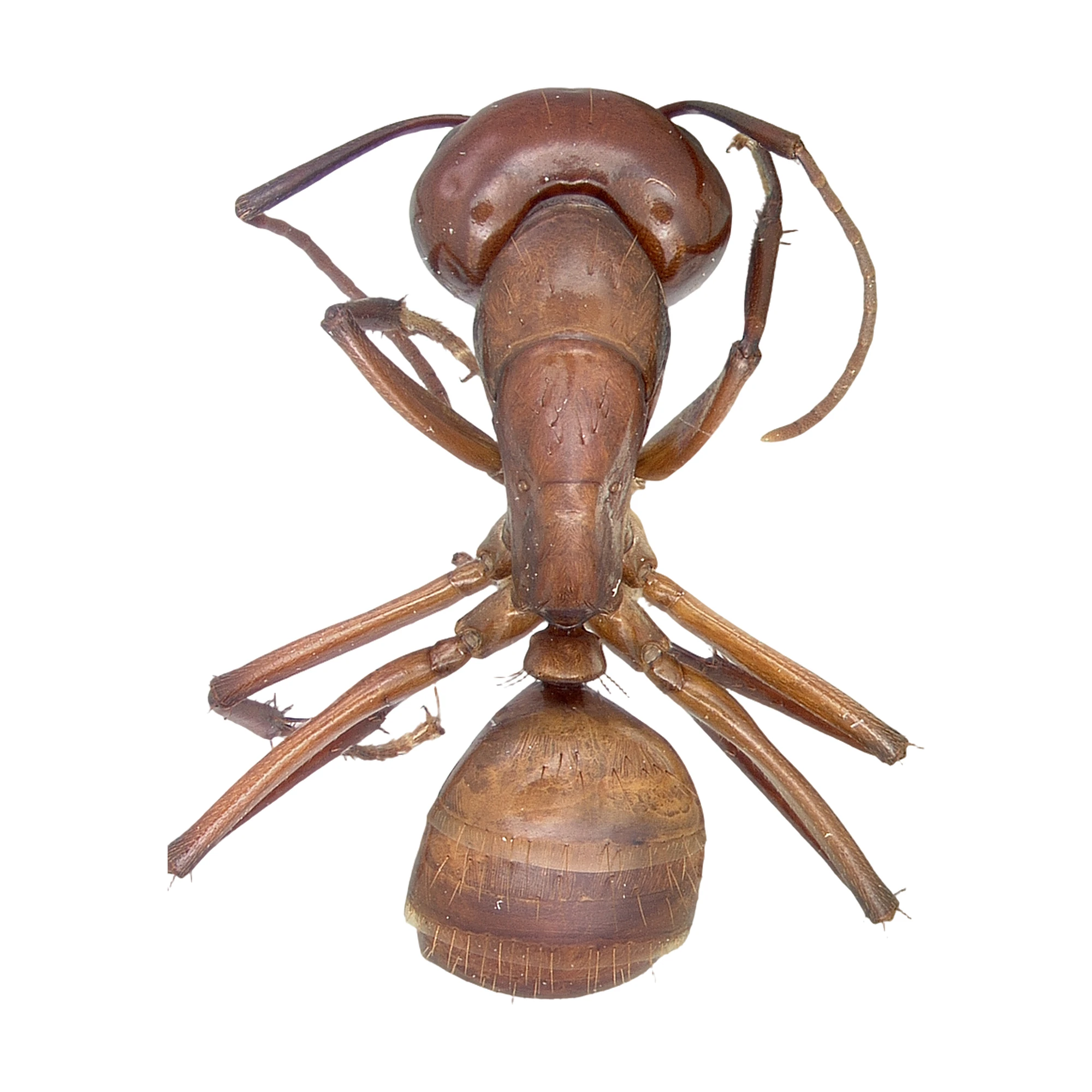
The Chestnut Carpenter Ant, Camponotus castaneus, is a medium to large carpenter ant in the subfamily Formicinae of the family Formicidae. Its species name means “chestnut-colored,” and it is easy to recognize by its uniform reddish orange to golden honey color, with surfaces that are often partly glossy. Workers vary in size, from about 7 to 8.5 mm in smaller individuals to about 11 to 12 mm in the largest, which have a broader, squarer head. Like other carpenter ants, it has elbowed antennae, a single node at the waist and an evenly arched thorax with no spines. Its closest relative, Camponotus americanus, looks similar but has a darker head.
Chestnut Carpenter Ants live in the eastern United States, from New York south to Florida and west to Oklahoma and Texas, and they are widespread across the Southeast, including northwest Georgia, where these specimens were collected. They are habitat generalists, found in oak and hickory woods, mixed pine and hardwood forests, longleaf pine, bottomland forests, flatwoods, prairies, sandy scrub, and disturbed places such as yards, orchards, campgrounds and fields. Colonies nest in rotting logs and stumps, in soil under rocks and other objects, in exposed soil, or at the bases of trees.
This species is timid and mostly active at night. Colonies are moderately populous. Foragers are regularly found on tree trunks, and the ants feed as predators and scavengers. Like other ants in the subfamily Formicinae, they do not sting, but they can bite and spray formic acid in defense. Winged ants are often drawn to lights at night during their mating flights.
Like all ants, the Chestnut Carpenter Ant goes through complete metamorphosis (egg, larva, pupa, adult). Winged queens and males have been collected from early May through mid-June and again in September. As in other carpenter ants, a mated queen sheds her wings and starts a new colony on her own, raising the first small brood herself before the workers take over foraging and brood care.
The Chestnut Carpenter Ant is not considered a serious pest. It usually nests in rotting wood or soil rather than sound timber, and it mostly enters buildings only while foraging, so it is at most an occasional nuisance. In the wild it is beneficial, as a predator and scavenger and by helping turn over the soil.
This preserved specimen educates on carpenter ants of the eastern United States and their role as forest predators and recyclers, suitable for displays or studies. Check it out on BugGuide! https://bugguide.net/node/view/109034
| Weight | 0.01 lbs |
|---|
Only logged in customers who have purchased this product may leave a review.
Reviews
There are no reviews yet.