
$8.95
 <–
3 in stock
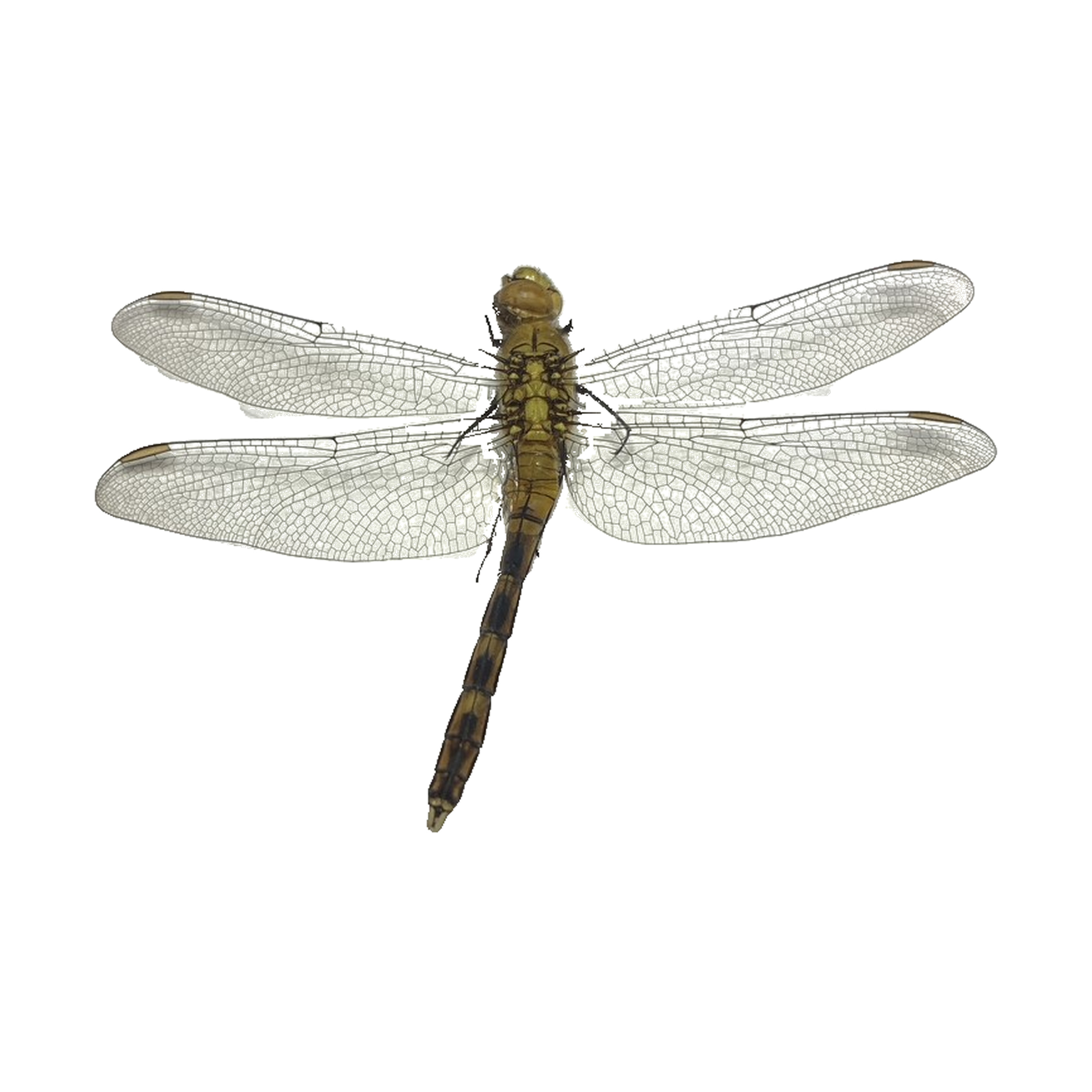
The Cherry-faced Meadowhawk is a small skimmer, about 31 to 36 mm (1.2 to 1.4 inches) long. Mature males have a red face and a red abdomen with black triangles along the sides, black legs, and usually clear wings, sometimes with a small amber patch at the wing bases. Females and young adults are yellow-tan with the same black side markings. The photo shows a female. Females of this species have a small egg-laying plate that lies flat against the underside of segment 8, which separates them from the closely related Ruby Meadowhawk, whose plate sticks out as a pointed scoop.
Cherry-faced Meadowhawks live at marshy edges of ponds, lakes, and slow streams, including shallow or temporary waters, and nearby meadows. The species occurs across the northern and central United States and most of Canada, including Wisconsin. Our specimen was collected in Douglas County, Wisconsin.
Adults often perch on grasses and low plants near the water or in open meadows, and they hunt small flying insects such as mosquitoes and flies. Males hold small territories. Mating can be lengthy. Females lay eggs alone or in tandem, sometimes by dropping them onto dried pond basins or vegetation near the shoreline.
This species has incomplete metamorphosis, with egg, aquatic naiad, and adult stages. The naiads are aquatic predators that live among debris on the bottom. Adults fly from early summer into fall, typically from June into September.
Cherry-faced Meadowhawks are beneficial predators of mosquitoes and other small insects. They are not pests and have no significant economic impact.
Sympetrum internum Montgomery, 1943 belongs to the skimmer family Libellulidae, genus Sympetrum (meadowhawks). It is closely related to the Ruby Meadowhawk, Sympetrum rubicundulum, and the two are best separated by the shape of the female egg-laying plate or the male clasping structures.
This preserved specimen educates on dragonfly biology and wetland insects, suitable for displays or studies.
Check it out on BugGuide! https://bugguide.net/node/view/9029/bgimage
| Weight | 0.01 lbs |
|---|
Only logged in customers who have purchased this product may leave a review.
Reviews
There are no reviews yet.