
$3.00
 <---
103 in stock
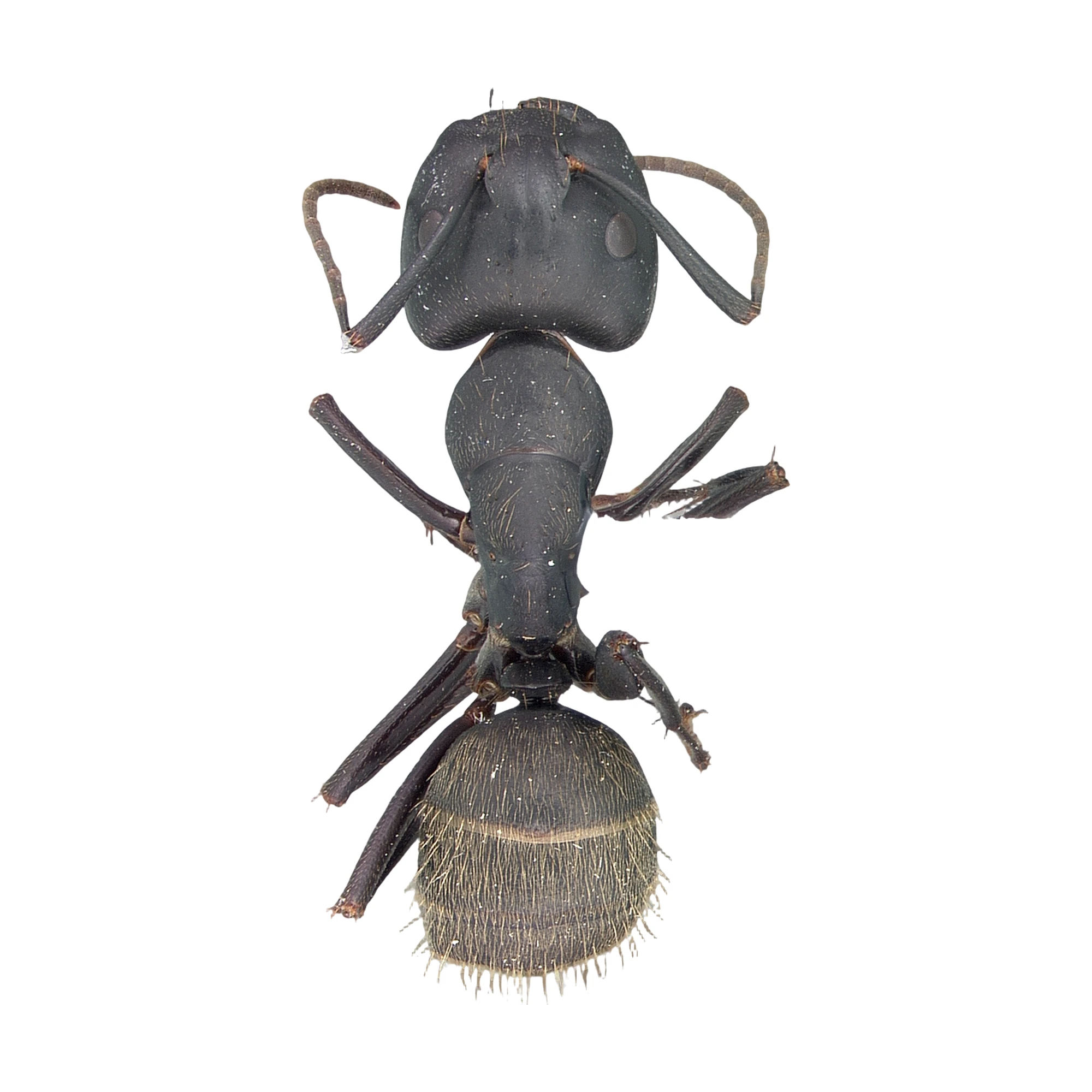
The Black Carpenter Ant, Camponotus pennsylvanicus, is one of the largest and most common ants in North America and belongs to the subfamily Formicinae of the family Formicidae. It is dull black on the head and body, with whitish or yellowish hairs on the abdomen. Workers come in a wide range of sizes, from about 6 or 7 mm up to 12 to 14 mm, and the larger ones have a noticeably big head and strong jaws. Queens are bigger still, about 15 to 18 mm. Like all ants, it has elbowed antennae, and it has a single node at the waist and an evenly rounded, arched thorax with no spines.
Black Carpenter Ants are found across eastern and central North America, from southern Canada to the Gulf states and west onto the Great Plains. They live almost everywhere east of the Rocky Mountains, and BugGuide notes they are probably becoming more widespread in the West thanks to tree planting on the Plains. They are well established in western South Dakota, including the Black Hills, where these specimens were collected. They live in broadleaf and mixed forests, woodlands, parks, cemeteries and wooded yards, nesting in dead, usually already rotting wood in logs, stumps, tree cavities and dead limbs.
Carpenter ants do not eat wood. They chew out galleries along the grain of soft, moist or decayed wood to make room for the nest, pushing out a coarse sawdust (frass) mixed with bits of dead insects. A large colony has a parent nest in moist wood, where the queen, eggs and young larvae live, and often one or more satellite nests in drier spots that hold workers, older larvae and pupae. Workers forage mostly at night, often along scent trails and sometimes up to 100 yards from the nest. They feed on sweets and protein: honeydew from aphids and other sap-feeding insects, plant nectar, and living or dead insects. They cannot sting, but larger workers can give a sharp bite and spray formic acid into it.
Like all ants, the Black Carpenter Ant goes through complete metamorphosis (egg, larva, pupa, adult). Winged queens and males are reared in late summer, spend the winter in the nest, and usually fly out to mate on the first warm, humid days of spring. A mated queen sheds her wings, seals herself in a small cavity, often under bark or in a rotting log, and raises her first small brood of workers on her own body reserves. After that the workers do all the foraging and brood care. Colonies grow slowly, taking several years before they produce winged ants, and mature colonies can live for 15 years or more. Workers are inactive through the winter.
In the wild, Black Carpenter Ants help break down dead wood and return it to the soil. They are also a common structural pest of homes. Colonies that move into damp wood in homes, often around leaks, windows, roofs or decks, can weaken it over time, and foragers come indoors looking for sweets and other food. Extension specialists say a carpenter ant problem is usually a moisture problem, so fixing leaks and removing damp, rotting wood near a building helps prevent infestations.
This preserved specimen educates on carpenter ants, their wood nesting habits and their role as both recyclers and household pests, suitable for displays or studies. Check it out on BugGuide! https://bugguide.net/node/view/543
| Weight | 0.01 lbs |
|---|
Only logged in customers who have purchased this product may leave a review.
Reviews
There are no reviews yet.