
$3.00
 <---
25 in stock
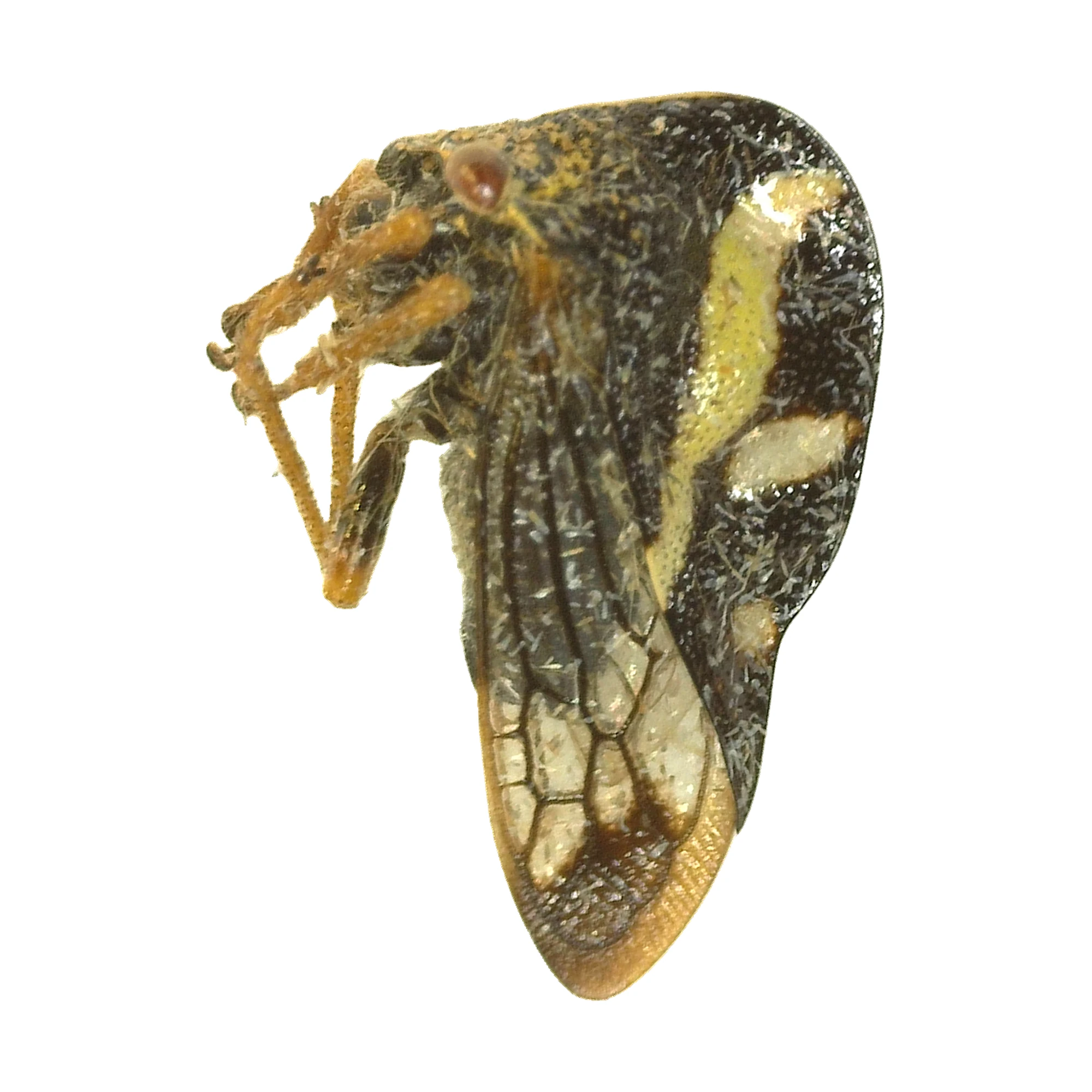
The Camel Treehopper, Smilia camelus, is a typical treehopper in the family Membracidae. Adults are about 8 to 9 mm long. The enlarged pronotum forms a tall, sharp keel, or crest, that is vertical in front and covers the abdomen. That camel-like hump gives the species its name and helps separate it from the more southerly Smilia fasciata, whose crest slopes backward. Color is often dark brown to black, with a pale or yellowish midline and pale spots or patches on the sides of the pronotum. The forewings are clear with dark veins and often a brown tip. The legs are brown or orange-brown.
BugGuide gives the range as eastern North America and California (Texas to Florida, north to Quebec and Minnesota, and also California). It lives in woods and edges where its host plants grow. Named hosts are oaks (Quercus), including black, bur, red, shingle, blackjack, post, and Shumard oaks, and also smooth sumac (Rhus glabra).
Some of our specimens were collected in Douglas County, Wisconsin.
Like other treehoppers, it feeds on plant sap with piercing-sucking mouthparts. It is often found on twigs and leaves of host oaks and can hop or fly a short distance when disturbed. It does not bite people.
Like other true bugs, it has incomplete metamorphosis: egg, nymph, and adult. Eggs are laid in plant tissue. Nymphs feed on the host and molt several times before becoming adults. In our area, adults are found mainly from March to June. One generation per year is typical.
This species is not a major crop or household pest. It feeds on oaks and occasionally on sumac, but it rarely causes noticeable damage. The preserved specimens are useful for teaching about treehoppers in the family Membracidae and about the tall, keeled pronotum that is typical of the tribe Smiliini.
This preserved specimen educates on treehoppers in the family Membracidae, suitable for displays or studies.
Check it out on BugGuide! https://bugguide.net/node/view/10014/bgimage
Only logged in customers who have purchased this product may leave a review.
Reviews
There are no reviews yet.