
$6.95
 <–
1 in stock
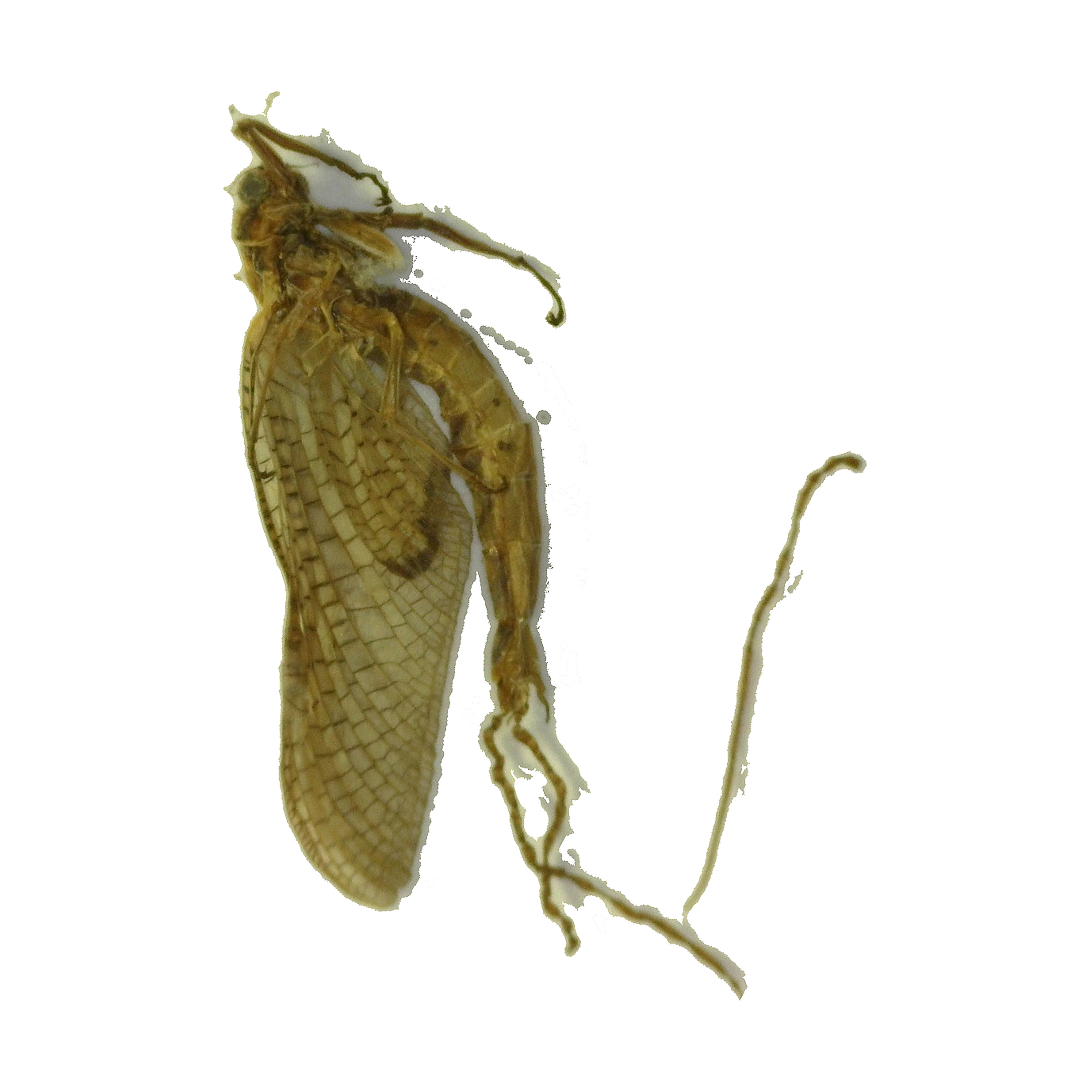
The Burrowing Mayfly belongs to the family Ephemeridae, the common burrower mayflies. Adults are large mayflies, usually about 10 to 30 mm from head to wing tip, not counting the long tails. The body is typically pale tan to yellowish brown, sometimes with darker marks on the abdomen. The forewings are large and triangular, with a dense net of cross-veins, and the hindwings are relatively large. Two or three long, thread-like tails extend from the tip of the abdomen. The legs are slender, and the antennae are short. This specimen is listed at the family level.
Ephemeridae is found worldwide. In North America the family includes 12 species in three genera: Ephemera, Hexagenia, and Litobrancha. The nymphs burrow in sand and silt in streams, rivers, and lakes. Adults are found near those waters and often come to lights after dark. These specimens were collected in Douglas County, Wisconsin.
Adults live only a short time, often just a few hours to a couple of days, and they do not feed. They rest on vegetation near the water and fly mainly to mate and lay eggs. Some species, especially in Hexagenia, emerge in large swarms that can be conspicuous along rivers and lakes. Fly fishers know several of the larger species as green drakes, brown drakes, or Hex. The nymphs live in U-shaped burrows in the sediment and feed on organic particles they filter or gather there.
Mayflies have a life cycle unlike that of other insects: egg, nymph, subimago, and adult. The female lays eggs in the water. The nymph may live in its burrow for a year or more, then swims to the surface and molts into a winged subimago, the dull-winged stage fly fishers call a dun. The subimago later molts into the shiny-winged adult, or spinner. Mayflies are the only insects that molt after they already have functional wings. Adults are most often collected in summer.
Burrowing mayflies are not pests. They do not damage crops, stored products, or structures, and they are harmless to people. The nymphs are an important food for fish and a normal part of stream and lake communities. Large emergences are of interest to fly fishers, who imitate the adults and the subimagoes, and the preserved specimens are used in teaching and collections.
Ephemeridae Latreille, 1810 belongs to the order Ephemeroptera (mayflies). The family name comes from the Greek word for living a day, a reference to the short adult life. In North America the family includes 12 species in the genera Ephemera, Hexagenia, and Litobrancha. Adults are large, and the media and cubitus veins of the forewing are strongly divergent. Genera can be hard to separate from a side photograph alone, because a sure identification often requires a closer look at the wings or, in males, the genitalia. This specimen is therefore listed at the family level as Ephemeridae.
This preserved specimen educates on mayflies and the burrowing mayfly family, suitable for displays or studies.
Check it out on BugGuide! https://bugguide.net/node/view/13468/bgimage
| Weight | 0.01 lbs |
|---|
Only logged in customers who have purchased this product may leave a review.
Reviews
There are no reviews yet.