
$7.95
 <—
2 in stock
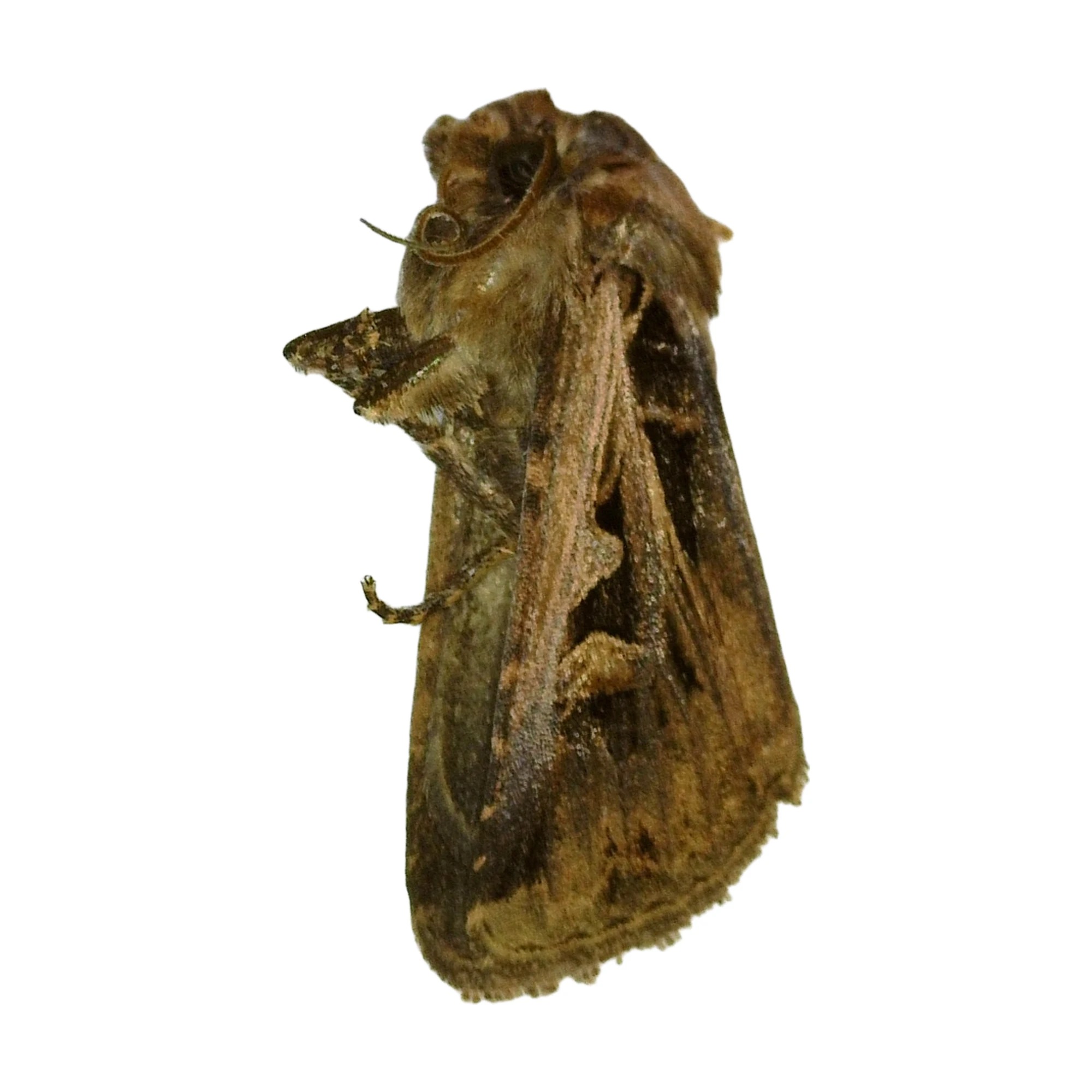
The Black Cutworm moth, also called the Ipsilon Dart, is a fairly large, plain-looking moth with a wingspan of 40 to 55 mm (about 1 1/2 to 2 inches). The forewing is yellowish brown to purplish, shaded with dark brown or blackish along the front edge in the male and over most of the wing in the female. The best identification mark is a small black wedge, like a dagger, that points outward from the kidney-shaped spot, often with a second black wedge pointing in from the outer edge. The two wedges sometimes meet in an hourglass shape, and they gave the moth its name, because they resemble the Greek letter upsilon. The hindwing is dirty white with grayish-brown shading and darker veins. These marks are clearest on fresh moths and fade as the scales wear off with age. Our photo shows a worn specimen resting on its side. The caterpillar is gray to nearly black with a greasy look, lighter underneath, and has rough, grainy skin. It grows to 1 1/2 to 2 inches (about 40 to 50 mm).
The Black Cutworm is found in croplands, fields, and gardens across all of the United States and southern Canada. It is found around the world, and in North America it is absent only from the arctic.
This is a migratory moth. In the Midwest, spring infestations come mostly from moths carried north on southerly winds from the Gulf Coast and Mexico. In Missouri the adults can be found for about ten months of the year, and they are caught in light traps from late February to early December. The caterpillars feed at night and hide by day in shallow burrows or under clods of soil. They cut seedlings off at the base and often drag the cut plants down into their burrows. When disturbed, they curl into a C shape and play dead.
Complete metamorphosis (egg, larva, pupa, adult). A female can lay more than 1,000 yellowish-white eggs, singly or in clusters of 30 or fewer, on low plants or on the ground near them. The eggs hatch in 3 to 16 days. The caterpillar passes through six or seven stages, and pupation takes place in the soil. A generation takes 35 to 50 days from egg to adult, and there are several generations a year. In Missouri and Illinois the species does not normally overwinter, except occasionally in the Missouri Bootheel.
A serious pest. University of Missouri Extension calls the Black Cutworm by far the most destructive of the cutworms in corn. The caterpillars cut young plants at or below the soil surface, and one caterpillar can cut about four corn seedlings at the one-leaf stage or one plant at the four-leaf stage before it pupates. Older caterpillars can also tunnel into stalks and cause wilting, called dead heart. Besides corn, they damage seedlings of cotton, soybeans, wheat, turf grass, and vegetables such as lettuce and tomato. Damage is usually worst in the first generation, in fields that were recently flooded or where weeds or cover plants were recently destroyed. Growers scout fields as the crop emerges and treat when the share of cut seedlings passes set thresholds.
Some of our specimens were collected at a light near Saint James, Missouri.
This preserved specimen educates on migratory moths and the cutworm pests of seedling crops, suitable for displays or studies. Check it out on BugGuide! https://bugguide.net/node/view/38914/bgimage