
$9.95
 <–
15 in stock
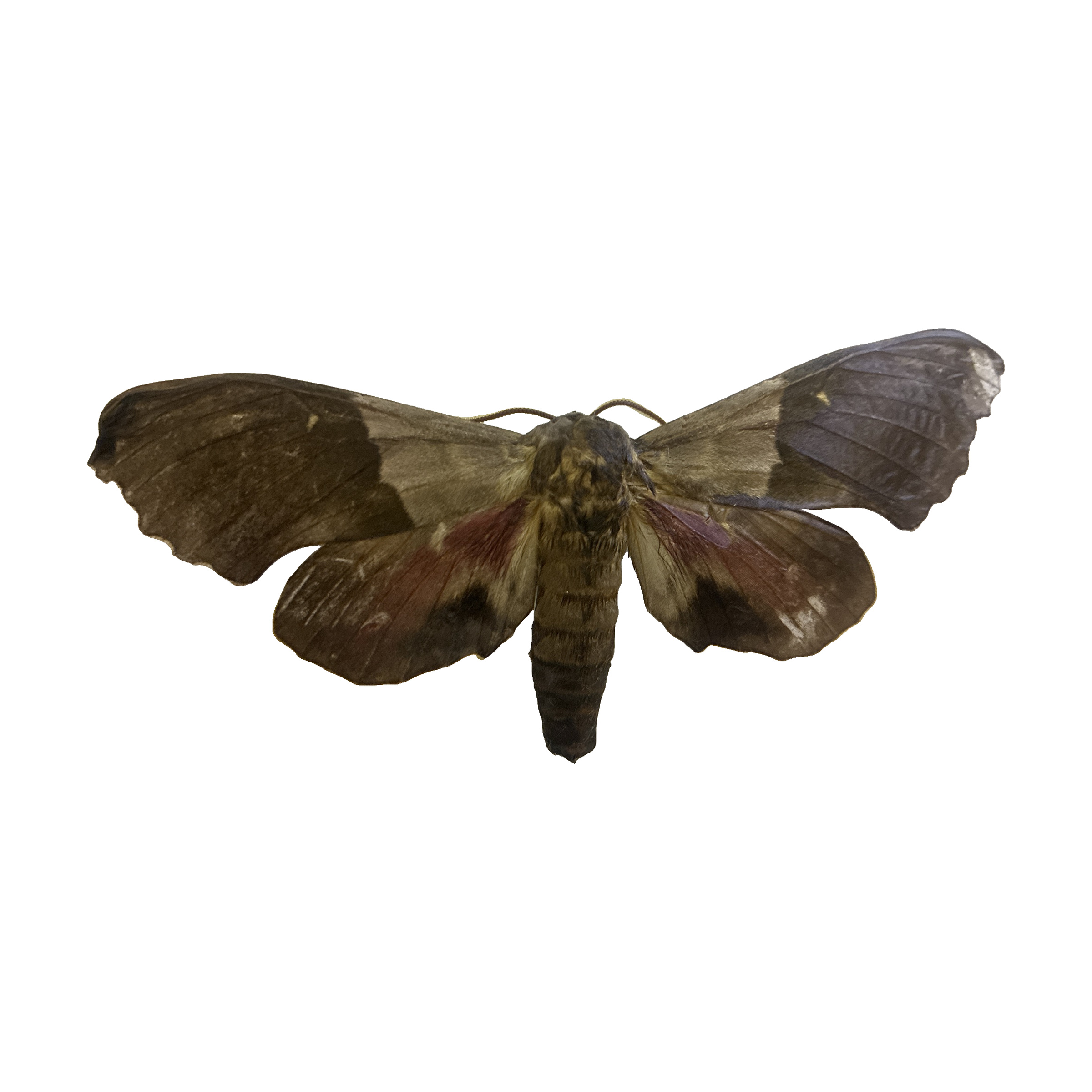
The Big Poplar Sphinx has a wingspan of 76-120 mm (7.6 to 12 cm). It is a large, heavy-bodied sphinx moth. The forewings are gray to olive-brown, with the basal third lighter and the outer third often lighter as well, leaving a darker median band. Each forewing usually has a small dark spot near the center, and the outer margin is scalloped. The hindwings are gray with a crimson or rosy-red patch and an inward-pointing bluish-black triangle near the outer margin. Adults do not show the blue eyespots with black pupils seen in the eyed sphinxes (Smerinthus and Paonias). This moth is also known as the Modest Sphinx. The Western Poplar Sphinx (Pachysphinx occidentalis) is similar but is restricted to western North America; P. modesta occurs coast to coast.
This species is found across much of North America, from British Columbia to Nova Scotia, south to northern Florida, and west to Texas, Oregon, and New Mexico. It is absent from California, Arizona, Nevada, and the arctic. It lives along rivers, on moist mountainsides, and anywhere its host plants grow. Our specimen was collected in Douglas County, Wisconsin.
Adults fly at night and come to lights. Adults do not feed. In the north they fly mainly in June and July; in the Gulf states they may fly from April to September.
Eggs are laid on leaves of the host plant and hatch in about nine days. There is one generation per year in the north and two in the south. The caterpillars feed on poplar, aspen, cottonwood (all Populus spp.), and willow (Salix spp.). They are usually pale green with white granulose spots, oblique yellow side stripes, and a rear horn. The species overwinters as a pupa in a shallow burrow in the ground.
The caterpillars eat the leaves of poplar and willow, but they are rarely numerous enough to cause serious damage. The species is common and widespread where its hosts occur.
Hodges number 7828. Pachysphinx modesta (Harris, 1839) belongs to the sphinx moth family Sphingidae, subfamily Smerinthinae, tribe Smerinthini. The original combination was Smerinthus modesta. The name modesta refers to the dark lower half of the resting moth, as though modestly covered by a cloak. Both this species and P. occidentalis have been called Big Poplar Sphinx in different guides; Modest Sphinx is the clearer common name for P. modesta.
Check it out on BugGuide! https://bugguide.net/node/view/19817/bgimage