
$3.00

16 in stock
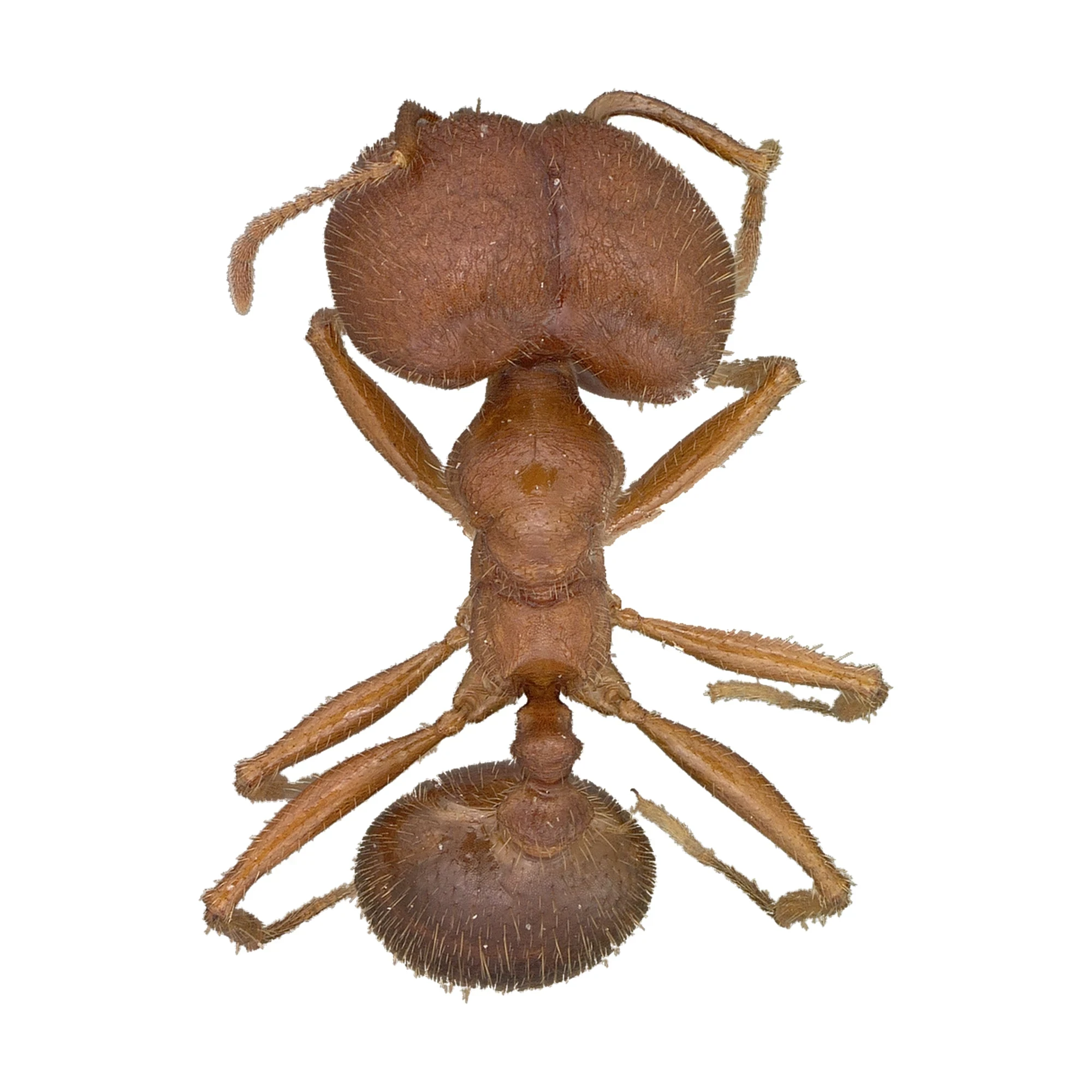
Big-headed Ants are small ants with two distinct kinds of workers. Minor workers are about 1.5 to 4 mm long and have normal, rounded heads. Major workers, often called soldiers, are about 2 to 5 mm long and have huge, heart-shaped heads that are out of proportion to their bodies, packed with muscle that powers their strong jaws. A few desert species also have an even larger supermajor caste. Depending on the species, they are yellow, reddish brown, dark brown or nearly black. They have a two-segmented waist (a petiole and a postpetiole), 12-segmented antennae ending in a three-segmented club, and usually a pair of short spines on the back of the thorax. The specimens we sell are real, US-collected workers from Denton County, Texas, likely including both minors and majors.
The genus Pheidole is found around the world and is one of the largest ant genera, with more than 1,000 described species and many more still unnamed. About 80 species live in the United States and Canada. They are few in the northern states, more varied in the Southeast and especially diverse in the deserts of the Southwest. Colonies nest in soil, under stones and logs, in rotting wood and leaf litter, and in cracks in sidewalks and pavement. These specimens were collected from a swimming pool skimmer in Denton County, Texas.
Minor workers do most of the everyday work of the colony, including foraging, caring for the brood and tending the nest. They quickly recruit nestmates to food along scent trails. Majors are specialists. They use their big heads and jaws to crack hard seeds, cut up large prey and defend the nest, and in some species they plug nest entrances with their heads. Many Pheidole species are seed harvesters that store seeds in their nests, while others are general predators and scavengers of small insects. In Texas and the Southeast, majors of some native species are known for rushing out to fight off invading fire ants.
Like all ants, Big-headed Ants go through complete metamorphosis (egg, larva, pupa, adult). Workers are sterile females. Whether a larva grows into a minor or a major is decided mainly by how much it is fed and by its hormone levels during development, not by its genes. Winged queens and males fly from the nest on mating flights, usually in summer and often after rain. A mated queen sheds her wings and starts a new colony, raising her first small workers herself. Colonies range from a few hundred to many thousands of workers.
Most native Big-headed Ants are harmless and only occasionally wander indoors. Their stings are weak and rarely noticed. One introduced species, the African Big-headed Ant (Pheidole megacephala), is among the world’s worst invasive ants. It is established in Florida and other warm places, where it displaces native ants and protects crop-damaging scale insects and mealybugs. Native species are valuable members of the ecosystem. They prey on other small insects, recycle dead animals and move and store seeds, and some help defend against fire ants.
This preserved specimen educates on one of the most diverse ant genera in the world and its remarkable big-headed soldier caste, suitable for displays or studies. Check it out on BugGuide! https://www.bugguide.net/node/view/49416
| Weight | 0.01 lbs |
|---|
Only logged in customers who have purchased this product may leave a review.
Reviews
There are no reviews yet.