
$5.95
 <—
1 in stock
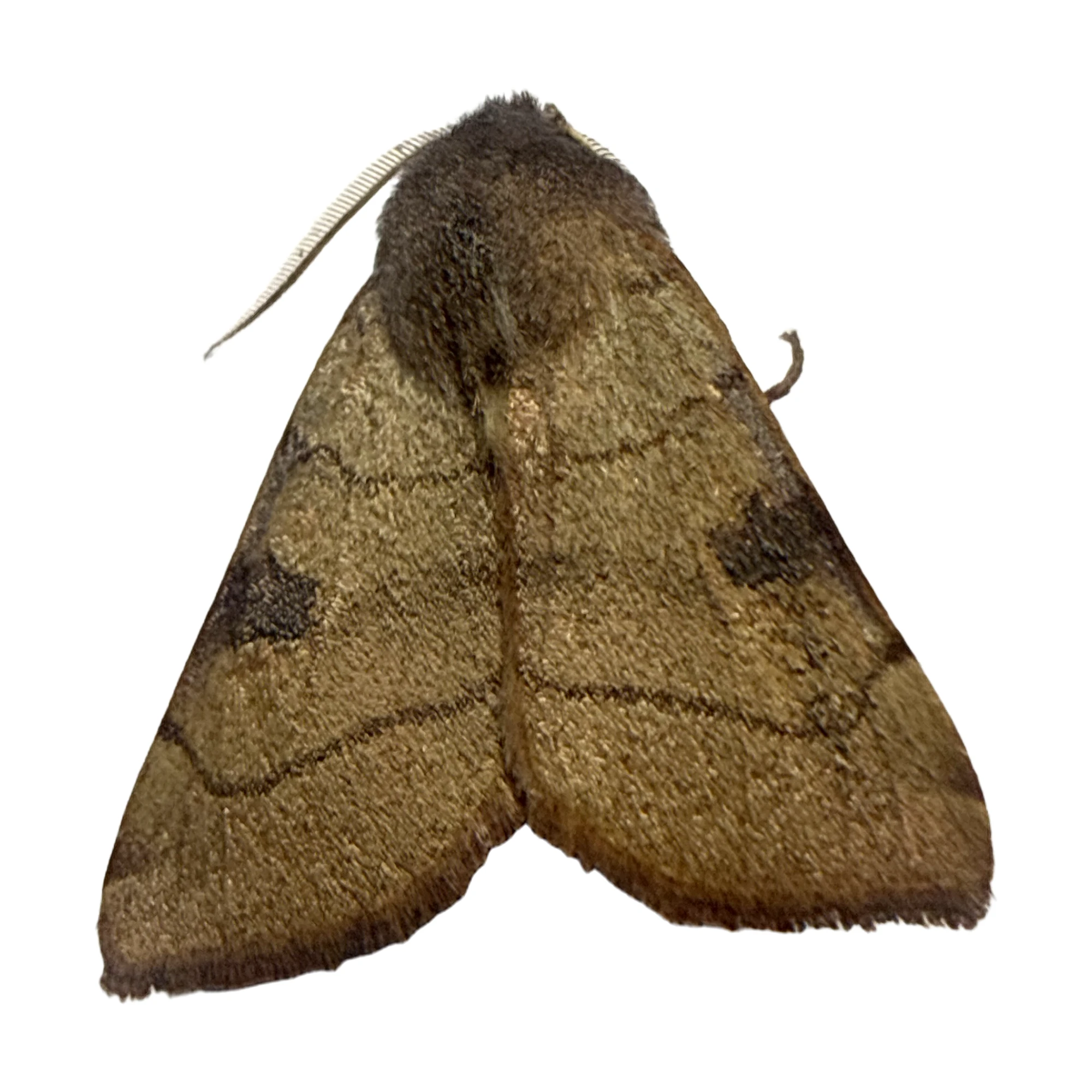
The Bicolored Sallow, Sunira bicolorago, is a medium-sized owlet moth with a wingspan of 28 to 38 mm. The forewing ranges from pale straw-yellow to deep orange-yellow or tan, shaded with light brown or gray, and crossed by faint, wavy lines that are often reduced to rows of dark dots. A kidney-shaped spot near the outer part of each forewing has its lower half filled with gray to black, the best field mark for the species. In some individuals the outer half of the forewing is purplish gray, and in about 1% it is dark brown; the species was first described from one of these two-toned moths, which gave it the name bicolorago. The hindwing is paler than the forewing and shaded grayish brown. At rest the wings are folded in a broad triangle over the body, as in this specimen.
This moth is found across the eastern half of the United States, except southern Florida, and across southern Canada, becoming less common west of the 100th meridian, with records from Alberta, Montana, and Colorado. It is common to abundant through nearly all of its range, including Missouri. It lives almost anywhere with unsprayed hardwood trees, especially maples and elms, from forests and floodplains to city parks and suburban yards. It is most common in southern swamps and northern forests with plenty of red maple.
Adults are nocturnal and come readily to lights, which is how this specimen was collected. They are also strongly drawn to overripe fruit and sugar baits, and in wooded parts of eastern North America they are often the most common moth at bait in autumn. Around sunset they can be seen darting among trees and shrubs 5 to 15 feet above the ground. The caterpillars are broad generalists, recorded on maple, elm, willow, oak, cherry, plum, peach, crabapple, dock, grasses, and crops such as tobacco and cabbage.
The Bicolored Sallow undergoes complete metamorphosis (egg, larva, pupa, adult) and has one generation per year. Adults fly in the fall, from September to November in the north and August to December in the south, and mating peaks around the time of peak fall color. Females apparently lay eggs in masses among the flower buds of trees such as maples and elms. The eggs overwinter and hatch in late winter or early spring, about when red maples bloom. Larvae mature by about May in the middle latitudes, then enter the soil, spin a cocoon, and stay dormant through summer before pupating and emerging as adults in the fall.
The Bicolored Sallow is not considered a significant pest. Its caterpillar, known as the Shield-backed Cutworm, has been recorded on tobacco, cabbage, and fruit trees such as cherry and peach, but damage is minor. Ecologically it is valuable: the caterpillar is one of the most common forest caterpillars in eastern North America and its abundance makes it an important part of the spring food supply for forest birds and other wildlife.
This preserved specimen educates on fall moth diversity and owlet moth biology, suitable for displays or studies. Check it out on BugGuide! https://bugguide.net/node/view/31779