
$3.00
 <---
5 in stock
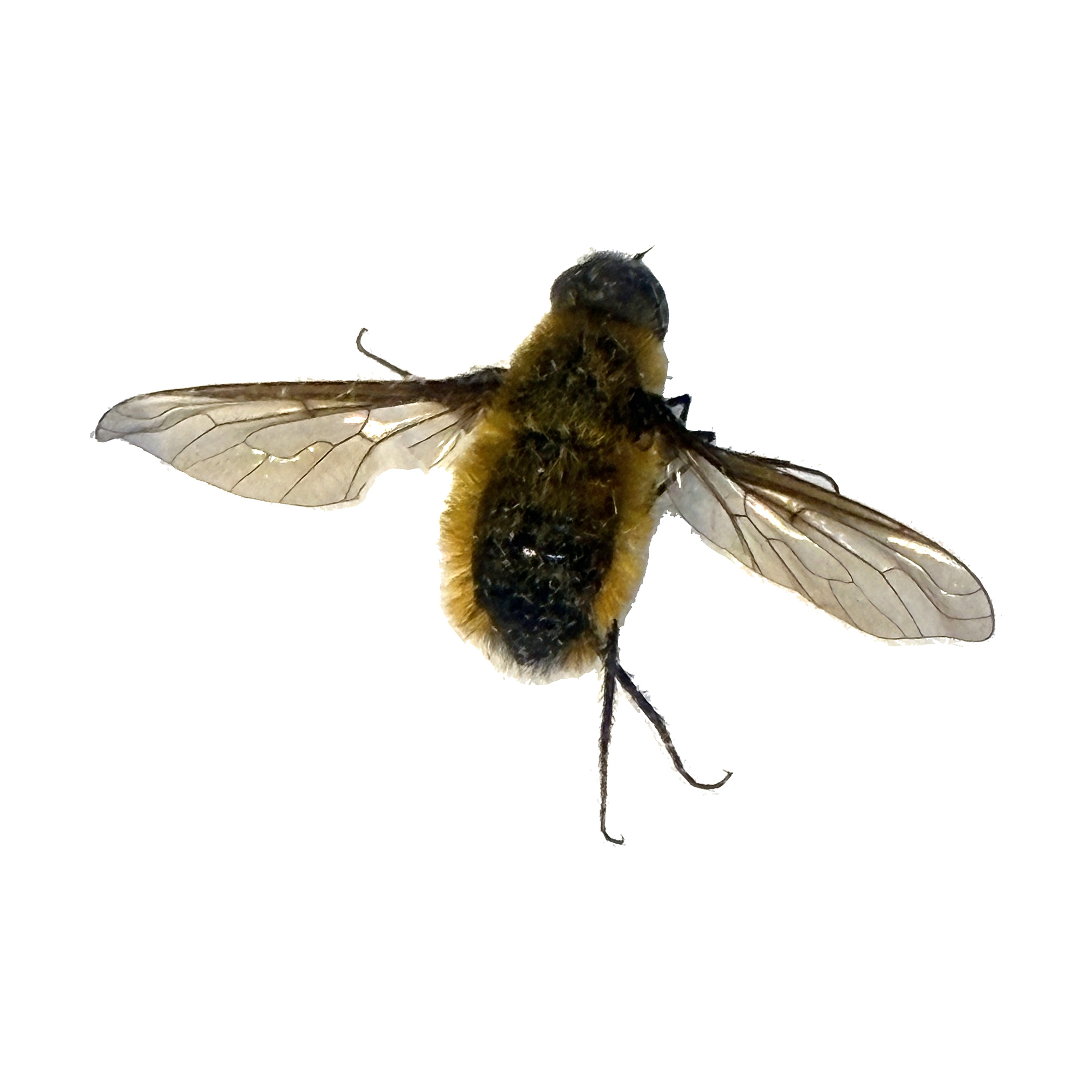
The Bee Fly in this listing belongs to the family Bombyliidae. These specimens are about 10 mm long, with dense yellow or golden pile that gives them a bee-like look. Bee flies in this family vary in form. Some species have a long, forward-pointing proboscis used to take nectar from flowers, and the wings may be clear or may have a dark tint or markings along the front edge, depending on the species. These specimens are identified to the family Bombyliidae only, not to genus or species.
Bombyliidae is a large, worldwide family. In North America, bee flies occur across the continent, with the greatest diversity in the West and Southwest. Adults are usually found in open, sunny places with flowers, including meadows, grasslands, roadsides, and sandy or open woods. Some of our specimens were collected in Douglas County, Wisconsin.
Adults visit flowers for nectar. They often hover in front of blossoms or settle on flowers or on the ground in the sun. They do not sting.
Like other true flies, bee flies have complete metamorphosis: egg, larva, pupa, and adult. The larvae of many members of this family are parasitoids of other insects, including solitary bees, wasps, beetles, or moths, depending on the group.
This family is not a pest of crops or households. The adults visit flowers for nectar, and the larvae of many species develop as parasitoids of other insects. They do not sting or bite people. The preserved specimens are used in teaching and collections, and they are a good example of a small, yellow-haired bee fly in the family Bombyliidae.
This preserved specimen educates on bee flies in the family Bombyliidae, suitable for displays or studies.
Check it out on BugGuide! https://bugguide.net/node/view/6029
Only logged in customers who have purchased this product may leave a review.
Reviews
There are no reviews yet.