
$3.00
 <—
11 in stock
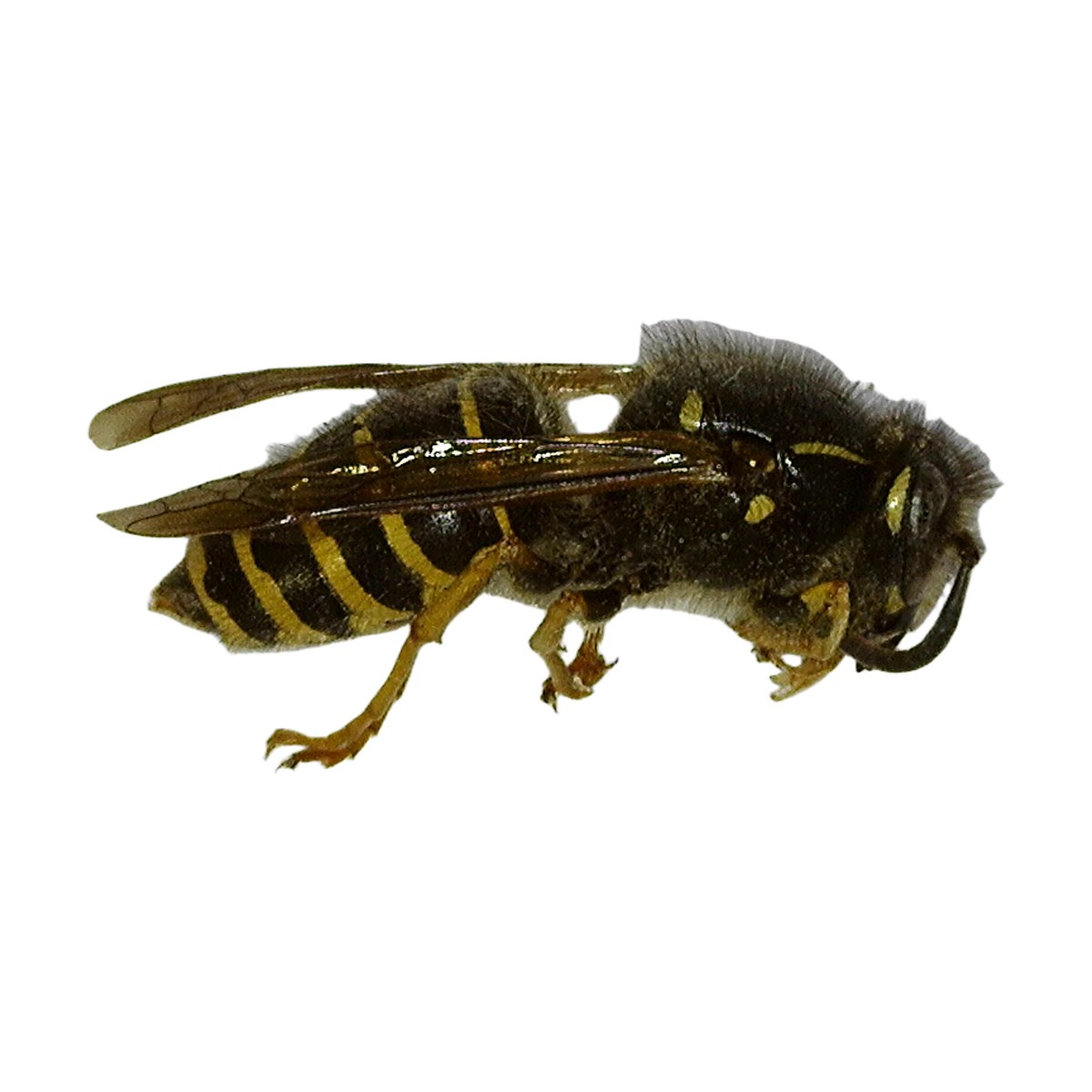
The Alaska Yellowjacket, Vespula alascensis, also called the American or North American Yellowjacket, is a black and yellow social wasp. Workers, the sterile females that make up most of a colony and the kind we offer, are about 10 to 16 mm long, with queens a bit larger. The body is banded black and yellow, with yellow markings behind each eye. Until 2010 this species was treated as the Eurasian Common Wasp, Vespula vulgaris, but the two are different species: they differ in the male genitalia, and the North American form is usually darker and almost never has yellow spots on the rear of the thorax (the propodeum), which V. vulgaris often shows. The lookalike German Yellowjacket, Vespula germanica, is told apart by the face: workers of V. germanica have three small black dots on the clypeus (the plate above the mouthparts), while in V. alascensis and V. vulgaris the clypeus carries a single broad black mark, often anchor-shaped.
The Alaska Yellowjacket is native to North America and occurs across Canada, the northern and western United States, and into central Mexico, including Minnesota and the Great Lakes states. It is generally a ground-nesting wasp. Nests are built in underground cavities, rotten logs and stumps, and forest litter, and sometimes in wall voids and other parts of buildings, and they can grow very large. Some of our specimens were collected near Cloquet, Minnesota.
This is a social wasp that lives in a colony, and the workers do all the jobs: building the paper nest from chewed wood fibers, hunting, gathering sugar, feeding the larvae, and defending the nest. Workers hunt live insects and other arthropods to feed the grubs, and they will also scavenge any source of protein or sugar, such as carrion, fruit, and sweet drinks. Colonies are most active from July to September. Like other yellowjackets, workers defend their nest vigorously when it is disturbed, and they become bolder and more numerous around people in late summer and fall, when food gets scarce.
The Alaska Yellowjacket undergoes complete metamorphosis (egg, larva, pupa, adult), and its colonies usually last one season. A mated queen spends the winter alone in a sheltered spot, then in spring starts a new nest by herself and raises the first workers. The workers take over the building and foraging while the queen lays eggs, and the colony grows through the summer. In late summer and fall the nest produces new queens and males, which leave to mate. The old queen, the workers, and the males die with the cold weather, and the nest is not reused. In warm climates, nests can survive for more than one year.
The Alaska Yellowjacket is both beneficial and a nuisance. Its workers kill large numbers of caterpillars, flies, and other insects, which makes the colony a natural form of pest control. However, because it nests in the ground and around buildings and scavenges for sweets and meat, it often pesters people at picnics and near garbage cans in late summer, and a disturbed nest can deliver many painful stings, which are dangerous to people who are allergic. Nests are best left alone in quiet spots and removed only when they are close to doors or busy areas.
This preserved specimen educates on social wasp colonies and the recent split of the North American yellowjacket from its Eurasian look-alike, suitable for displays or studies. Check it out on BugGuide! https://bugguide.net/node/view/14087