Short Description
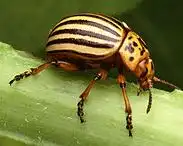
The Colorado Potato Beetle (Leptinotarsa decemlineata) measures 5.5-11 mm with pale yellow elytra featuring ten black stripes. Larvae show black spots. A major potato pest across North America. (25 words) Learn more: https://bugguide.net/node/view/2706
Long Description
Appearance
The Colorado Potato Beetle grows to 5.5-11 mm long. Adults display a pale yellow body with elytra marked by ten narrow black stripes. Irregular black punctures dot the surface. Larvae feature a reddish humpbacked form with two rows of black spots along each side. This distinctive pattern aids quick identification in fields.
Habitat and Range
This beetle ranges transcontinentally from Nova Scotia to British Columbia and south to Florida and California. It favors potato fields and related Solanum plants. In southern US regions, it feeds on species like Solanum rostratum and S. carolinense. Northern populations struggle on S. elaeagnifolium in Arizona, often leading to their decline.
Behavior
Adults and larvae feed voraciously on potato foliage, defoliating plants rapidly. Larvae locate hosts visually, biting leaves at random to clip hairs and pierce the epidermis. They accept plants based on taste detected by tarsal setae, which sense sugars, salts, and alkaloids. This methodical foraging maximizes damage during active seasons.
Life Cycle
Adults overwinter in soil, emerging in spring to feed and mate. Females lay clusters of yellow eggs on leaf undersides. Larvae hatch and disperse, searching for hosts before feeding intensively for two to three weeks. They then drop to pupate in soil for about ten days. New adults emerge to continue the cycle, yielding one to two generations yearly.
Economic Impact
The Colorado Potato Beetle ranks as a serious pest in potato-growing areas across North America and Europe. It originated in Colorado on native Solanum before spreading with potato cultivation, causing major crop losses through defoliation. Control relies on resistant varieties and targeted pesticides, incurring significant agricultural costs.
This preserved specimen highlights the iconic black-striped pattern, ideal for pest education and entomology displays. Check it out on BugGuide! https://bugguide.net/node/view/2706

 <—
<—