
$3.00
 <---
2 in stock
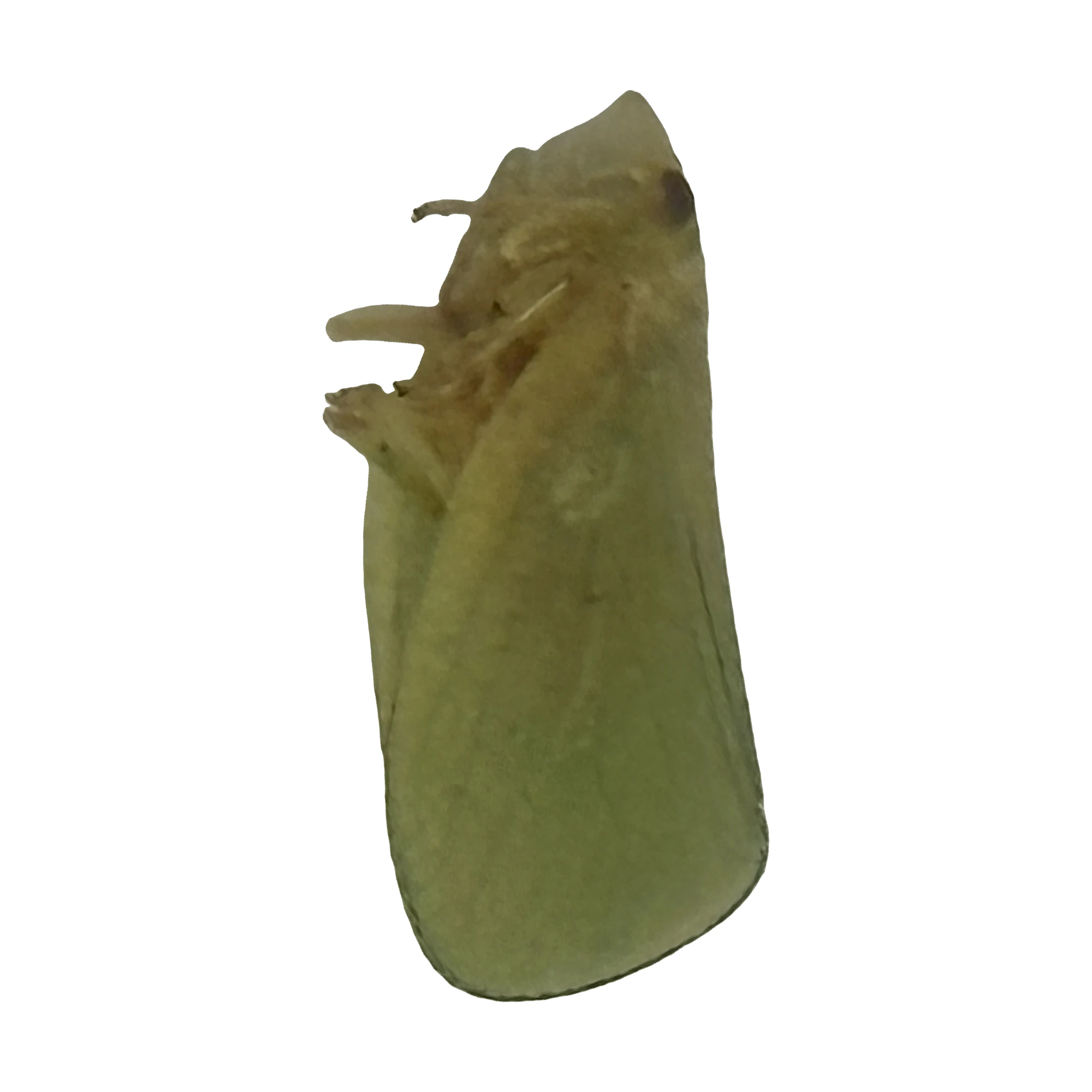
The Green Cone-headed Planthopper, Acanalonia conica, is a planthopper in the family Acanaloniidae. Adults are about 6 to 11 mm long. In life they are bright green, with broad, prominently veined wings held nearly vertically along the body, like a small leaf. The head is produced into a distinct point, or cone, in front of the eyes, and there are usually two small black dots between the wings. It usually lacks the dark stripes along the inner edges of the forewings that mark the similar Two-striped Planthopper, Acanalonia bivittata. Dried specimens often fade from green to yellowish, as in the photo.
This species is native to eastern North America, from Quebec to Florida and west to Nebraska and Texas. It has also been introduced to Italy and other parts of Europe. It lives on a wide range of trees, shrubs, and herbaceous plants.
Some of our specimens were collected in Ringgold, Georgia.
It feeds on plant juices with piercing-sucking mouthparts. It can hop or fly when disturbed. It does not bite people.
Like other true hoppers, it has incomplete metamorphosis: egg, nymph, and adult. It has one generation per year. Eggs overwinter inserted in woody vegetation. Nymphs pass through five instars, and in the eastern United States adults are typically found from early summer into early fall.
In North America this species is not a serious crop or household pest. It feeds on many kinds of plants, but it rarely causes noticeable damage. In parts of Europe, where it has been introduced, it is watched as an invasive species on ornamental plants. The preserved specimens are useful for teaching about planthoppers in the family Acanaloniidae.
This preserved specimen educates on planthoppers in the family Acanaloniidae, suitable for displays or studies.
Check it out on BugGuide! https://bugguide.net/node/view/15671/bgimage
| Weight | 0.01 lbs |
|---|
Only logged in customers who have purchased this product may leave a review.
Reviews
There are no reviews yet.