
$3.00
 <---
5 in stock
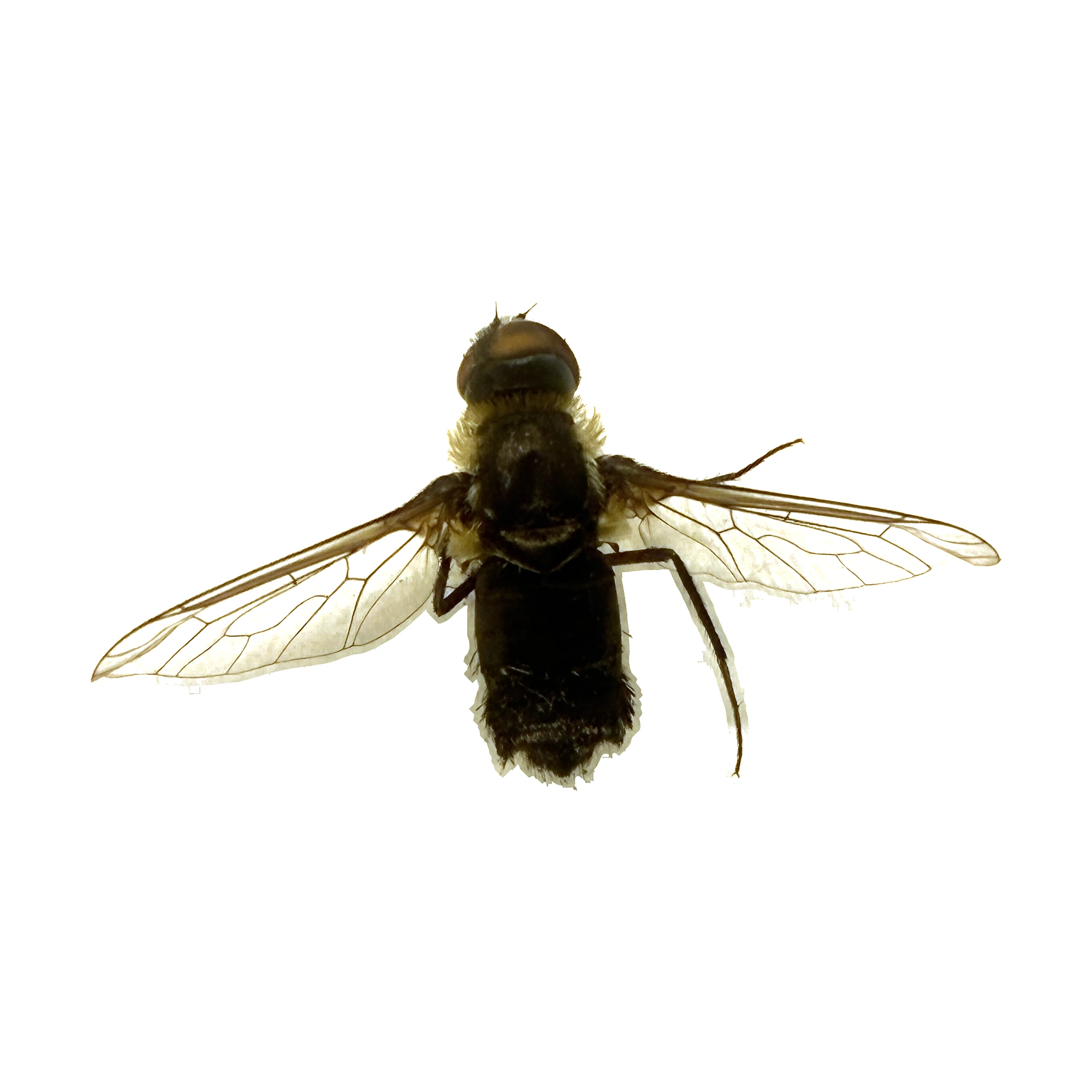
The Bee Fly in this listing is Villa sp., a bee fly in the family Bombyliidae. These specimens are about 12 to 13 mm long. The body is shiny black, with a band of yellow pile around the front of the thorax that looks like a collar. The wings are clear, with an amber tint along the front (costal) edge. The face is rounded in side view and does not stick out past the eyes. That rounded face is the main way to tell Villa from the similar genus Paravilla, which has a conical face that projects forward. Many Villa species also have bands of pale or yellowish scales on the abdomen. Species in this genus are often hard to name with certainty, and these specimens are identified to the genus Villa, in the lateralis group.
Villa is a large, worldwide genus. In North America it is most diverse in the west, but it is also well represented in the east, and a few species are transcontinental. One of the most widespread is Villa lateralis, which occurs from Canada south through much of the United States into Central America. Adults are usually found in open, sunny places with flowers, including grasslands, meadows, roadsides, and sandy or open woods. Some of our specimens were collected in Douglas County, Wisconsin.
Adults visit flowers for nectar. They often hover over blossoms or bare ground, and they also settle on flowers or on the ground in the sun. They do not sting. The structure at the front of the head is a short proboscis used for feeding, not a stinger. Females of some species gather sand, which they later use when laying eggs.
Like other true flies, this bee fly has complete metamorphosis: egg, larva, pupa, and adult. The larvae are parasitoids, most often of noctuid moth larvae or pupae. Some species have also been recorded from other hosts, including darkling beetles. The first-instar larva is active and has to find a host on its own. After that it develops inside the host. Adults are usually on the wing from early summer into early fall, depending on the species and the region.
This genus is beneficial. The larvae parasitize moths, including noctuid moths, some of which are crop or garden pests, and the adults visit flowers. They are not pests, and they do not sting or bite people. The preserved specimens are used in teaching and collections, and they are a good example of a dark bee fly in the genus Villa.
This preserved specimen educates on bee flies in the genus Villa and the family Bombyliidae, suitable for displays or studies.
Check it out on BugGuide! https://bugguide.net/node/view/9865
Only logged in customers who have purchased this product may leave a review.
Reviews
There are no reviews yet.