
$7.95
 <–
Out of stock
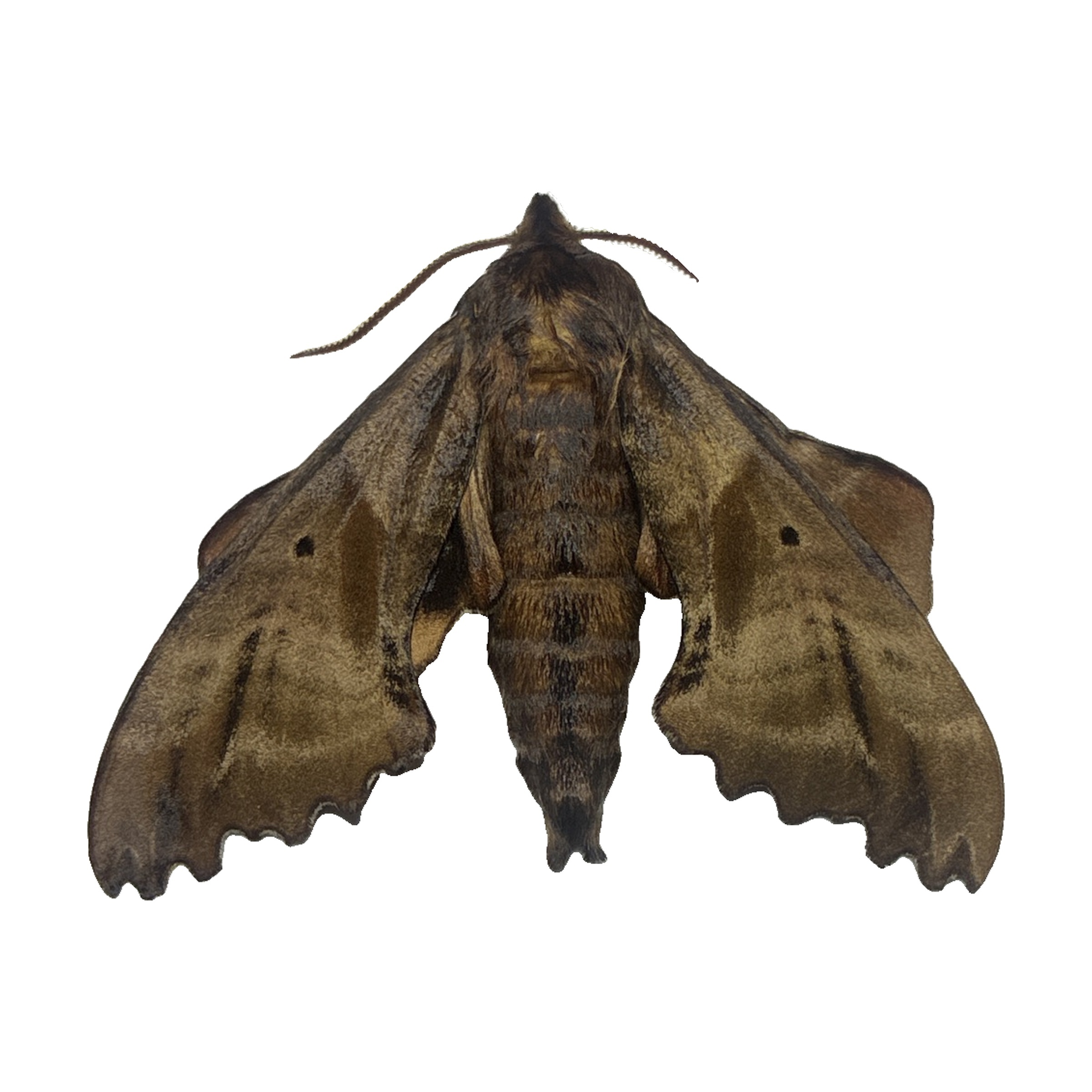
The Blinded Sphinx has a wingspan of 55-95 mm (5.5 to 9.5 cm). The forewings are various shades of brown, sometimes with a purplish tint in the middle and a greenish tint near the outer edge. The outer margin of the forewing is deeply and evenly scalloped all the way along, like a pie crust, with a thin white fringe in the notches. Each forewing usually has a small dark spot near the center. The hindwings are brown above and pink below, and near the inner corner there is a large black eyespot with a small blue center and no black pupil inside the blue. That missing pupil is what gives the moth its name. It can be told from the Small-eyed Sphinx (Paonias myops), which has a yellow patch around a blue eyespot that does have a black pupil, and whose forewing outer margin has only one or two lobes rather than a full pie-crust scallop. The One-eyed Sphinx (Smerinthus cerisyi) and Twin-spotted Sphinx (Smerinthus jamaicensis) also have pink hindwings, but their blue eyespots have a solid black pupil or a black bar through the blue.
This species is found across all of the Lower 48 United States and southern Canada. It lives in open deciduous forests, woodland edges, clearings, shrubby areas, and gardens. Our specimen was collected in Douglas County, Wisconsin.
Adults fly at night and come to lights. Adults do not feed. When disturbed, the moth may lift its forewings to flash the pink hindwings and blue eyespots.
Adults fly from May to August and are most common in June and July in the north and west. There is one generation per year in the north and west, and two or three in the south. The caterpillars feed on a wide range of deciduous trees and shrubs, including apple, basswood, birch, cherry, elm, hawthorn, hop-hornbeam, poplar, rose, serviceberry, and willow. They are green or yellowish green, heavily granular, with oblique yellow side lines and a rear horn. The species overwinters as a pupa in the soil.
The caterpillars eat the leaves of many hardwood trees and shrubs, but they are rarely numerous enough to cause serious damage. The species is common and widespread.
Hodges number 7824. Paonias excaecata (J.E. Smith, 1797) belongs to the sphinx moth family Sphingidae, subfamily Smerinthinae, tribe Smerinthini. The specific name is from Latin for “to blind,” referring to the blue hindwing spot that lacks a black pupil. Spellings excaecatus and exaecatus appear in older literature.
Check it out on BugGuide! https://bugguide.net/node/view/4481/bgimage