
$7.95
 <–
1 in stock
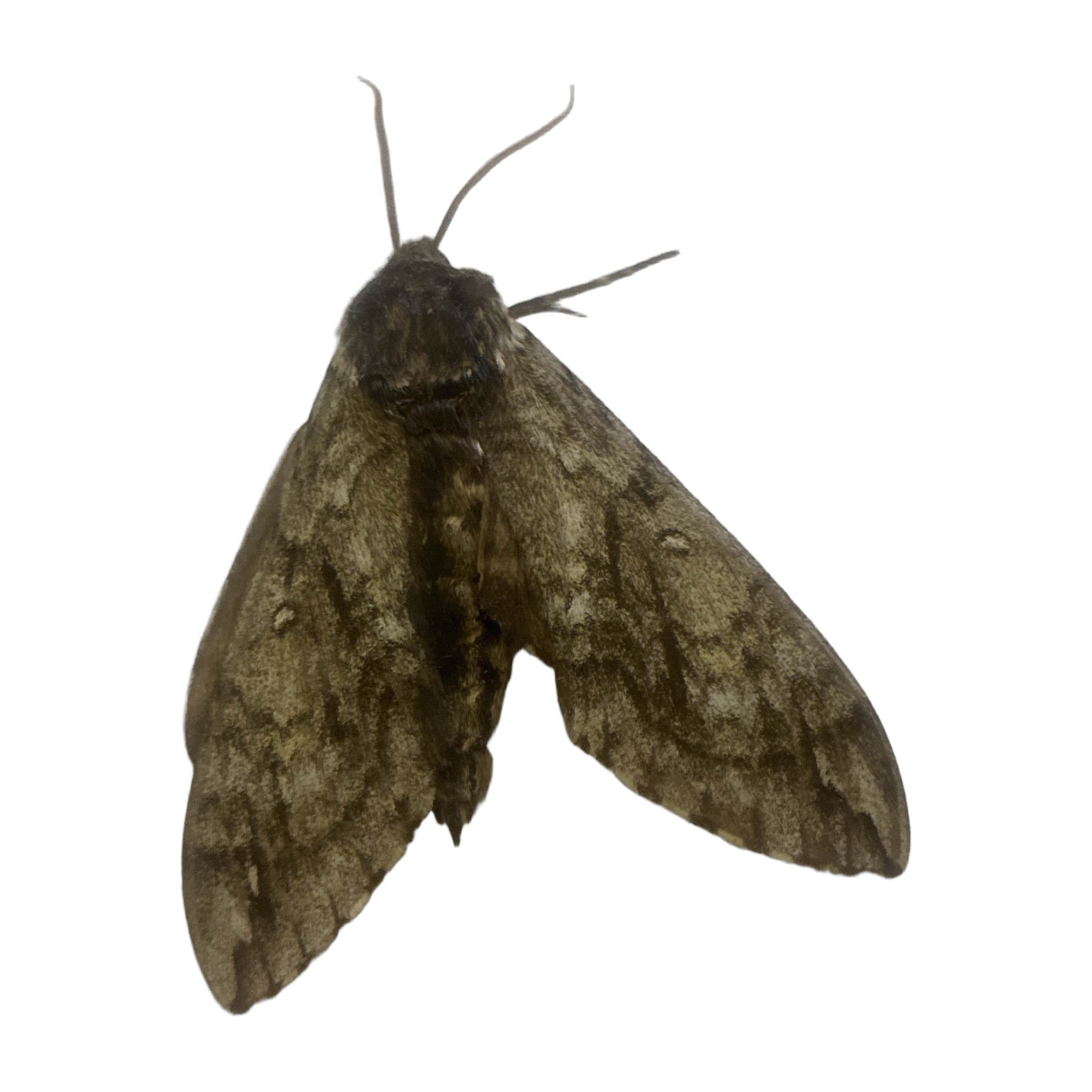
The Waved Sphinx has a wingspan of 78-110 mm (7.8 to 11.0 cm). The forewings are pale brownish gray to yellowish brown, crossed by distinct wavy dark lines, with a white cell spot outlined in black on each forewing. The hindwings are gray with darker bands and a white and dark checkered fringe. It can be told from the Elm Sphinx (Ceratomia amyntor), which looks streakier and lacks these strong wavy cross bands.
This species is found across eastern and central North America, from Maine west to Alberta and Colorado, and south to Florida, the Gulf Coast, and Texas. It lives in deciduous forests, woodlots, shrubby areas, stream sides, and suburbs. Our specimen was collected in Douglas County, Wisconsin.
Adults fly at night and come to lights. In the north they fly mainly from May through August. Farther south there are two generations, from March through October. Adults probably do not feed.
There is one generation per year in the North and two in the South. The caterpillars feed mainly on ash, and also on privet, oak, hawthorn, lilac, and fringe tree. Fully grown caterpillars enter the soil to pupate, and the species overwinters as a pupa.
The caterpillars feed on the leaves of ash and other woody plants, but Butterflies and Moths of North America reports no special management needs for the species. It is one of the more common sphinx moths in eastern North America.
Hodges number 7787. Ceratomia undulosa (Walker, 1856), originally described as Daremma undulosa, belongs to the sphinx moth family Sphingidae, subfamily Sphinginae, tribe Sphingini. The name undulosa refers to the wavy lines on the forewings.
Check it out on BugGuide! https://bugguide.net/node/view/3749/bgimage