
$7.95
 <–
5 in stock
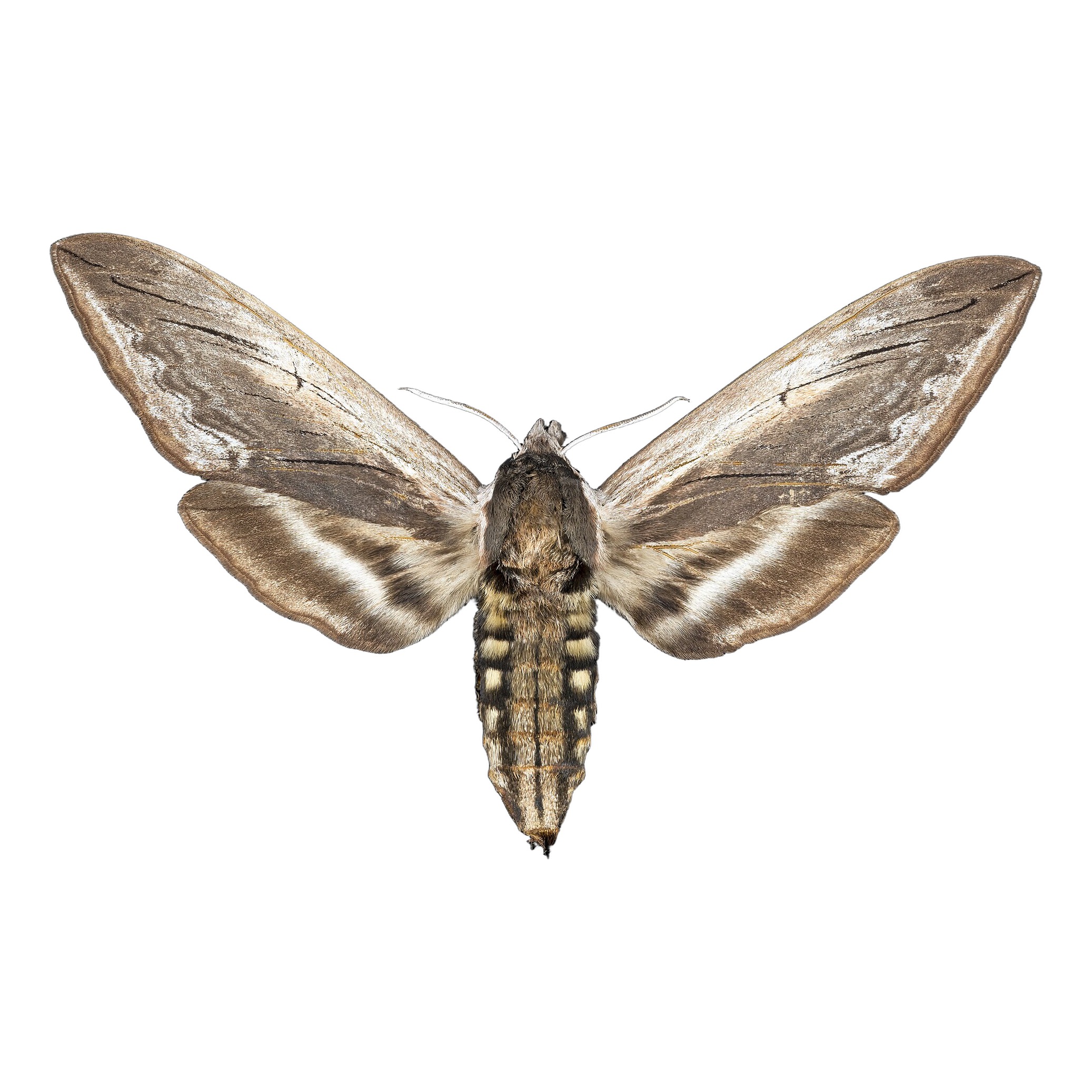
The Wild Cherry Sphinx has a wingspan of 75-115 mm (7.5 to 11.5 cm). It is a large sphinx moth with a black, velvety thorax. The forewings are two-toned, pale gray to whitish along the costa (leading edge) and outer margin, with a broad dark gray to brown shade running from the base to the wing tip. The hindwings are banded in dark brown and pale gray. The abdomen is banded with gray or pale and dark segments. It resembles the Huckleberry Sphinx (Sphinx gordius), but the light and dark areas of the forewing are reversed. This moth is also known as the Plum Tree Sphinx.
This species ranges across southern Canada and much of the United States, south in the East to Georgia and north Texas. It lives in woodlands, woodland edges, old fields, orchards, and suburban yards where cherry, plum, and apple trees grow. Our specimens were collected in Douglas County, Wisconsin.
Adults fly at dusk and at night and take nectar from flowers with their long tongue. They are readily attracted to lights.
Adults fly mainly from late spring into summer, with one generation in the North and sometimes two in the South. Females lay eggs on the leaves of host plants in the rose family, especially wild cherry, plum, peach, and apple, as well as lilac. The green caterpillars have seven oblique white stripes along the sides and a horn at the rear. Mature larvae leave the host plant and pupate in chambers in the soil, where they overwinter.
The caterpillars feed on the leaves of fruit trees such as cherry, plum, and apple, but they rarely occur in numbers large enough to cause serious damage. The adults are pollinators of night-blooming flowers.
Hodges number 7812. Sphinx drupiferarum J.E. Smith, 1797 belongs to the sphinx moth family Sphingidae, subfamily Sphinginae, tribe Sphingini. The species name is Latin for “of drupe-bearers,” referring to the stone fruit trees, such as cherries and plums, that the caterpillars feed on.
Photo: Didier Descouens, CC BY-SA 4.0, via Wikimedia Commons. Background removed and cropped.
Check it out on BugGuide! https://bugguide.net/node/view/40782/bgimage