
$14.95
 <–
1 in stock
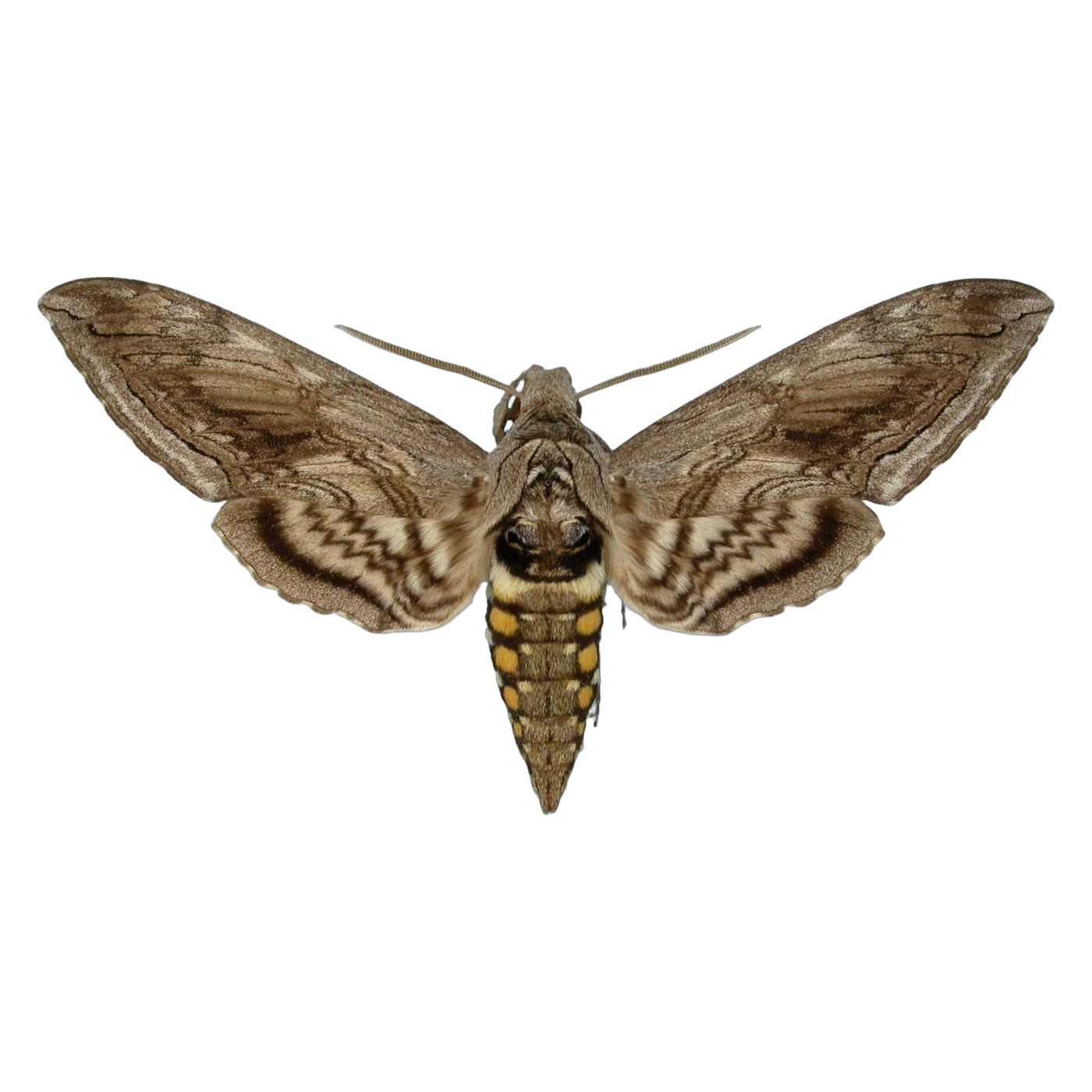
The Five-spotted Hawk Moth has a wingspan of 90-135 mm (9 to 13.5 cm). It is a large, heavy-bodied sphinx moth with mottled gray-brown forewings that resemble tree bark. Five pairs of yellow-orange spots run down the sides of the abdomen, giving the moth its name. The hindwings have sharp zig-zag lines separated by white. It is similar to the Carolina Sphinx (Manduca sexta), which usually has six pairs of abdominal spots and less sharply separated hindwing bands. This moth is also known as the Tomato Hornworm, the name more often used for its caterpillar.
This species occurs in eastern North America and is more common in the southern United States, especially along the Gulf Coast. It inhabits gardens, fields, and edges where plants in the nightshade family grow. Our specimen was collected near Ringgold, Georgia.
Adults fly at dusk and at night. They take nectar from flowers including Japanese honeysuckle (Lonicera japonica), petunia (Petunia hybrida), bouncing bet (Saponaria officinalis), tobacco (Nicotiana), and phlox (Phlox). They are also attracted to lights.
BugGuide reports adults from May to October. Females lay eggs on host plants in the nightshade family (Solanaceae), including tomato, tobacco, and related plants. The caterpillars, commonly called tomato hornworms, feed on the foliage. Mature larvae pupate in the soil and overwinter at that stage.
The caterpillars are sometimes pests of tomato and other garden plants in the nightshade family, where they can strip leaves quickly. Natural enemies often keep their numbers down.
Hodges number 7776. Manduca quinquemaculata (Haworth, 1803) belongs to the sphinx moth family Sphingidae, subfamily Sphinginae. It was originally described as Sphinx quinquemaculata. Some references, including BugGuide, list the name as Manduca quinquemaculatus.
Photo: The Trustees of the Natural History Museum, London, CC BY 3.0, via Wikimedia Commons. Background removed and cropped.
Check it out on BugGuide! https://bugguide.net/node/view/5011/bgimage