
$6.95
 <–
1 in stock
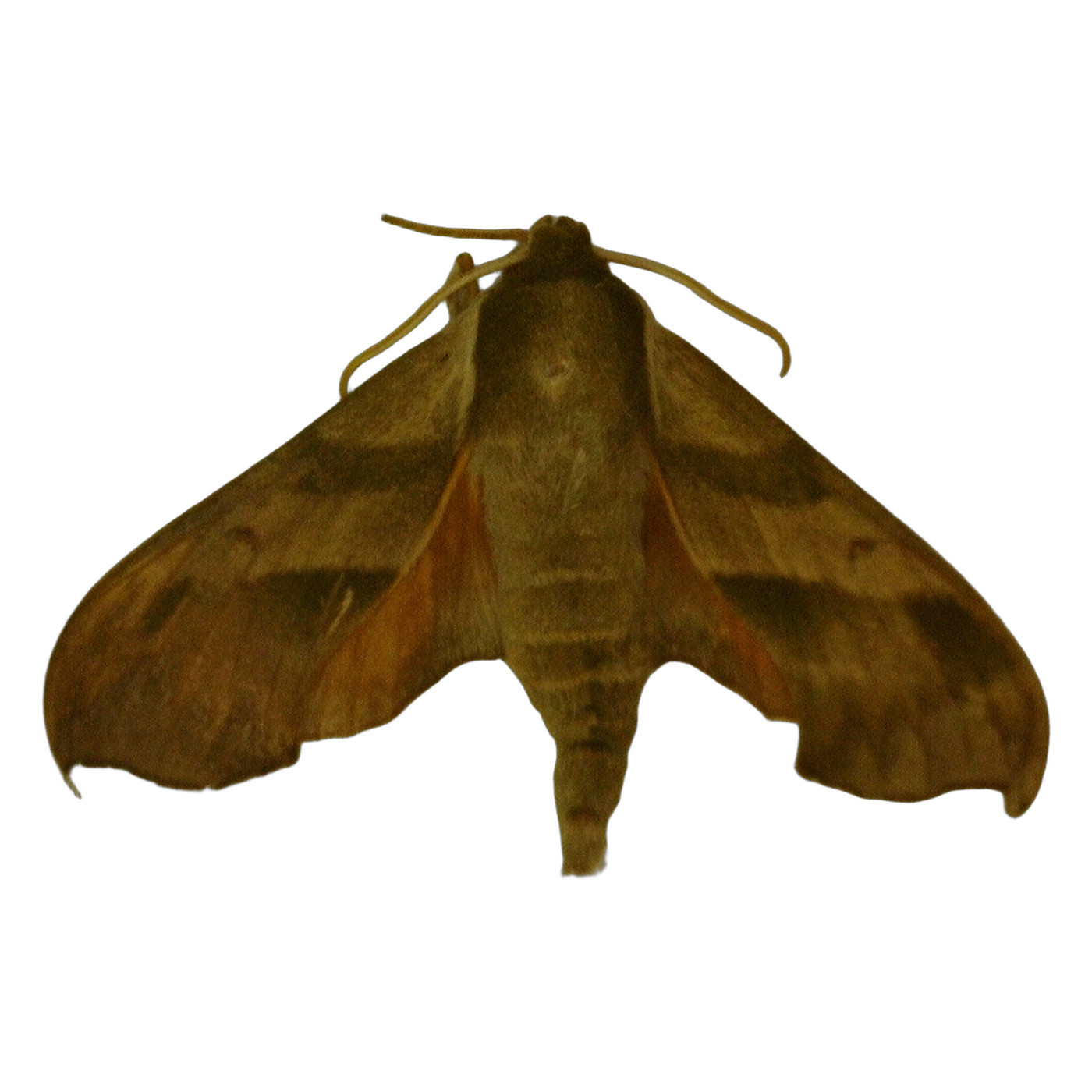
The Virginia Creeper Sphinx has a wingspan of 45-65 mm (4.5 to 6.5 cm). Its forewings have a muted camouflage pattern ranging from dark brown to pale yellowish-gray, often with green shading. Dark bands and patches contrast with a paler middle area, and the hindwings are brownish-orange. This moth is also known as the Hog Sphinx.
This species occurs in the eastern United States, with occasional strays farther north and west. It inhabits woodlands and edges near its larval host plants. Our specimen was collected near Ringgold, Georgia.
Adults are nocturnal and attracted to lights. Unlike silk moths that do not feed as adults, Virginia Creeper Sphinx moths take nectar from flowers.
There are one or two generations per year in the north and two or more in the south, including Georgia. BugGuide reports adults flying from March to September outside Florida and throughout the year in Florida, with larvae present from April to November. Caterpillars feed on Virginia creeper (Parthenocissus quinquefolia), grape (Vitis), and peppervine (Ampelopsis species). Females lay eggs in small groups on the undersides of host leaves. Mature caterpillars spin loose cocoons among fallen leaves on the ground.
The caterpillars eat grapevine leaves and can seriously defoliate young vines. They are not usually economically important pests in established vineyards, where natural enemies help keep their numbers low.
Hodges number 7885. Darapsa myron (Cramer, 1780) belongs to the sphinx moth family Sphingidae, subfamily Macroglossinae. It was originally described as Sphinx myron.
Check it out on BugGuide! https://bugguide.net/node/view/3568/bgimage