
$24.95
 <–
1 in stock
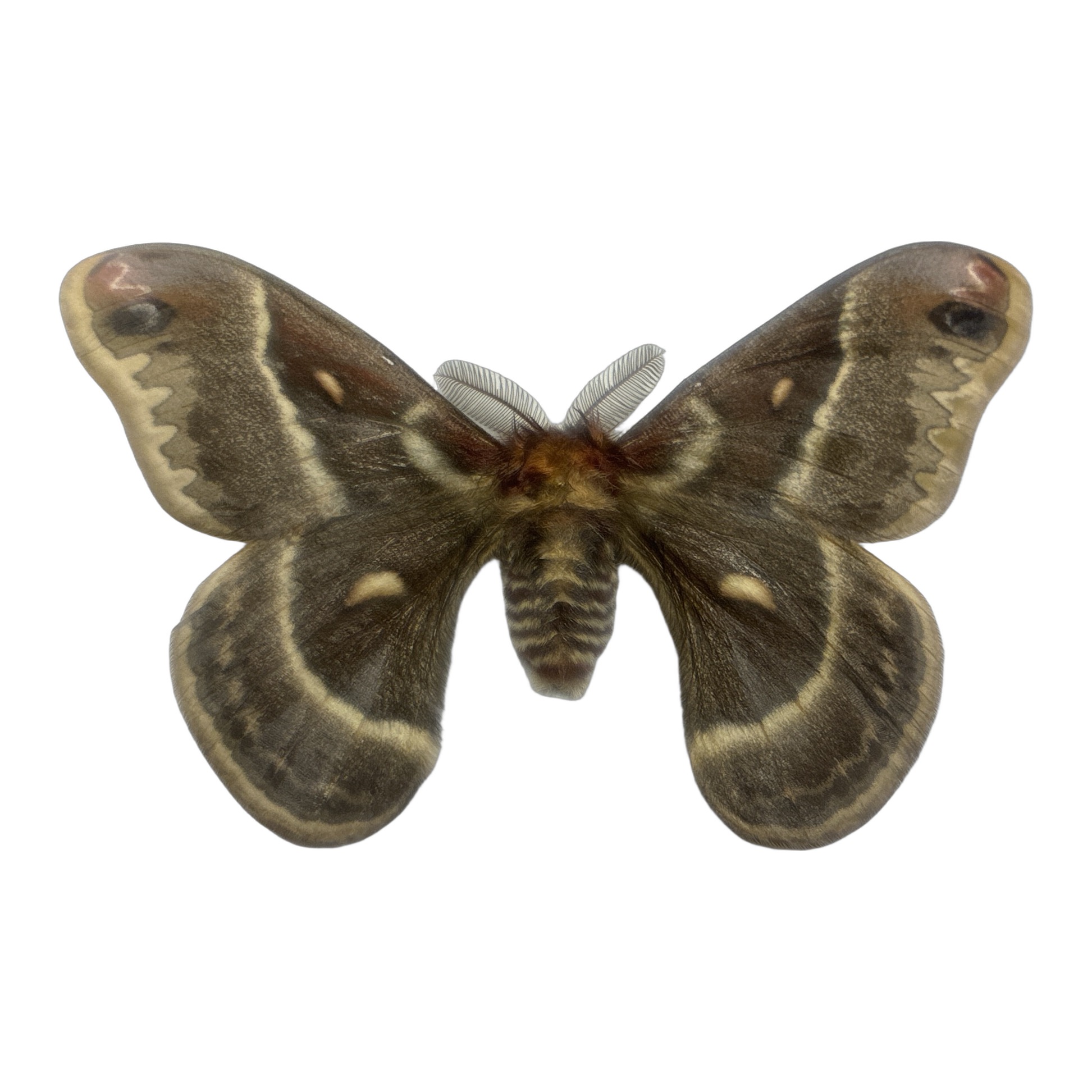
The Cecropia Moth is North America’s largest native moth, with a wingspan of 110 to 150 mm (about 11 to 15 cm). The wings are dark brownish to gray, with red near the base of the forewings, cream bands, crescent-shaped spots, and an eyespot near each forewing tip. The furry body is reddish, and the abdomen has bold alternating light and dark bands. It is also called the Robin Moth.
This moth lives in open areas with nearby trees, meadows, along waterways, and in urban and suburban spaces. It is widespread in North America east of the Rocky Mountains, from southern Canada to Florida and west across the plains. Our specimen was collected in Douglas County, Wisconsin.
Adult Cecropia Moths do not eat. They live only about one to two weeks, and their only objective is to reproduce. They are nocturnal and are attracted to lights at night.
There is one generation per year in the northern part of the range, including Wisconsin, and as many as two or three in the south. Females lay eggs on the leaves of many host trees and shrubs, including maple, cherry, birch, willow, apple, and elm. The large green caterpillars feed on the foliage, then spin a spindle-shaped silk cocoon attached lengthwise to a branch and overwinter as a pupa. The adult moth is the stage shown in the photo.
This species is not considered a pest. It is a popular, showy native moth valued by collectors, educators, and nature enthusiasts.
Hodges number 7767. The species was described by Linnaeus in 1758 and belongs to the giant silkworm and royal moth family Saturniidae, subfamily Saturniinae.
Check it out on BugGuide! https://bugguide.net/node/view/4625/bgimage
| Weight | 0.01 lbs |
|---|