
$5.95
 <–
7 in stock
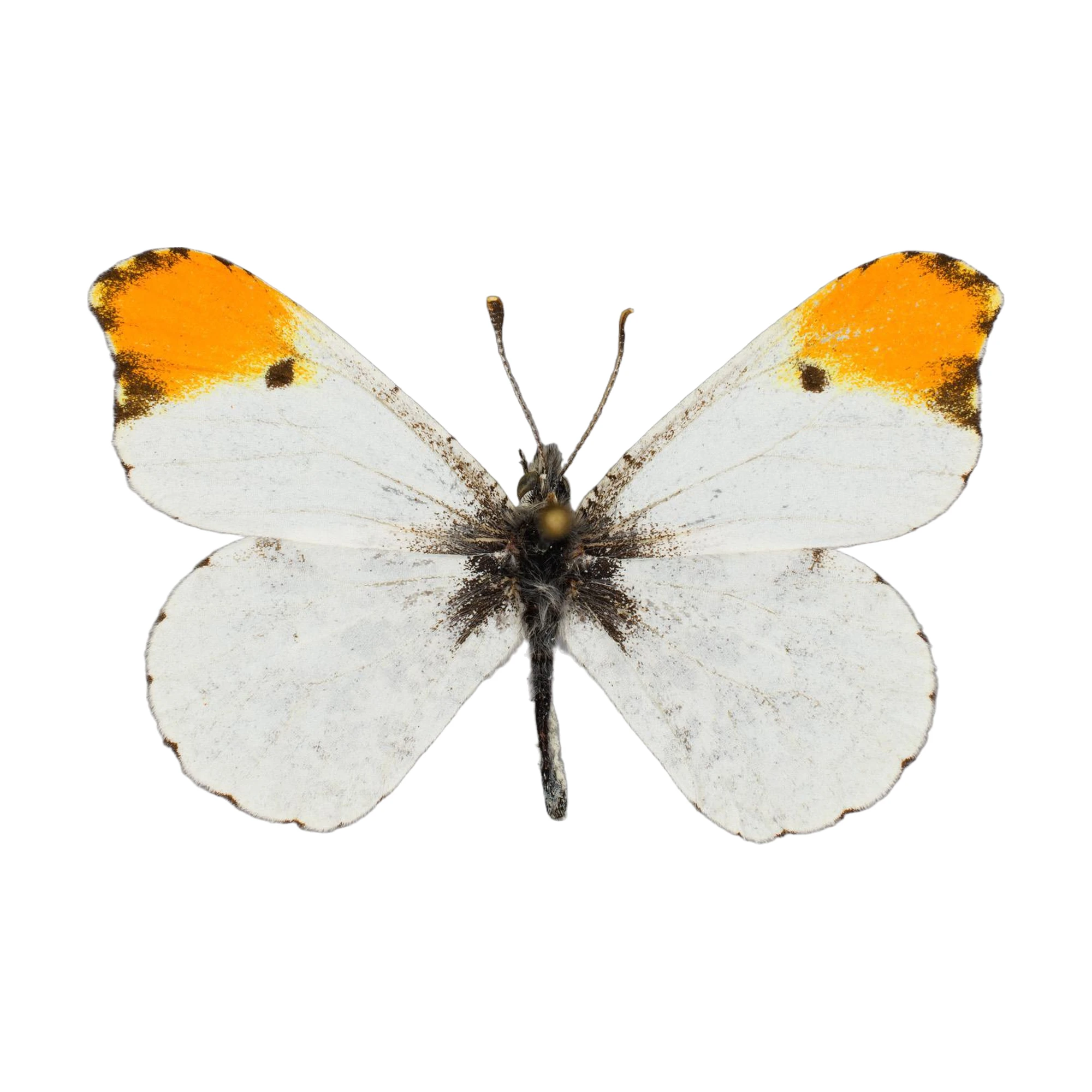
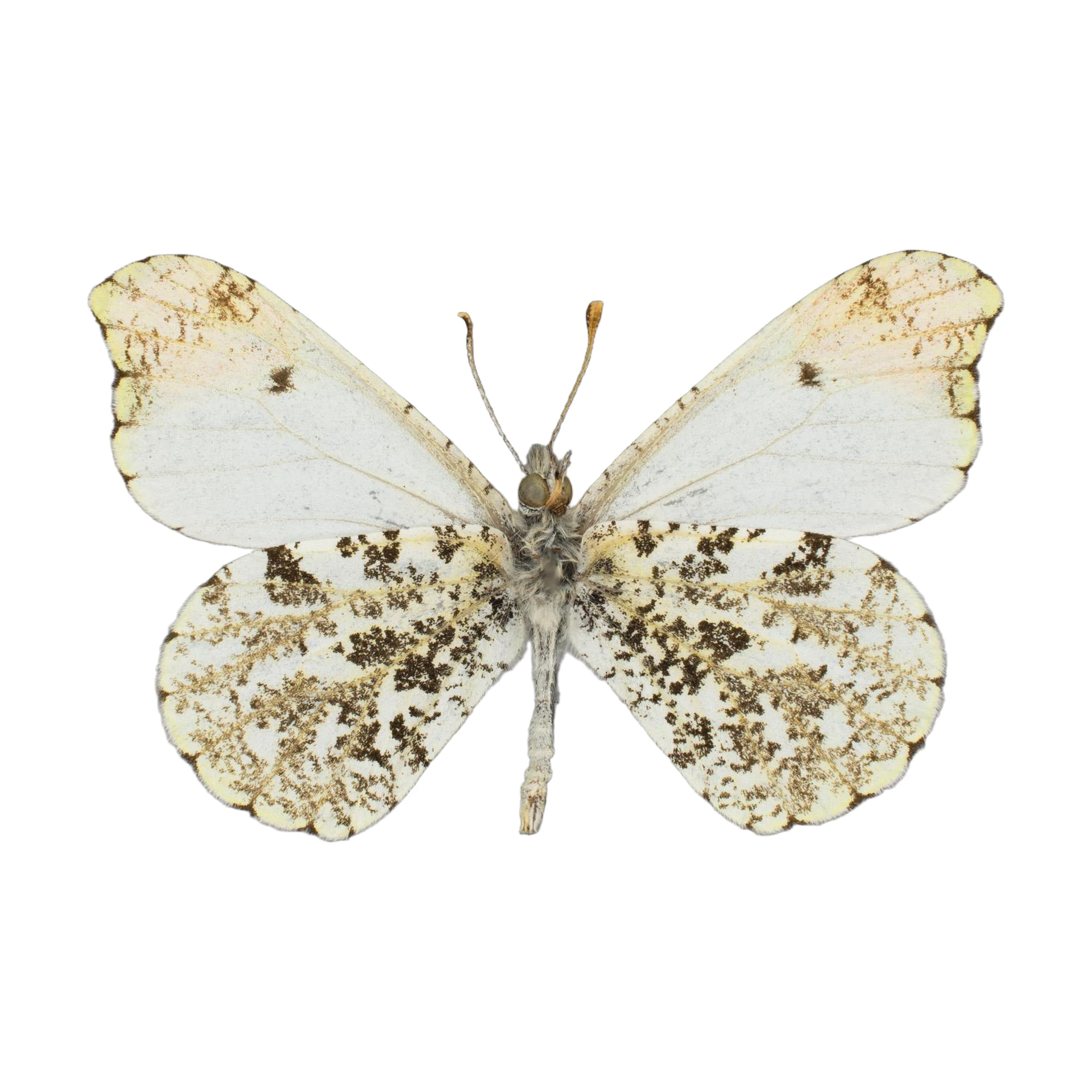
The Falcate Orangetip, Anthocharis midea, is a small white butterfly with a wingspan of about 35 to 45 mm (1 3/8 to 1 3/4 inches). The name “falcate” means hooked, and both sexes have a hooked forewing tip. Males are unmistakable, because the dorsal tip of each forewing is bright orange, although the size of the orange patch varies a lot from one butterfly to the next. Females are somewhat larger and have no orange on the wings. Both sexes have a round black spot in the middle of each dorsal forewing and black spots along the wing edges. The ventral hindwing is covered with a fine, marbled pattern of green and brown, which looks like moss on a rock. The only similar butterfly in its range is the Olympia Marble, Euchloe olympia, which has a grayish black forewing tip with no orange and yellow-green marbling on the ventral side. Our photos show spread museum specimens of the same species, dorsal and ventral.
The Falcate Orangetip lives in open, wet woods along streams and rivers, in open swamps, and sometimes in dry woods and on ridgetops. It is mostly an eastern butterfly, found from southern New England southwest to south Texas and north to eastern Oklahoma and Kansas. There are local populations or strays in the Florida panhandle, eastern Nebraska, and southern Wisconsin. In Missouri it is found nearly statewide except the northern edge, mostly in forested regions, particularly the Ozarks, and it can be abundant in some Ozark localities.
This is a true spring butterfly, on the wing for only a few weeks, mostly from March to May. It flies low to the ground, and the flight is not rapid but can be quite erratic. Males patrol hilltops and flats all day looking for females, and they seldom stop to take nectar. Adults visit small spring wildflowers such as toothwort and other mustards, violets, and spring beauty. As caterpillars they feed on mustard plants and keep some of the bitter mustard oils in their bodies as adults, which gives them some protection from predators.
Complete metamorphosis (egg, larva, pupa, adult). There is one brood a year. The female lays her eggs singly on the flower stalks of plants in the mustard family, such as rockcress, winter cress, bittercress, and toothwort, and she usually does not lay on a flower cluster that already holds an egg. The eggs are yellow-green and turn red just before they hatch. The caterpillars feed mostly at night on flowers, flower buds, developing seed pods, and young leaves, and they will eat smaller caterpillars that share the same plant. A full-grown caterpillar is olive or bluish green with a stripe down the back and a white stripe along each side, and it reaches about 3 cm (1.2 inches). It pupates by late spring or mid-June. The chrysalis is yellowish with black spots and has a spike on the head, which makes it look like a thorn. The butterfly spends the rest of the year, including the winter, as a chrysalis, and some chrysalises stay dormant for a second winter before the adult emerges.
The Falcate Orangetip is not known as a pest. Its caterpillars feed on wild mustards such as rockcress, winter cress, and toothwort, and the butterfly is considered secure across its range, so no special conservation management is needed. Because its host plants die back by summer, gardeners who want to see it can plant toothworts in a woodland garden to attract the butterflies.
Our specimens were collected in Venango County, Pennsylvania.
Please note that our specimens are damaged, with wing wear or chips and possibly a missing or bent antenna, which is why they cost less. The photos show undamaged examples.
This preserved specimen educates on butterfly identification and spring flight behavior, suitable for displays or studies. Check it out on BugGuide! https://bugguide.net/node/view/3545/bgimage
Photos: ETH Zurich Entomological Collection (specimen AZ11-1579), CC BY 4.0, via GBIF. Cropped, background removed. Photos are representative examples, not the exact insect you will receive.