
$7.95
 <—
1 in stock
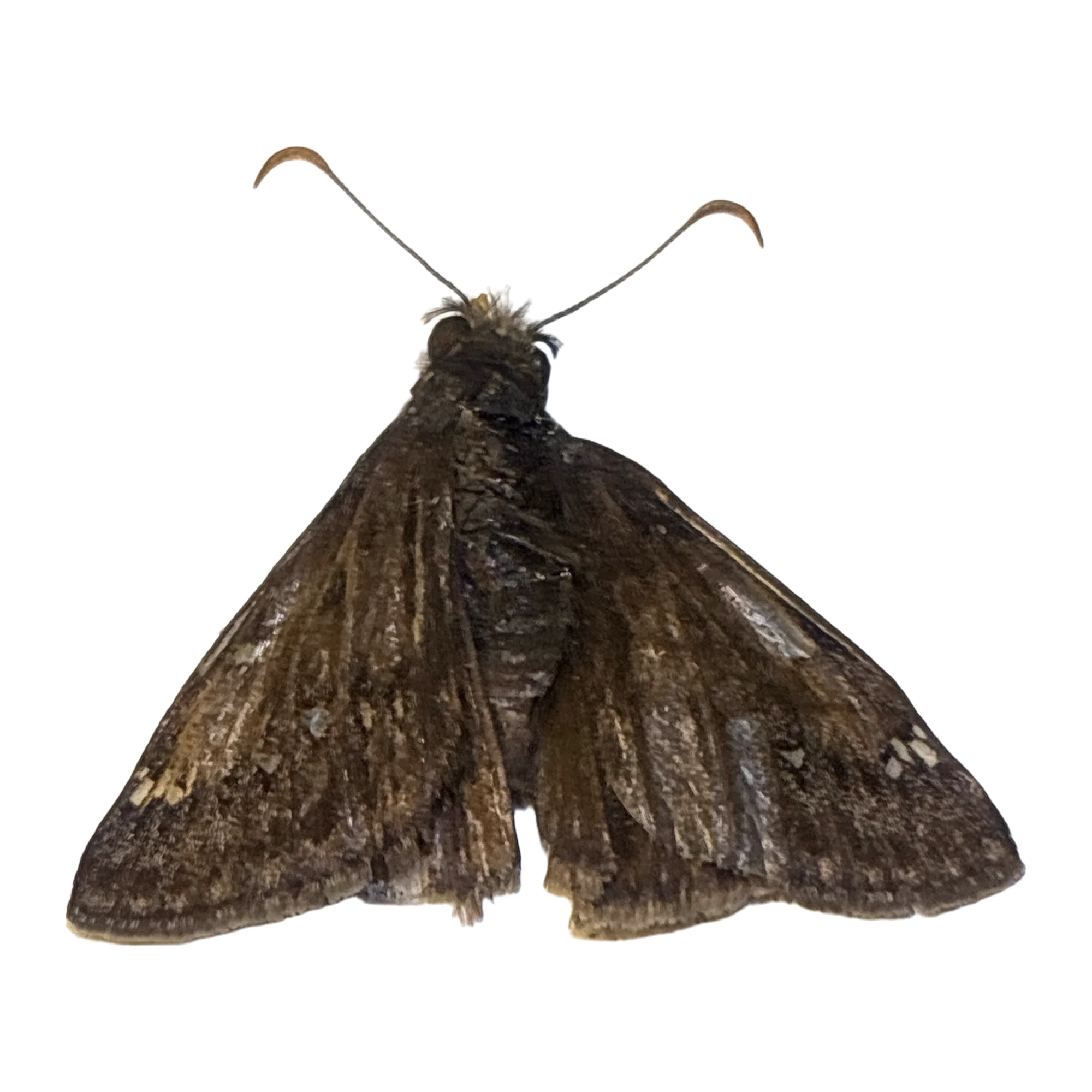
Duskywings, genus Erynnis, are small to medium skippers with a wingspan of about 29 to 49 mm (1 1/8 to 1 15/16 inches), depending on the species. The wings are dark brown to blackish, mottled with gray and tan, and the forewings usually carry darker bands and a few tiny glassy white spots near the middle and the tip. The body is stout and the head is broad, with the antennae ending in a small hooked club. Like other spread-wing skippers, they rest with the wings held flat. Our photo shows the top of a spread specimen. It is a worn specimen, and duskywings are among the hardest butterflies to tell apart, so we list it only to the genus level.
The genus is found across the Northern Hemisphere, and the most species live in North America, where BugGuide lists 17. In the eastern United States, duskywings are found in oak woods and woodland edges, forest clearings, brushy fields, fencerows, roadsides, and yards, and some species favor places where wild legumes grow.
Adults fly by day and visit flowers for nectar. Males gather at mud puddles and damp ground to drink, and they perch on twigs to watch for passing females. Depending on the species, the adults fly in spring, or from spring through early fall.
Complete metamorphosis (egg, larva, pupa, adult). The female lays her eggs singly on young leaves of the host plant. The caterpillars feed on the leaves and hide in shelters made of rolled or tied leaves. The host plant depends on the species: oaks for Juvenal’s and Horace’s duskywings, willows and aspens for the Dreamy Duskywing, and legumes for the Wild Indigo and Zarucco duskywings. Fully grown caterpillars overwinter in their shelters in the leaf litter and pupate in spring. Some species have one generation a year, and others have two or three.
Not known as pests. The caterpillars feed on the leaves of wild trees and plants, and we found no record of significant damage to crops or forests.
Some of our specimens were collected near Saint James, Missouri.
This preserved specimen educates on skipper identification and the spread-wing skippers of woodland edges, suitable for displays or studies. Check it out on BugGuide! https://bugguide.net/node/view/377/bgimage