
$7.95
 <—
1 in stock
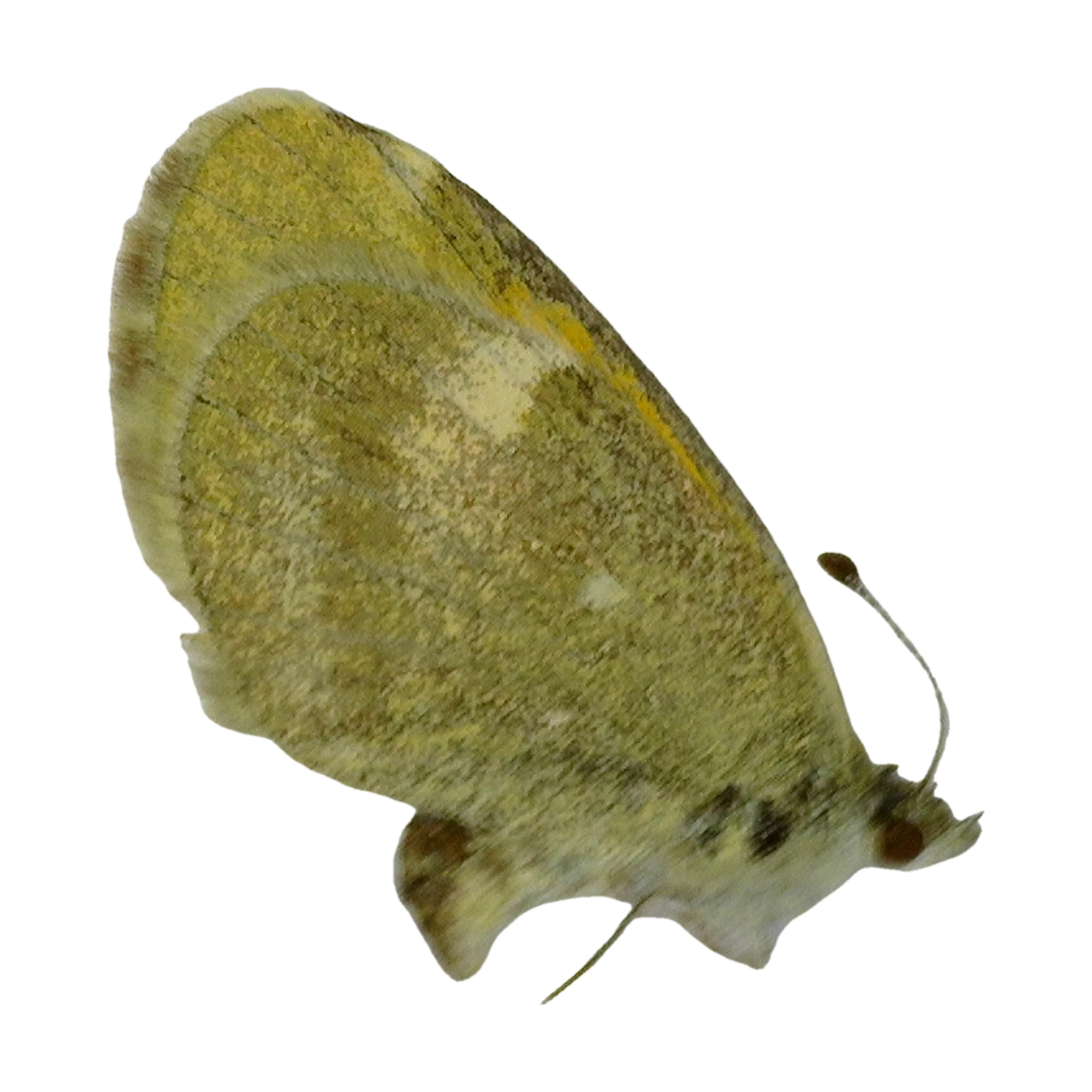
The Dwarf Yellow, Nathalis iole, is the smallest sulphur in North America, with a wingspan of about 20 to 32 mm (3/4 to 1 1/4 inches). The forewings are long and narrow compared to other sulphurs. The upperside is yellow with a black forewing tip and black bars along the rear edge of the forewing and the front edge of the hindwing. The female has more black than the male. The underside, which is the view in our photo, changes with the season. Summer butterflies have a pale yellow hindwing, while cool-season butterflies have a dusty olive-green hindwing, like our specimen. Both forms have a yellow or orange patch at the base of the forewing underside and black spots near its outer edge. The similar Little Yellow, Pyrisitia lisa, is larger and lacks both the upperside black bars and the underside forewing spots.
The Dwarf Yellow lives in open, dry places such as deserts, coastal flats, weedy fields, grasslands, road edges, vacant lots, and hillsides. It is a resident from Guatemala north through Mexico to peninsular Florida and the Southwest. It cannot survive hard winters, so each summer it spreads north and recolonizes the Great Plains, and it strays as far as southeastern Washington, southeastern Idaho, Wyoming, and Minnesota. In California it is most common in the southern deserts, and it wanders irregularly farther north, sometimes in good numbers. Some of our specimens were collected near Barstow, California.
The Dwarf Yellow flies low, just inches above the ground, and visits small flowers such as asters, wild marigold, and rabbitbrush for nectar. Males patrol low areas looking for females. A male that is turned down may spread his wings and show off the black bars and the scent patches on his hindwings, which sometimes changes the female’s mind. Adults rest with their wings closed and held at a right angle to the sun’s rays to warm up. In the warmest areas it flies all year, and farther north the flight lasts about 6 months.
Complete metamorphosis (egg, larva, pupa, adult). The female lays lemon-yellow to orange-yellow eggs singly on the young leaves of low-growing host plants, and they hatch in about 4 to 7 days. Hosts are mostly members of the aster family, including Spanish needles and other beggar-ticks (Bidens), sneezeweed (Helenium), dogweed (Dyssodia), and greenthread (Thelesperma). Chickweed is also used, and the caterpillar can be raised on garden marigolds (Tagetes). The caterpillar is dark green with a lavender or pink stripe down the back and a yellow and dark stripe along each side, and it has two reddish bumps behind the head. The chrysalis is green or yellow-green with pale yellow dots, and it lacks the pointed head projection found on most of its relatives. There are several broods a year. Caterpillars that grow up in short days make a dark winter form that has about three times the usual number of dark scales, which helps the butterfly absorb heat.
Not an economic pest. The caterpillars feed on small weedy members of the aster family, and we found no record of crop damage from this species. It is rated globally secure, and no conservation action is needed.
This preserved specimen educates on butterfly identification, seasonal forms, and the smallest of our sulphurs, suitable for displays or studies. Check it out on BugGuide! https://bugguide.net/node/view/10773/bgimage