
$5.95
 <—
2 in stock
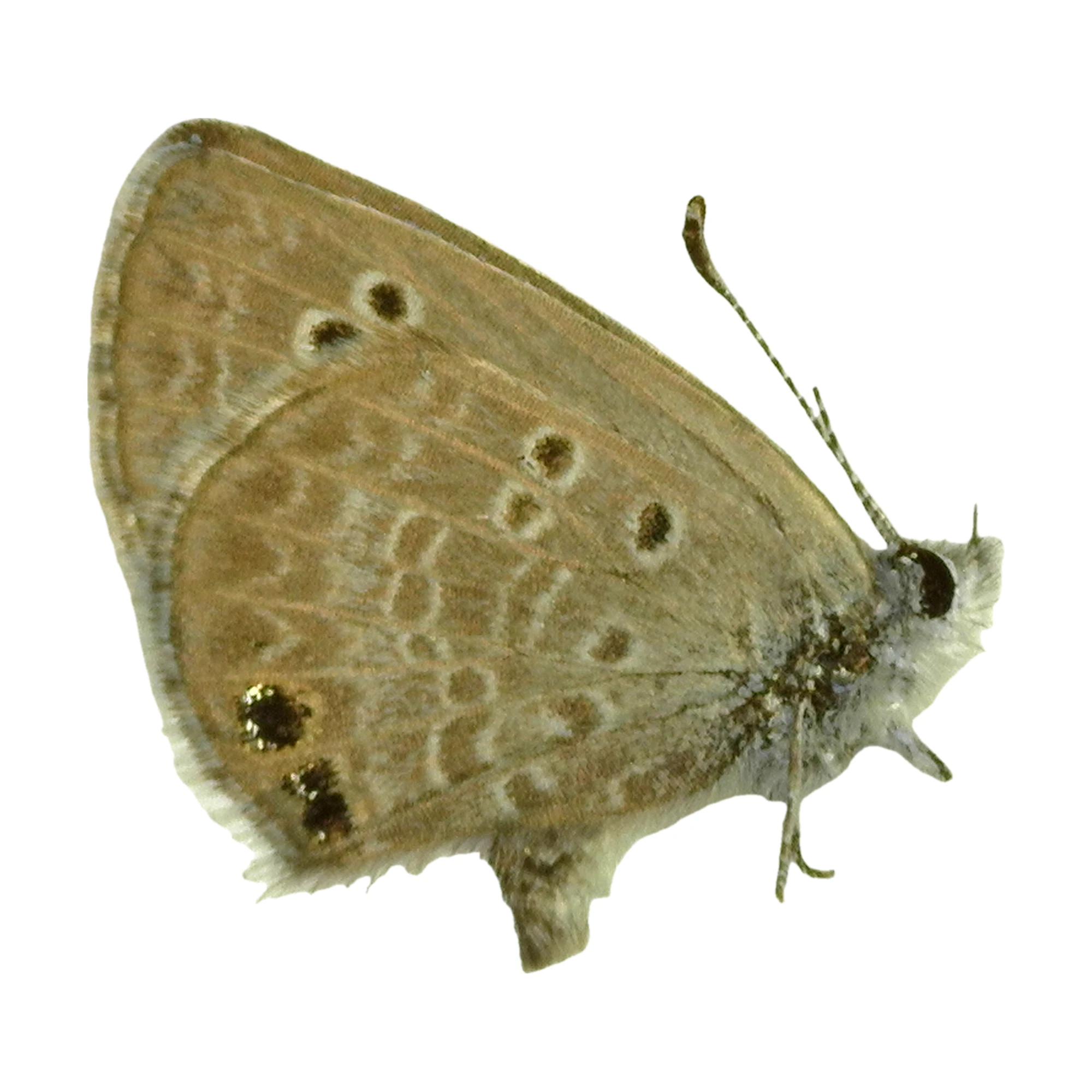
The Marine Blue, Leptotes marina, is a small butterfly with a wingspan of about 22 to 29 mm (7/8 to 1 1/8 inches). The upperside is blue. The male has a purple tinge, and the female is paler with a wide dark border and no white. The underside, which is the view in our photo, is the easy way to identify it. It is light brown with pale, wavy cross bands, a bit like zebra stripes, and the bands on the forewing run unbroken from the front edge to the inner edge. The hindwing has two black eyespots near the tail corner. They are ringed with orange and filled with shiny metallic scales. The wing fringe is white, and there is a very short tail on the hindwing. The similar Cassius Blue, Leptotes cassius, is found mostly in Florida and south Texas and has a white patch on the underside of the forewing, which the Marine Blue lacks.
The Marine Blue lives in warm, open places such as mesquite scrub, desert washes, city gardens, waste areas, and alfalfa fields. It is a resident from Guatemala and Mexico north into southern California and the Southwest, and east to southern Texas. It is a famous wanderer, and every year some individuals fly north and temporarily settle as far as Wisconsin, Indiana, Kentucky, and Louisiana. These northern colonies usually die out before the end of the year. In South Dakota it is a rare late-summer stray, listed on the state checklist, with only two records in the 1994 state butterfly survey (Minnehaha and Pennington counties, with one record dated August 2). Some of our specimens were collected near Hot Springs, South Dakota.
The Marine Blue flies fast and erratically, close to the ground. Males patrol for females, and adults visit many flowers for nectar. Both sexes also sip minerals from damp soil and dung. Adults live only about 5 to 10 days, so the long trip north is a remarkable journey for such a short-lived butterfly. One idea is that some are carried north in shipments of alfalfa. In the north it flies from about April to September, and in southern Texas and southern California it flies all year.
Complete metamorphosis (egg, larva, pupa, adult). The female lays single, disc-shaped eggs on the flower buds of the host plant. Hosts are leadwort (Plumbago, including the garden shrub blue plumbago) and many members of the pea family, including alfalfa, milkvetch (Astragalus), and mesquite (Prosopis). The caterpillars eat the buds, flowers, and seedpods, but never the leaves. They are slug-shaped and green, brown, or reddish, and their color partly depends on the color of the flowers they eat. In the West they are tended by ants, which guard them in return for a sweet liquid they give off. The pupa forms in leaf litter below the host plant. There are several broods a year, and they overlap continuously in the far south.
Not an economic pest. The caterpillars do eat the flowers and seeds of legumes, and alfalfa is one of their host plants, but we found no record of crop losses from this species. It is listed as secure, and no conservation action is needed. Its fondness for blue plumbago has helped it to settle in garden plantings outside its native range.
These are damaged specimens, with slight damage to the wings or fringe. They are a low-cost way to study the underside pattern of a butterfly that is rarely collected in South Dakota, suitable for displays, practice mounting, or art projects. Check it out on BugGuide! https://bugguide.net/node/view/13113