
$7.95
 <—
2 in stock
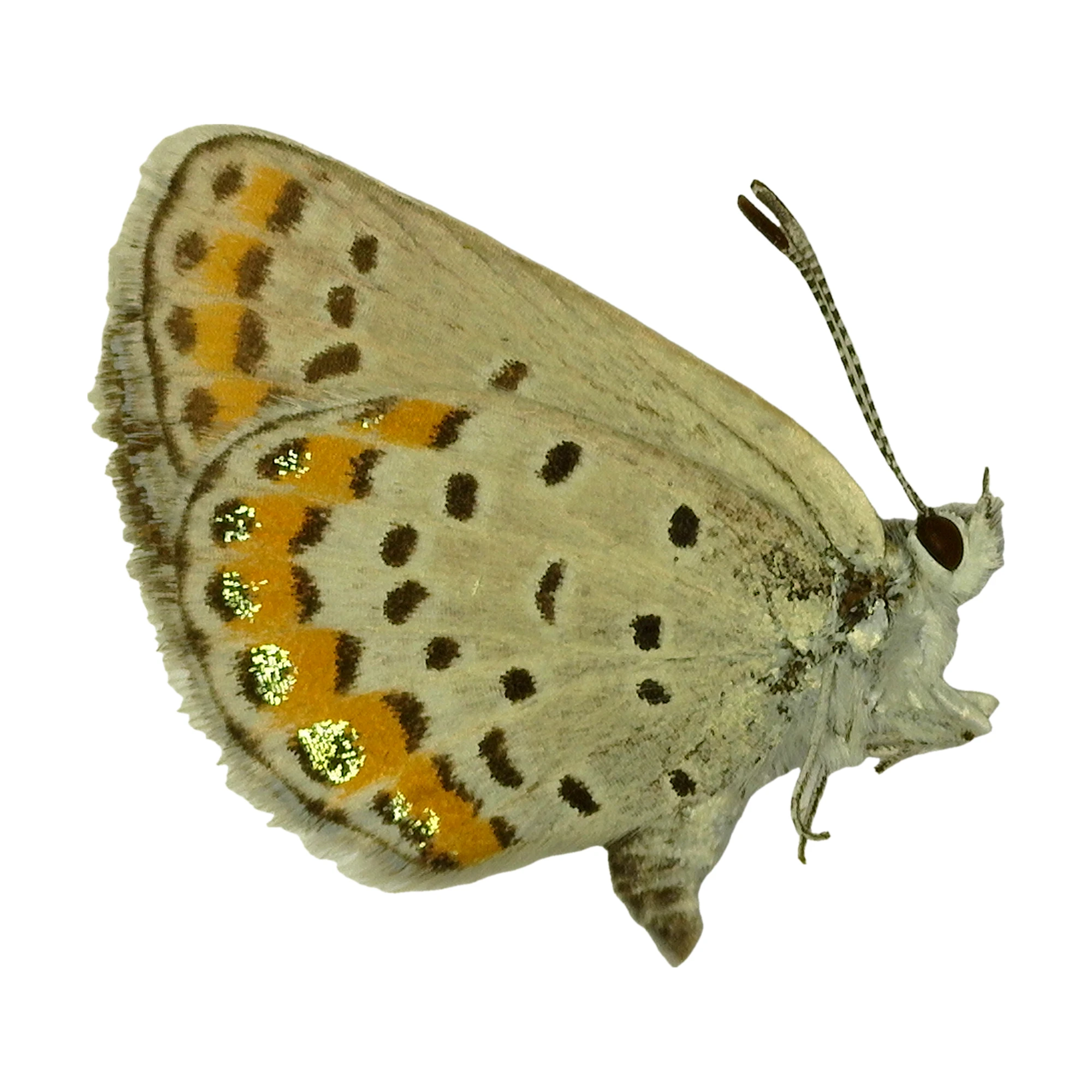
The Melissa Blue, Plebejus melissa, is a small butterfly with a wingspan of about 22 to 35 mm (7/8 to 1 3/8 inches). The sexes look very different on top. The upperside of the male is blue with a narrow dark border, while the female is brown, often with a blue tinge near the body, and has orange trim along the edges of both wings. The underside, which is the view in our photo, is gray-brown with a ring of small black spots and a red-orange band near the edge of the hindwing. That band usually reaches onto the forewing as well, and in the western Melissa Blue it is continuous. Just outside the band is a row of shiny blue-green scale spots, and a continuous black line runs along the outer edge, thickened where the wing veins meet it. The wing fringe is solid, not checkered. The similar Northern Blue, Plebejus idas, has a muted underside, and its black edge line breaks up into small dots at the vein ends. It cannot always be identified without examining the male genitalia and knowing where it was collected. The Karner Blue, Plebejus samuelis (treated by some authorities as an eastern subspecies of the Melissa Blue), has the orange band broken into separate spots, and it lives only in small, isolated colonies in sandy lupine habitats in the northeast and upper Midwest.
The Melissa Blue lives in open, weedy places such as native prairie, dry mountain meadows, sagebrush country, fallow fields, roadsides, and alfalfa fields. The western form is found from southern British Columbia east to southern Manitoba and south through the western United States to northern Baja California, western Texas, and mainland Mexico. It reaches east onto the plains and prairies to northwestern Iowa and southwestern Minnesota, and the eastern Karner population is found in small, isolated colonies from New Hampshire and New York west to Wisconsin. In South Dakota it is one of the most widespread butterflies, recorded in more than 60 of the state’s 66 counties, including Fall River County. Some of our specimens were collected near Hot Springs, South Dakota.
Adults visit many flowers for nectar, including yarrow, clover, sweetclover, thistles, asters, and goldenrod. They also sip mud and urine for minerals. Males patrol near the host plants all day looking for females and do not migrate. Depending on the place, the butterfly flies from April to October, with two broods in much of its range and three in the warmest areas. In South Dakota the flight period runs from about mid-May to early October. The caterpillars feed at night and hide at the base of the host plant by day, where they are often tended by ants.
Complete metamorphosis (egg, larva, pupa, adult). The female lays her eggs singly on the stem or leaflets of a host plant, on debris, or on a blade of grass near the base of the plant. Host plants are members of the pea family, including lupines, milkvetches (Astragalus), licorice (Glycyrrhiza), trefoils (Lotus), and alfalfa. Summer eggs hatch in about 8 days, and the caterpillar goes through four stages and pupates in roughly two more weeks. The caterpillar is flattened and pea green with pale lateral stripes, and it gives off a sweet liquid from special glands that ants eagerly collect. In return the ants guard it, and tended caterpillars survive better. The pupa is green and forms under the host plant, in the soil or under the lowest leaves. Eggs laid late in the season spend the winter and hatch the next spring.
The Melissa Blue is not an economic pest. It does lay eggs on cultivated and wild alfalfa, but its numbers are never high enough to cause crop damage, and alfalfa is a poor food for its caterpillars, producing adults that can be up to 70 percent smaller than those raised on native legumes. The western Melissa Blue is common and secure. The Karner Blue is a different story, since it is endangered or gone from several states and needs careful habitat management, especially of its lupine habitat.
This preserved specimen educates on butterfly identification and the differences between the sexes, suitable for displays or studies. Check it out on BugGuide! https://bugguide.net/node/view/12406